Your Voice Agent Doesn't Cost $0.05 a Minute: The Real Cost-Per-Minute Math at Scale (2026)
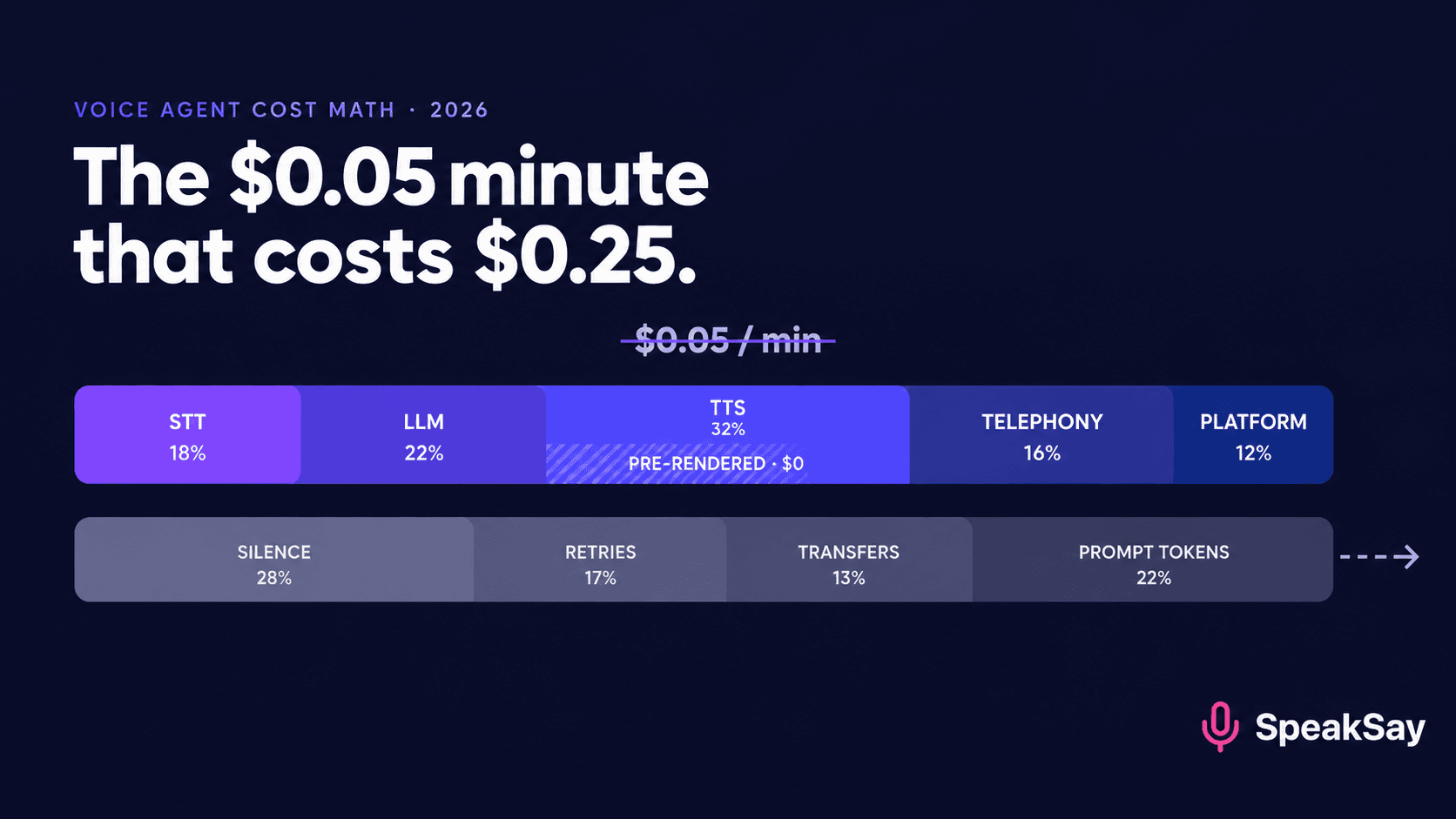
The advertised price of a voice agent is the platform fee. The real cost is five vendors, billed silence, long prompts and retries — usually three to five times the headline. Here is a line-by-line cost model, a worked 40,000-minute month, and the seven levers that actually move the number, starting with the speech you never needed to generate live.
1. Why the headline price is the wrong number
A voice agent is not one product. A single conversational minute passes through at least five billable systems: something that turns the caller's speech into text, a language model that decides what to say, a text-to-speech engine that says it, a telephony carrier that carries the audio, and usually an orchestration platform that ties them together. Each bills on its own unit — minutes, tokens, characters, seconds — and each has its own rounding rules.
Platform pages quote their own fee because it's the only line they control. Several 2026 cost analyses make the same point bluntly: the "$0.05 per minute" agent typically lands at $0.15 to $0.25 once everything is on the bill, and higher with premium voices and large models (Klariqo; AutoInterviewAI).
The gap matters most at the moment you scale. At 500 minutes a month, being off by 4x is a rounding error. At 50,000 minutes, it's the difference between a profitable deployment and a cancelled one.
2. The five lines on every voice-agent bill
The ranges below are typical published 2026 rates. Your contract will differ; the structure won't.
| Line | Billed by | Typical 2026 range per call-minute | What drives it up |
|---|---|---|---|
| Speech-to-text (STT) | Audio minutes streamed | ~$0.002–$0.024 | Streaming vs batch, premium accuracy tiers, extra languages |
| Language model (LLM) | Input + output tokens | ~$0.01–$0.03 (GPT-4o class) | Long system prompts re-sent every turn, conversation history, tool-call output |
| Text-to-speech (TTS) | Characters or audio seconds generated | ~$0.01–$0.08 | Premium "natural" voices, low-latency streaming tiers, regenerations |
| Telephony | Carrier minutes, per leg | ~$0.005–$0.02 per leg | Inbound + outbound legs, transfers, international numbers |
| Orchestration platform | Call minutes | ~$0.05–$0.10 | Add-ons: analytics, recording, concurrency, compliance features |
One commonly cited 2026 production stack — platform at $0.05, telephony at $0.015, STT at $0.005, a GPT-4o-class LLM at $0.02, and a premium TTS voice at $0.06 — totals about $0.15 per minute before any hidden costs (AutoInterviewAI). Notice which line is largest: in that stack, the voice is 40% of the bill.
4. A worked month: 10,000 calls, 40,000 minutes
Take a mid-sized inbound support line: 10,000 calls a month, four minutes average, 20% transferred to a human. Use the mid-range stack from section 2.
| Line | Assumption | Monthly cost |
|---|---|---|
| Platform | 40,000 min × $0.05 | $2,000 |
| Telephony (inbound leg) | 40,000 min × $0.015 | $600 |
| Telephony (transfer leg) | 2,000 transfers × 3 min × $0.015 | $90 |
| STT | 40,000 min × $0.005 | $200 |
| LLM | 40,000 min × $0.02 (short prompt) | $800 |
| TTS | 40,000 min × $0.06 (premium voice) | $2,400 |
| Total | $6,090 (~$0.152/min) |
Now apply two realistic corrections. If the system prompt is long and LLM cost doubles, add $800. If 15% of agent audio is regenerated or interrupted, add about $360 to TTS. You're at roughly $7,250, or $0.18 a minute — 3.6x the headline — without changing a single vendor.
The useful thing about this table is not the total. It's that two lines, platform and TTS, are 72% of the bill, and only one of them depends on how you design the conversation.
Price the voice line before you pick the platform
TTS is often the largest variable line on a voice-agent bill. Compare SpeakSay voices and character-based plans against what your current per-minute voice costs at your real volume.
5. Seven levers that actually cut the number
Ordered from least effort to most.
- Pre-render everything the agent always says. Greetings, recording disclosures, hold messages, "let me check that for you", closing lines, and IVR menu prompts don't change between calls. Generate them once as audio files and play them, rather than synthesising them live on every call. More in section 6.
- Shorten replies. The agent speaking two sentences instead of five cuts TTS cost, LLM output tokens, and interruption waste at the same time. It usually improves satisfaction scores too.
- Trim and cache the system prompt. Move reference material into retrieval rather than the prompt, and use prompt caching where your LLM provider supports it. This attacks the line most likely to double.
- Route by difficulty. Use a smaller, cheaper model for routine turns (confirmations, slot-filling) and escalate to a larger model only when the conversation needs reasoning.
- Match the voice tier to the job. A premium expressive voice earns its price on sales and sensitive support calls. On appointment reminders and order-status lines, a clear standard voice is indistinguishable to most callers and can cost a fraction.
- Detect silence and end-of-call properly. Hang-up detection, idle timeouts and "are you still there?" prompts stop calls that are open but finished from billing on three lines.
- Measure cost per resolved call, not per minute. A cheaper agent that transfers 40% of callers costs more per resolution than a pricier one that resolves 80%. Per-minute is an input; per-resolution is the number your finance team cares about.
6. Lever one in detail: stop generating speech you already know
Pull a week of transcripts and highlight every agent line that was word-for-word identical across calls. On most support and booking lines, that's a surprising share of all agent speech: the greeting, the recording notice, confirmations, hold fillers, apologies, and sign-offs. Templated lines with a small variable — "Your appointment is on {day} at {time}" — can be split into a pre-rendered frame and a short live insert.
Pre-rendered audio has three advantages that compound:
- Zero marginal TTS cost. You pay once to generate the file, then it plays for free on every call.
- Zero time-to-first-audio. A file starts instantly, which is why the opening of a call feels fastest when it's pre-rendered. (We covered the latency side of this in our voice-agent latency budget guide.)
- Perfect consistency and reviewability. Legal disclosures and brand phrases are approved once and never mispronounced live. If your agent struggles with names, numbers or locale pronunciation, see our pronunciation QA guide.
The practical requirement is that the pre-rendered lines and the live lines sound like the same speaker. That means choosing a voice you can use both for batch generation and for your live stack, or cloning one consistent brand voice and using it for both. If 25% of agent speech in the worked example above moves to pre-rendered files, the TTS line drops by roughly $600 a month at that volume — before touching any other lever.
Build your fixed-line audio library once
Generate greetings, disclosures, hold messages and IVR prompts in a consistent SpeakSay voice, export them, and play them from your phone system with no per-call voice cost.
7. How to forecast cost before you launch
Before signing an annual contract, run a two-week pilot and record these numbers, not the vendor's estimate:
| Metric | Why it matters |
|---|---|
| Average billed call length (not talk time) | Silence is billed on three lines |
| Agent-speech seconds per call | Drives TTS cost directly |
| Share of agent speech that is identical across calls | Your pre-render opportunity |
| Average input tokens per turn | Reveals prompt bloat |
| Transfer rate and average transfer duration | Second telephony leg |
| Resolution rate | Turns cost per minute into cost per outcome |
Multiply each by your projected volume, add 15% for regenerations and failed calls, and compare that number — not the headline — to the cost of the human-handled call you're replacing. Free calculators such as Softcery's and RaftLabs' are useful for a first pass; your pilot data should replace their defaults.
8. FAQ
How much does an AI voice agent really cost per minute in 2026?Most production deployments land between about $0.12 and $0.45 per minute all-in, depending on the LLM, the voice tier and how much silence and transfer time is billed. The $0.05–$0.08 figures on pricing pages usually cover the orchestration platform only.
Which part of a voice agent costs the most?It varies by stack, but the orchestration platform and premium TTS are often the two largest lines. The LLM becomes the largest when system prompts are long and re-sent every turn.
Is a cheaper TTS voice worth it for a voice agent?For routine, transactional calls, often yes — callers care about clarity and speed more than expressiveness. For sales, retention and sensitive support, a more natural voice can earn its cost through better resolution rates. Test both on real calls.
Can I pre-render parts of a live voice agent's speech?Yes. Fixed lines like greetings, disclosures, hold messages and closings can be generated once and played as audio files. This removes their per-call TTS cost and makes them start instantly. The key is using the same voice for the pre-rendered and live parts.
Is cost per minute the right metric?It's a useful input, but cost per resolved call is the better decision metric. An agent that costs more per minute but transfers fewer callers can be cheaper overall.