Who Controls Your Voice Clone After You Die? Write the Instructions Now (2026)
If you've cloned your own voice, it will outlast you unless someone deletes it, and right now nobody knows what you'd want. State laws give your heirs control, a federal bill would add registration and renewals, and none of it records your wishes. Here are the four decisions to make, the inventory to write down, and a one-page template.
1. Why this is your decision to make now
A cloned voice is unusual among the things people leave behind. A photo shows what you looked like. A recording plays what you said. A voice clone can say new things, in your voice, indefinitely. That's what makes it useful while you're alive, and what makes its future hard to decide for anyone else.
Without instructions, the people left with that decision are usually grieving, often disagree, and are guessing. Some will feel that using the clone keeps you present; others will find it unbearable. Some will see income your family needs; others will see exploitation. Every one of those positions is reasonable, which is exactly why your own answer matters.
There's also a business reason. If your voice is your brand (a faceless channel, a course library, an audiobook catalogue, a podcast), there's existing content that keeps earning and possibly in-progress work that could be finished. Someone will have to decide whether the clone touches any of it.
2. What the law does (and doesn't) settle
The legal picture in 2026 is a patchwork, and it mostly answers a different question: who can stop unauthorised use after you die.
| Law | Status | What it does after death |
|---|---|---|
| California AB 1836 | In force since January 1, 2025 | Requires consent from a deceased personality's estate to use a digital replica of their voice or likeness in an audiovisual work or sound recording, with damages of at least $10,000 (Manatt; Davis+Gilbert) |
| Tennessee ELVIS Act | In force since 2024 | Protects voice, including AI imitations. Executors, heirs or devisees can enforce rights for ten years after death, continuing if the rights are commercially exploited and ending after two years without use (ArentFox Schiff) |
| NO FAKES Act of 2026 (federal) | A bill. Cleared the Senate Judiciary Committee unanimously in June 2026; not law (Holland & Knight) | As drafted: a post-mortem right for 10 years, renewable in five-year periods up to 70 years if the rights holder shows active, authorised public use, with a registration system run by the Register of Copyrights (Reed Smith) |
| Other states and countries | Varies widely | Some have post-mortem publicity rights, some don't, and many weren't written with AI voice in mind |
Three things stand out for anyone with a clone of their own voice:
- Control tends to pass to your estate or heirs by default. That's who decides, unless you've said something different in a way that holds up.
- Some rights fade without use. Under the ELVIS Act, and the NO FAKES draft's renewal model, protection is tied partly to continued authorised use. Your heirs may face pressure to use your voice in order to keep control of it. If you'd rather they didn't, say so, and ask a lawyer how to protect your voice without requiring that.
- None of these laws records your wishes. They set who has power. Your instructions tell that person how to use it.
Platform terms matter too. Your clone lives in an account on a service, governed by that service's terms on account closure, inactivity and deletion. Read them once with this question in mind.
3. The four decisions
Most people find it easier to answer four specific questions than one big one.
Decision 1: What may the clone be used for?
| Use | Typical choices |
|---|---|
| Existing published content in your voice | Keep it up / keep it up but stop monetising / take it down |
| Work in progress (a half-narrated audiobook, a scheduled series) | Finish from your script only / finish with edits by a named person / don't finish |
| Corrections to existing work (a wrong figure, an outdated line) | Allowed / not allowed |
| New content | Never / only in named categories (e.g. reading your own unpublished writing) / at the decision-maker's discretion |
| Private family use | Allowed (state what) / not allowed |
| Licensing to others | Never / existing licences honoured until they end / new licences allowed with conditions |
"Corrections only" is a useful middle ground many people haven't considered. It lets someone fix a mistake in a course or audiobook without the clone ever saying anything you didn't write.
Decision 2: Who decides?
Name one person, and a backup. It doesn't have to be the executor of your will. It should be someone who understands what the clone is and who you trust to follow your instructions rather than their own preferences. Tell them you've named them.
Decision 3: What happens to the money?
If content in your voice earns money, whoever inherits that income may have a different interest from whoever you named to make voice decisions. Say who receives it, and whether any of it depends on new uses of the clone. Your will usually handles the money itself; the instruction should at least not contradict it.
Decision 4: When should the clone be deleted?
Options include: immediately; after in-progress work is finished; after a fixed period; or never, at the decision-maker's discretion. Be specific about what "delete" covers: the voice model on each platform, the raw training recordings, and any copies held by licensees. Ask the person to confirm deletion in writing from each platform.
Know where your clone lives
Your SpeakSay voice clone sits in your account. Knowing exactly which clones you've made, and where, is the first line of the inventory below.
4. Incapacity: the case people forget
Death isn't the only point where you can no longer consent. Illness or injury can leave you alive but unable to make decisions, sometimes for a while and sometimes permanently. In that period your business may still need to run: courses need updates, sponsors expect episodes, an audiobook is due.
Decide separately:
- Whether anyone may use your clone while you can't consent, and for what (perhaps corrections and finishing scheduled work, but no new content).
- Who decides, which may be the person holding your power of attorney, or someone you name specifically for this.
- Disclosure. Should audiences be told that content was produced in your voice while you were unable to approve it? We'd suggest yes.
This is different from banking your voice ahead of a planned loss, where you stay in control of the clone. Our voice-banking guide covers that case.
5. The inventory your family will need
Instructions are useless if nobody can find the clone. Write down, and keep updated:
- Every platform where a clone of your voice exists, with the account email (not the password; see section 7).
- Where your raw training recordings are stored: cloud folders, hard drives, the platform itself.
- Every licence you've granted for your voice: who, for what, until when, and how it ends. If you've licensed your voice commercially (our voice licensing guide covers how), the contract may already say what happens on your death. Check it.
- Where content in your voice is published: channels, podcast feeds, audiobook retailers, course platforms.
- Integrations and keys: any automation, scheduled publishing or API use that could keep generating audio in your voice after you're gone. This one is easy to miss. A scheduled pipeline can keep publishing new content in your voice with nobody reviewing it.
- Disclosures you've made: where you've told audiences content is AI-voiced, so your successor can keep that consistent.
And one item for protection rather than use: how to report someone else cloning your voice without permission. Your successor may need it. Our takedown guide covers the process.
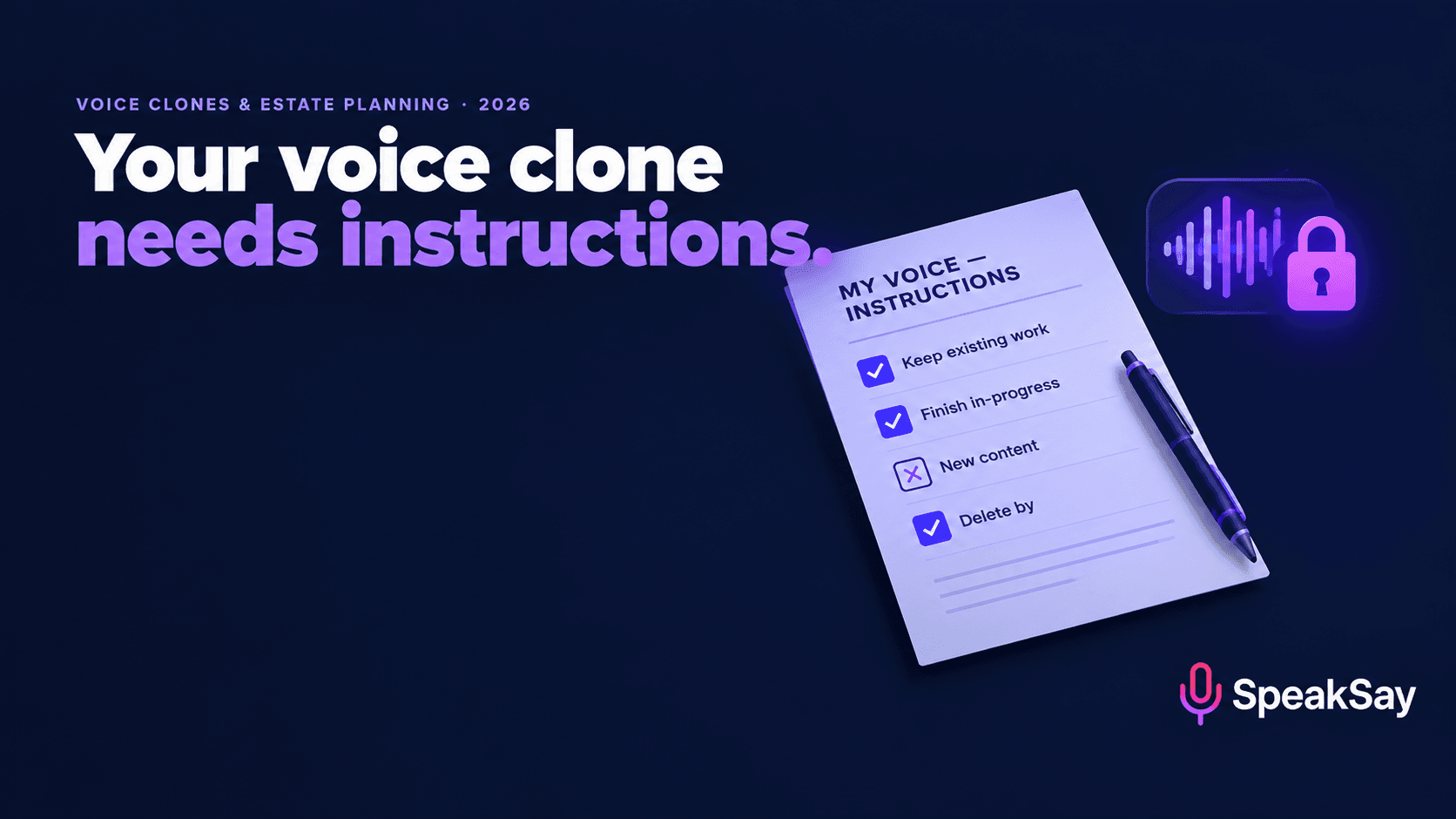
6. A one-page voice instruction
Keep it to one page so it gets read. Here's a structure.
| Section | Example wording |
|---|---|
| Who decides | "[Name] decides how my voice clone is used. If they can't, [backup name]." |
| Existing content | "Keep my published videos and audiobooks available. Monetisation may continue." |
| Work in progress | "Finish [named project] using my script as written, with no new lines." |
| Corrections | "Factual corrections to existing courses are allowed." |
| New content | "No new content in my voice, except reading my unpublished letters privately to family." |
| Licensing | "Honour existing licences until they end. Grant no new ones." |
| Disclosure | "Anything produced in my voice after my death must say so." |
| Deletion | "Delete all clones and training recordings within 12 months, after [project] is finished. Get written confirmation." |
| Incapacity | "While I can't consent: corrections and scheduled work only, decided by [name]." |
Date it and review it when anything changes: a new clone, a new licence, a new business.
7. Making it count: lawyers, wills and access
A note in a drawer expresses your wishes. Whether it binds anyone depends on where you live and how it's done. This is where a lawyer is worth the hour.
- Ask an estate lawyer to reference your voice instruction in your will or trust, and to advise how your state's publicity and digital-replica laws affect it. If your voice is a meaningful part of your income, an entertainment or IP lawyer may also be worth consulting.
- Digital asset access. In the US, most states have adopted a version of the Revised Uniform Fiduciary Access to Digital Assets Act, which lets you authorise your fiduciary to access online accounts. Use the mechanisms it recognises, along with any legacy-contact tools platforms offer, rather than writing passwords into your will.
- Contracts. If you work with brands, publishers or licensees, add a clause covering what happens to their rights in your voice if you die or become incapacitated.
- Tell people. The named decision-maker should know the instruction exists and where it is.
One practical point about the account itself: check what your platform does with clones and files if a subscription lapses. A monthly plan that quietly stops renewing after your card is cancelled is one way a clone disappears before anyone has made a decision. A one-time plan removes that particular failure point.
One less renewal for your family to manage
SpeakSay's lifetime plan has no monthly renewal, so your voice account doesn't depend on a card someone has to remember to keep paying.
8. FAQ
What happens to my AI voice clone when I die?It stays on whatever platform hosts it until someone deletes it or the account closes. Who can use or stop use of your voice depends on local law and platform terms. In places with post-mortem rights, control usually passes to your estate or heirs.
Can my family legally use my voice clone after I die?Often, yes, if they control your estate and the platform terms allow it. That's why written instructions matter: they tell your family what you'd want, not just what they're allowed to do. This isn't legal advice; ask a lawyer about your jurisdiction.
Is the NO FAKES Act law?Not as of October 2026. It cleared the Senate Judiciary Committee in June 2026 and awaits a full Senate vote. As drafted, it would create post-mortem voice and likeness rights lasting 10 years, renewable up to 70 with active use and registration.
Should I just ask for my voice clone to be deleted when I die?That's a valid choice and the simplest one. If you have work in progress or a catalogue that needs corrections, consider "finish named projects, then delete" instead.
What about if I'm alive but can't consent?Make a separate decision for incapacity: what's allowed, who decides, and how audiences are told. It's the case most people forget to cover.
Where should I keep the instruction?With your estate documents, referenced in your will or trust if your lawyer agrees, with a copy held by the person you've named to decide.