Make an Advent Calendar Podcast: 24 Daily Episodes for December, Produced Before November (2026 Playbook)
A daily advent podcast is one of the few shows listeners actively come back to every morning in December. It's also the show most likely to collapse by December 9 if you record it day by day in the busiest month of the year. Here's how churches, schools, shops, authors and families plan and produce all 24 episodes in October, then let the calendar run itself.
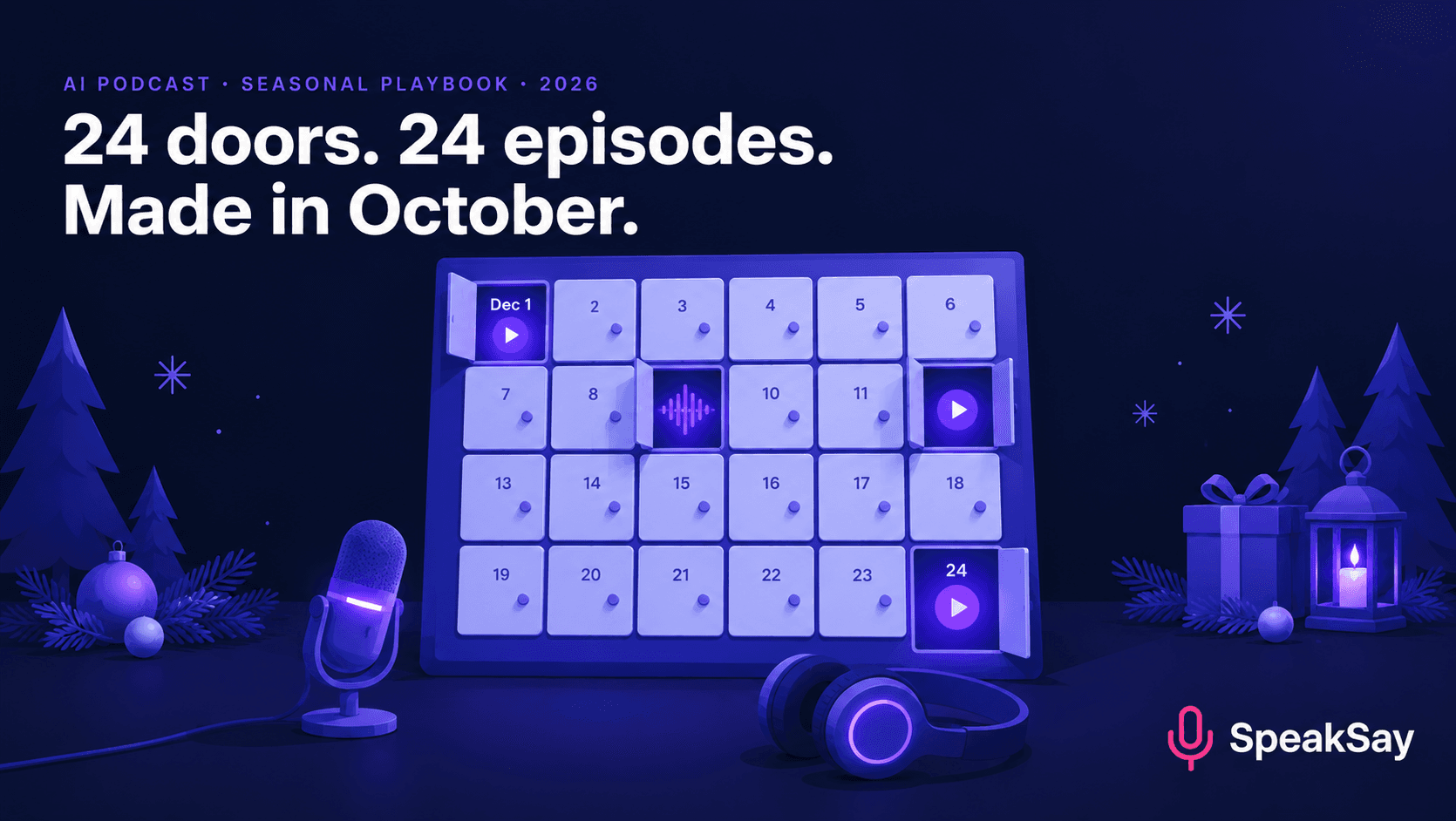
1. Why an advent podcast works
- The habit is built in. People already open a door every day in December. A short episode fits the same ritual.
- It's short by design. Three to six minutes a day is easy to finish, so listeners don't fall behind.
- It has an ending. Like a limited series, it's a commitment with a finish line, for you and the listener.
- It comes back every year. A good advent series becomes an annual event, and last year's episodes are still a reason to subscribe.
- It works for many kinds of creator, from a parish to a bookshop to a family making something for grandchildren.
Look at what existing advent shows have in common: they're short, they keep the same structure every day and they run on a fixed calendar. Those are exactly the things you can plan in advance.
2. Pick your calendar: 24 days or Advent season
| Calendar | 2026 dates | Episodes | Best for |
|---|---|---|---|
| Advent calendar (the chocolate kind) | Tuesday Dec 1 – Thursday Dec 24 | 24 | Schools, families, brands, authors, general audiences |
| Liturgical Advent | Sunday Nov 29 (first Sunday of Advent) – Thursday Dec 24 | 26 | Churches and devotional shows |
| Twelve days | Dec 13–24 or Dec 25 – Jan 5 | 12 | Smaller teams or a first attempt |
| Weekdays only | Dec 1–24, Monday to Friday | 18 | Workplaces, schools and B2B brands |
If it's your first year, the twelve-day or weekdays-only version is a safer bet. You can grow it to 24 next year.
3. Formats for five kinds of creators
| Creator | Format | Example episode |
|---|---|---|
| Church or ministry | A short reading, a two-minute reflection and a one-line prayer, same order every day | "Day 7: Waiting in the dark" with a reading, a reflection from a member of the congregation and a closing line |
| School or teacher | A story in 24 chapters, or a daily "winter fact", one per door | "Door 12: Why do penguins huddle?" in four minutes, ending with a question for the class |
| Shop or brand | A daily tip, story or behind-the-scenes moment. Not 24 ads. | A bakery's "Day 9: The recipe Grandma never wrote down", with a door-number offer mentioned once at the end |
| Author | A 24-part serial: a holiday novella, or a side story set in the world of your series | "Chapter 15", ending on a small cliffhanger before tomorrow's door |
| Family | A private feed for grandchildren: a story or memory each day | "Day 3: The winter the lake froze", told in a grandparent's own recorded voice |
For a brand, the rule is simple: if an episode only works as an ad, it isn't an episode. Give something useful or enjoyable every day, and mention the offer once.
4. The 24-door content map
Plan all 24 before you write any. A shape that works for most formats:
| Doors | Role | What goes here |
|---|---|---|
| 1 | The welcome | What this is, how long each episode is, when new doors open. Short and warm. |
| 2–6 | Build the habit | Your most immediately appealing episodes. Listeners decide in the first week whether to keep going. |
| 7, 14, 21 | Weekly anchors | A slightly longer or special episode: a guest, a listener question, a story told in parts |
| 8–13, 15–20 | The middle | Variety within the same structure. This is where most series sag, so plan these hardest. |
| 22–23 | The run-in | Build anticipation. Tie threads together. |
| 24 | The last door | The payoff: the end of the story, the biggest reflection, a thank-you, and a note about next year |
Write the 24 titles in a spreadsheet with a one-line summary each before you write any scripts. If you can't fill all 24 lines, switch to the twelve-day version.
5. The anatomy of one episode
Use the same structure every day. Familiarity is part of the appeal.
- The door (5–10 seconds): a short recurring sound and "Day 9 of the [show name] advent calendar." Our sonic identity guide shows how to make a recognisable sting.
- The hook (15 seconds): one sentence saying what today's door holds. No housekeeping, no "welcome back everyone". The first-minute guide explains why.
- The content (2–5 minutes): the story, reflection, fact or chapter
- The close (15 seconds): a recurring last line and "Door 10 opens tomorrow."
Keep each episode between three and six minutes. Consistent length matters more than the exact number.
Turn 24 scripts into 24 episodes
SpeakSay's AI podcast tool turns your scripts or notes into finished episodes with natural voices, so you can produce the whole calendar in a week instead of recording every morning in December.
6. Produce all 24 in one week
| Day | Task |
|---|---|
| 1 | Choose your calendar and format. Fill the 24-line content map. |
| 2–3 | Write all scripts or detailed notes. Write door 1, a middle door and door 24 first to set the tone. |
| 4 | Choose voices: one host, or a host plus a recurring second voice. Generate three test episodes and listen on a phone. |
| 5 | Generate the remaining episodes. Same voice settings for every one. |
| 6 | Listen to every episode. Fix names, readings and pronunciation. Even out the volume. |
| 7 | Make the cover art and trailer. Upload and schedule everything. |
Production notes:
- AI voices for the host and narration, real voices where they matter. A church might generate the reading and record the reflection by a member of the congregation. A family series should use a real grandparent's voice, or an AI voice of theirs only with their clear consent.
- Pronunciation list first: place names, biblical names, characters, product names. Fix them once in the settings, not 24 times.
- Volume: run every episode through a loudness check so door 14 isn't quieter than door 13.
- Disclose AI voices in the show description. Listeners to a devotional or family show especially should know what they're hearing.
7. Schedule, publish and promote
- Use your podcast host's scheduled publishing. Most hosts let you upload episodes and set each to go live at a set time. Choose an early-morning time in your audience's main time zone, so the door is open before breakfast.
- Separate feed or existing feed? If you already have a show, run the calendar as a clearly labelled mini-season. If not, give it its own feed and name it as an annual event ("The [Name] Advent Calendar").
- Publish a trailer by mid-November. Our trailer and audiogram guide covers how.
- Put the subscribe link where the habit already is: parish newsletters, school letters home, receipts and shop windows (with a QR code), your author newsletter.
- Give people a way to catch up. "Missed a door? They're all still there" in episode descriptions.
- Plan the after-life. The calendar works again next December, and it can be part of your year-in-review.
8. Mistakes that break an advent series
- Recording day by day. One sick day or busy week and the calendar has a gap. Make everything first.
- Episodes that keep getting longer. Day 3 is four minutes, day 15 is fourteen. Keep the length consistent.
- A weak middle. Doors 8–20 are where people drop off. Put some of your best material there.
- 24 ads. A brand calendar that's all promotion loses listeners by the first weekend.
- Forgetting door 24. End properly, and thank people for coming every day.
- Using someone's voice without asking. A cloned voice of a pastor, teacher or grandparent needs their clear permission first.
If you're also preparing a pre-recorded Christmas program, our Christmas program voice tracks guide uses a similar make-it-early approach.
One plan, the whole calendar
SpeakSay plans cover podcast production, natural voices and the rest of the audio studio, so all 24 episodes come from one place.
9. FAQ
How do I make a daily advent podcast?Choose a calendar (Dec 1–24 or the liturgical season), map all 24 episodes in advance, keep each episode three to six minutes with the same structure, produce everything in October or early November and schedule each episode to publish automatically every morning.
When does Advent start in 2026?The first Sunday of Advent in 2026 is November 29. Advent calendars traditionally run from December 1 to December 24.
How long should an advent podcast episode be?Three to six minutes is a good range. Short enough to fit a morning routine, and keep it consistent across all 24 days.
Can I use AI voices for an advent or devotional podcast?Yes, for narration, readings or a host voice, as long as you're open about it in the show description. Many creators mix AI narration with real recorded voices for the most personal parts.
Should my advent podcast have its own feed?If you already run a show, a labelled mini-season inside it is usually best. If you're starting fresh, give it its own feed and treat it as an annual event.
What if I can't fill 24 episodes?Run twelve days or weekdays only. A shorter calendar that finishes is better than a 24-day one that stops halfway.