Your AI Podcast Sounds Like Everyone Else's Because It Has No Sonic Identity — The 2026 Audio Branding Playbook
Stock voice, stock intro music, stock structure. Listeners can't tell your show from the twenty others in their feed because there is nothing to tell apart. Here's how to build an audio identity — stinger, tag, transitions, sign-off — for a show made with AI voices.
1. Why sonic identity matters more for an AI-made show
Audio branding is treated as a nice-to-have — the thing you add once the show is working. For an AI-produced podcast the priority is inverted, for three reasons.
- Your voice is not distinctive by default. A human host's voice is the sonic identity; nobody else has it. If you're using preset voices, thousands of shows are using the same ones. The recognisability that a human host gets for free, you have to build.
- Undifferentiated audio is the automation signature. Listeners and directory classifiers alike read "stock voice, stock music, no structural markers" as a template. A show with a deliberate audio identity reads as a produced show, because producing one takes decisions that a pipeline doesn't make.
- You have no face, no studio, and no personality shots. Every other branding surface a podcast can use is visual and lives outside the listening experience. The audio is where your brand actually meets the listener.
There's also a purely commercial argument. A recognisable open is what makes a listener who tapped by accident stay for ten seconds, and it's what makes a returning listener feel they've arrived somewhere rather than started a file.
Start with a voice nobody else has
Sonic identity begins with the voice itself. Design one from a prompt or clone your own so your show doesn't open on a preset the whole directory is using.
2. The five elements of a podcast sonic identity
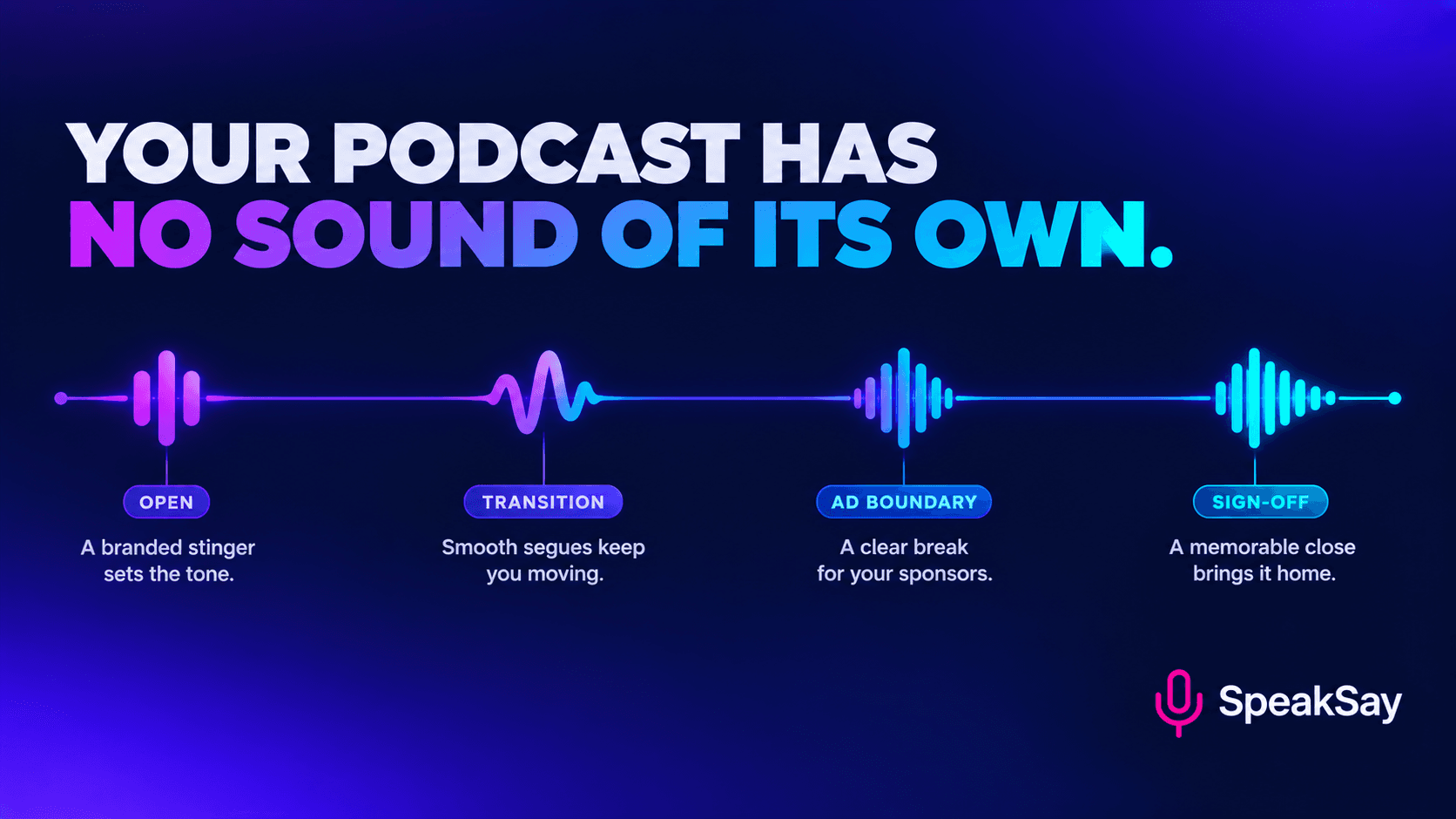
A complete identity is smaller than people expect. Five assets, and four of them are under five seconds long.
| Element | Length | Job | Where it goes |
|---|---|---|---|
| Stinger | 2–3.5 s | Recognition — "this is the show" | Cold open ends / top of episode |
| Voice tag | 1.5–3 s | Name the show in a fixed, spoken phrase | Immediately after the stinger |
| Transition mark | 0.8–1.5 s | Signal a segment change | Between segments |
| Ad boundary pair | 1–2 s each | Mark the exit to and return from an ad | Either side of an ad marker |
| Sign-off | 4–8 s | Close the loop; carry the one ask | End of episode |
Two design principles hold the family together:
- They must be relatives, not strangers. The transition mark should be recognisably derived from the stinger — the same instrument, the same interval, a fragment of the same motif. Five unrelated sounds is noise; five variations on one idea is a brand.
- They must be shorter than you want them to be. Every one of these elements sits between the listener and the content. The correct length is the shortest length that still registers. When in doubt, cut a second.
3. The stinger: three seconds that do the most work
The stinger is the small musical or sonic mark that says this show. It is not the intro track, and confusing the two is the most common mistake in podcast audio branding.
An intro track is thirty seconds of library music that the listener learns to skip. A stinger is under four seconds, too short to skip, and after five episodes the listener recognises it before they've consciously identified the show. That recognition is the entire point.
What makes a stinger work
- Three to five notes, maximum. Think of the sounds you can already hum from products you use. None of them are melodies. They're gestures.
- One distinctive timbre. Pick a sound source with character — a plucked string, a filtered synth, a struck object, a processed vocal note — and use only that. Generic piano and generic pad are what everyone else picked.
- An unambiguous ending. The last note should decay cleanly. A stinger that trails off into the first word of narration muddles both.
- Consistent loudness relative to speech. Master it so its perceived level sits close to your narration, not louder. A stinger that makes people reach for the volume control is a defect, not a statement.
The non-obvious option: make it vocal
If your show is voice-first, your stinger can be too. A two-note hummed figure, a whispered word, a single processed syllable — produced in the same voice as your host — is both more ownable than any library music cue and more thematically coherent. It also sidesteps music licensing entirely, which matters if your show is monetised or distributed widely.
4. The voice tag — your most ownable asset
The voice tag is a fixed spoken phrase, identical in every episode, that names the show. Radio has used it for a century for a reason: it survives being heard sideways in a kitchen.
Rules for writing one:
- Under eight words. "This is Signal Decay." is enough. "Welcome back to another episode of Signal Decay, the podcast where we…" is an intro, not a tag.
- The show name must be sayable in one breath. This is a hard constraint for synthetic hosts specifically: acronyms, ampersands, numerals and portmanteaus that look fine on a cover often come out of a voice model wrong or awkward. Generate your show name in your host voice before you commit to it. If it needs respelling to say correctly, you will be fighting it forever.
- Generate it once and reuse the same audio file. Do not regenerate the tag each episode. Small run-to-run variation in a phrase the listener hears every week is exactly the kind of inconsistency that undermines recognition — and the fix is free.
- Consider a second voice. A tag delivered by a different voice from your host — the announcer convention — is instantly more brand-like, gives your main voice a clean entrance, and adds contrast at the moment the listener is deciding whether to stay.
Placement: stinger, then tag, then content. Not tag, then stinger, and never both wrapped in thirty seconds of music.
Cast an announcer voice for your tag
A contrasting second voice for the tag and boundary marks costs nothing extra and does more for recognition than any music cue.
5. Transitions, ad boundaries and the return
Podcast retention analysis keeps finding the same thing: listeners leave at moments of confusion, not moments of boredom. A segment change with no acoustic marker is a confusion moment — the listener isn't sure whether they missed something, and the mental effort of checking is enough to break the session.
Transition marks
A sub-1.5-second fragment of your stinger motif, placed at every genuine segment change. Not at every topic shift — that becomes wallpaper — but at structural boundaries the listener would recognise if they could see them. Pair it with a spoken cue on the far side ("Second thing.") and you've solved segment navigation with about two seconds of audio.
Ad boundaries
If your show carries ads, especially dynamically inserted ones, the boundary marks do double duty. They tell the listener an ad is starting so it doesn't feel like a bait-and-switch, and they give the insertion a clean edge regardless of what creative gets dropped in.
| Position | Element | Length | Note |
|---|---|---|---|
| Before the marker | Descending fragment | 1–1.5 s | Signals "stepping out" |
| After the marker | Ascending fragment | 1–1.5 s | Signals "back in" |
| First line back | Spoken re-anchor | 3–5 s | "So — back to the second problem." |
That third row is the one people skip and it matters most. A listener returning from ninety seconds of unrelated advertising has lost the thread. One sentence of re-anchoring recovers it. Without it, the post-ad segment is where your retention curve drops.
Keep the boundary marks in the host episode audio rather than baked into the ad, so they behave predictably no matter what gets inserted.
6. The sign-off and the outro
The end of an episode is the highest-intent moment you get. The listener finished. They liked it enough to finish. This is where the one thing you want them to do belongs — and it is routinely wasted on a list of five things and a music fade.
A working structure, total 15–25 seconds:
- Content-final line — a real closing thought, not "and that's all for today".
- Fixed sign-off phrase — the verbal counterpart to your tag, identical every episode. This is what listeners quote back to you.
- One ask. One. Review, or subscribe, or the mailbag address — never all three. Rotate across episodes rather than stacking.
- Stinger, full version — closing the loop that the open started.
Two AI-specific notes. First, vary the wording of the ask across episodes even though the sign-off phrase stays fixed; an identical ask in identical words every week is one of the more visible automation tells, and it reads as a script rather than a person. Second, if your ask includes a destination — a URL, an email, a handle — say it slowly, say it once, and confirm your host voice can actually pronounce it in one breath. Anything with a hyphen, an underscore or an unusual spelling needs testing before it goes in the sign-off.
7. The consistency rules (where AI shows actually fail)
An identity only works if it is identical every time. This is where AI-produced shows have both an advantage and a specific trap.
| Rule | Why |
|---|---|
| Render brand elements once; reuse the files | Regenerating fixed phrases introduces run-to-run variation exactly where sameness is the point |
| Keep a single "brand kit" folder | Stinger, tag, transition, ad pair, sign-off — one folder, versioned, never edited in place |
| Master the kit to the same loudness as the show | Elements built in a different session at a different level are the most common cause of "why is the intro so loud" |
| Freeze the kit for at least 20 episodes | Recognition is built by repetition; changing it at episode six resets the clock |
| Store the voice settings, not just the audio | If you ever need to re-render the tag — new name, new host — you want the exact configuration, not an approximation |
| Re-cut, don't re-generate, when trimming | Editing the existing file preserves identity; a fresh generation quietly changes it |
That last-but-one row deserves a sentence of its own. The most avoidable disaster in AI podcast production is losing the ability to reproduce your own brand audio because the voice, the settings or the platform changed and nothing was written down. Save the configuration alongside the files.
8. Build it in an afternoon
- Pick the sound source (20 min). One instrument or one processed vocal timbre. Write down what it is.
- Write the motif (30 min). Three to five notes. Hum it. If you can't hum it back after two plays, it's too complex.
- Render the stinger and two fragments (30 min). Full version for open and close, a short descending fragment and a short ascending fragment for boundaries.
- Write and generate the voice tag (30 min). Test your show name in the host voice first. Use a contrasting voice if you have one.
- Write and generate the sign-off phrase (20 min). Fixed wording. Generate once.
- Level-match the whole kit (30 min). Against a representative narration clip, on phone speakers.
- Write the placement rules down (20 min). One page: what goes where, in what order, at what level. This is what keeps the identity intact when you're producing at speed six months from now.
- Retrofit the last five episodes (optional). If your back catalogue is small, re-uploading with the kit in place makes the show feel intentional to anyone who binges backwards.
One plan for the show and the brand kit
Host voices, a contrasting announcer voice, vocal stingers and unlimited re-renders while you tune the kit — produced in one place.
9. FAQ
What's the difference between a podcast intro and a stinger?An intro is a longer opening segment, often twenty to thirty seconds with music and a description of the show — listeners learn to skip it. A stinger is a two-to-four-second sonic mark that's too short to skip and becomes recognisable after a handful of episodes. Most shows would be better off replacing the intro with a stinger plus a short spoken tag.
How long should podcast intro music be in 2026?Shorter than most shows make it. Three to four seconds at the open, one to one and a half seconds for transitions, and four to eight seconds at the close. Anything longer sits between the listener and the content and gets skipped, taking your first line with it.
Can I make a stinger with an AI voice instead of music?Yes, and for a voice-first show it's often the better option. A hummed two-note figure, a whispered word or a single processed syllable in your host's voice is more ownable than library music, thematically coherent, and avoids music licensing questions entirely.
Should I regenerate my intro tag for each episode?No. Generate it once and reuse the same audio file. Small variation between runs is precisely what undermines recognition in the one phrase where sameness is the whole point — and reusing the file is free and faster.
Does audio branding help with podcast discovery?Indirectly. It doesn't affect search or directory ranking, but it improves the two things that do drive growth: how long a new listener stays in their first thirty seconds, and whether a returning listener recognises the show immediately. It also removes several of the surface signals that make a show read as templated.
What if my show name is hard for an AI voice to say?Test it before you commit. Generate the name in your host voice and listen. If it needs respelling to come out right, you can fix that in the tag — but you'll also be fighting it every time a guest, a listener or a search result says it aloud. A name that's easy to say in one breath is worth more than a clever one.