Earnings Season Is Here and Nobody Can Read 40 Filings: Turn 10-Qs and Earnings Releases Into a Weekly Audio Briefing With AI Podcast (2026)
Q3 earnings season began this week with the big banks, and the filings keep coming through early November. This guide shows how to turn the public documents you follow into a short audio briefing, what to put in it, how to check the numbers, and where the line sits between a briefing and advice.
1. The real problem is volume
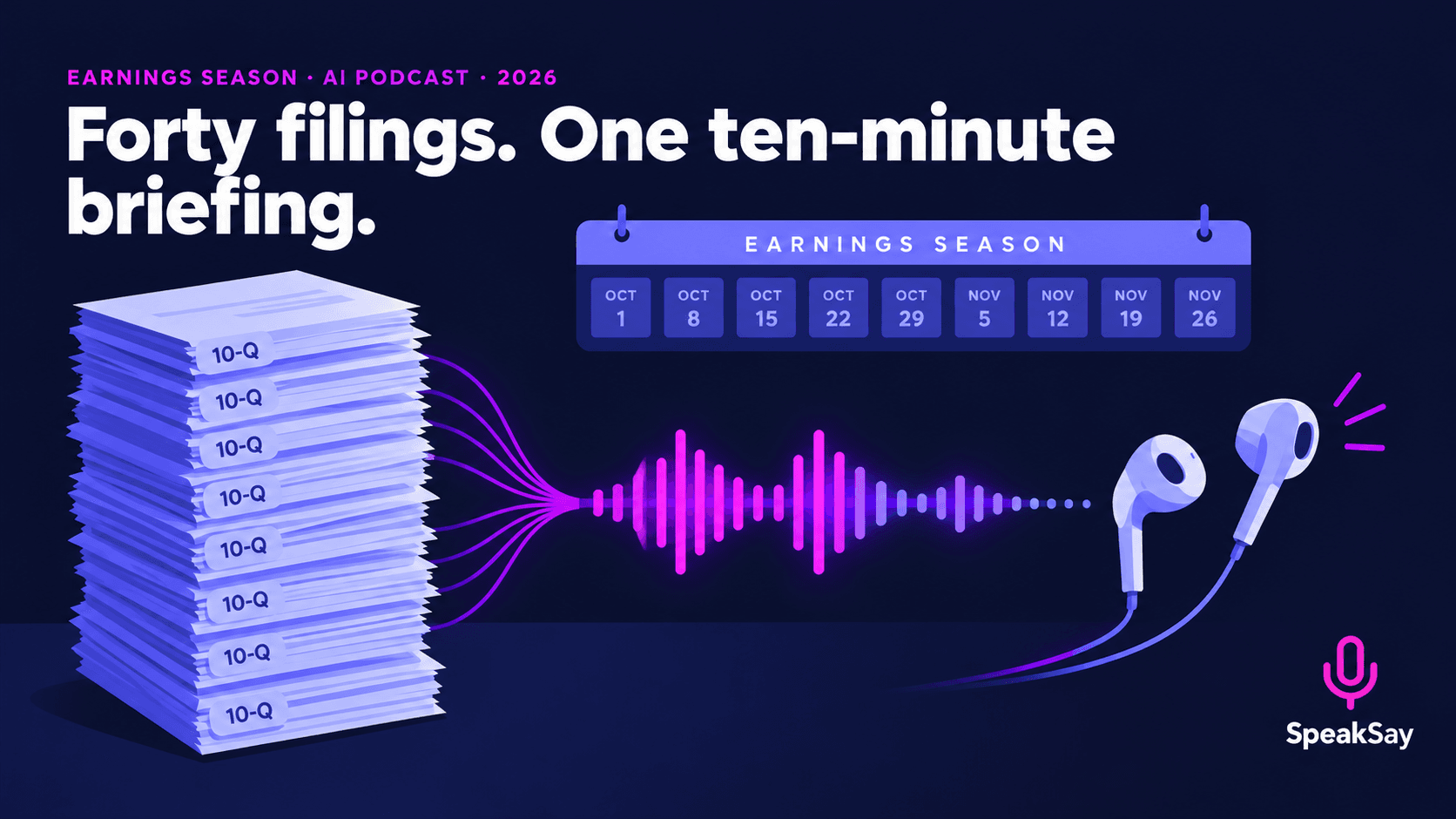
A single quarterly report is readable. Ten of them in a week are not, and the first ten come at the same time. Most people deal with that by reading headlines, which means they read what a journalist chose to emphasise and miss the sentence in the notes that changes the picture.
A good audio briefing does not replace the filing. It tells you which parts of the filing are worth your attention, in an order you can follow while doing something else.
2. Choose sources you can use
- Company earnings releases and presentations, which are published on the company's investor-relations page.
- Quarterly reports (Form 10-Q) filed with the SEC. Depending on the size of the company, these are due 40 or 45 days after the quarter ends, so many arrive in late October and early November.
- Your own notes from calls you attended.
Be careful with paid or third-party transcripts of earnings calls. They may be licensed to you for reading, not for uploading into other tools. If you are not sure, use the company's own materials and your own notes instead.
3. A six-part briefing template
Give the AI the same structure every week, so you always know where to listen for what.
- The headline numbers. Revenue, profit measure and any figure the company itself emphasised, each compared with the same quarter last year as the company reports it.
- What changed. The biggest difference from the previous quarter, in the company's own words.
- What management said about the future. Guidance, outlook or targets, quoted or closely paraphrased, with a clear line between what is stated and what is inferred.
- Risks and one-offs. Items the company flags as unusual, such as charges, legal matters or changes to the way it reports.
- What to check yourself. A list of three things in the filing the briefing could not settle.
- Where it came from. The documents used and their dates, read out at the end.
Ask for each company as a separate segment of about two minutes. Ten companies give a twenty-minute weekly show, which is about one commute.
4. Make the audio
- Build a source pack per company from the documents above. Keep each pack small and dated.
- Give instructions that limit the tool: use only these documents, quote numbers exactly as written, never infer causes that the company does not state, and say "not stated" when something is missing.
- Generate one episode per week with a single-host format. A two-host conversation is more entertaining but makes it harder to tell stated facts from banter.
- Listen once at normal speed, then replay the sections you want to check.
The same approach works for any recurring pile of documents. Our guide to internal communications audio briefings uses a similar structure.
Make your first weekly briefing
Upload a small source pack, choose a single-host format and listen to your first briefing before the next report lands.
5. Check the numbers
This is where briefings go wrong. Financial tables are dense, and a summary tool can misplace a decimal, mix up a column or confuse a full-year figure with a quarterly one.
- Verify every figure you plan to repeat. Open the filing and find it. If you can't find it, drop it.
- Watch units. Millions versus billions, per share versus total, and adjusted versus reported are the usual traps.
- Keep the briefing's numbers in a one-page list you check against the source. Our guide to keeping an AI podcast accurate to your own sources explains the method.
- Listen for numbers read aloud. If a figure is hard to follow by ear, ask for it to be rewritten in words. See our normalization pass for numbers and units.
6. What a briefing is not
- It is not advice. A briefing tells you what a company said. It does not tell you what to buy, sell or hold, and it should not be written or voiced as if it does.
- It is not a substitute for the filing if you are making a decision that matters. Read the sections it points you to.
- It is not for redistribution without care. If you share a briefing with a group or an audience, say it is a summary of public documents, name the documents and say that it is not advice. If you publish financial content for a living, check the rules that apply to you.
7. A weekly routine
- Sunday: list the companies you follow that report this week.
- As each report lands: add the release and the filing, when it appears, to that company's pack.
- Friday: generate the week's episode and listen to it.
- Weekend: open the filings for the "what to check yourself" items.
After earnings season ends, keep the same structure for monthly company updates, industry reports or regulatory announcements.
8. FAQ
Can AI summarise a 10-Q accurately?It can produce a useful first pass, but it can also misplace figures or units. Check every number you rely on against the filing.
Is a listening briefing the same as investment advice?No, as long as it only reports what the documents say and gives no recommendations. Keep it that way, and say so when you share it.
Can I upload an earnings call transcript?Only if you have the right to. Many transcripts are licensed for reading, not for reuse. Use the company's own materials or your own notes if you are unsure.
When are 10-Qs due?Generally 40 or 45 days after the end of the quarter, depending on the size of the company. For the quarter that ended September 30, that means early to mid November.
How long should the weekly briefing be?About two minutes per company. Ten companies make a twenty-minute episode that fits a commute.