Your Family Tree, Out Loud: Turn Genealogy Research Into an Audio Episode Relatives Will Actually Hear (2026)
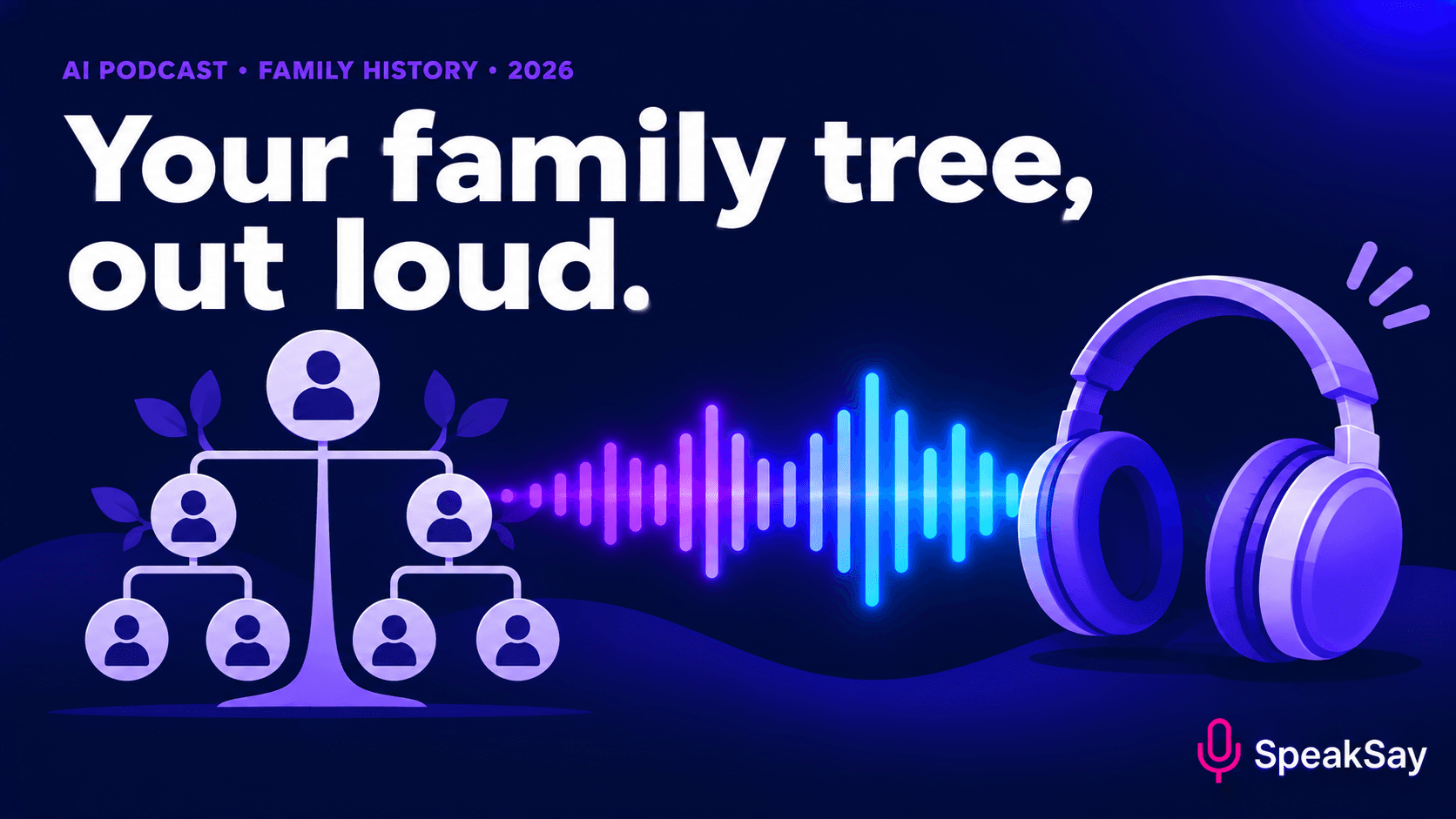
Hours of genealogy research end up in a PDF or a tree nobody opens. A 10-minute audio episode built from your notes can carry the story to relatives who will never read the report. Here is how to structure it, what to check and what to keep private.
1. Why the report goes unread
A research report is built for verification: names, dates, citations. Relatives want the story: who these people were, why they moved, what they lost and gained. Both matter, but only one gets listened to.
Audio lowers the effort. Nobody has to open a file, scroll a chart or work out who is whose cousin. They press play.
2. Choose one story, not the whole tree
A tree has hundreds of names; an episode can hold perhaps three people. Pick a thread with a clear arc:
- The migration: why one branch left, and how.
- The house or the town that appears in several records.
- A surprising find: a name that changed, a job nobody knew about, a photograph's story.
- A single ancestor's life in five scenes.
Keep the rest of the tree for later episodes. A short series of five or six episodes is more likely to be heard than one long one.
3. An episode structure that works
- Hook (20 seconds). One surprising detail from the research.
- Who we are talking about. Name, place, years, how they connect to the listener.
- The story in three beats. Before, turning point, after.
- What the records say, and what they do not. Make clear which parts are documented and which are guesses.
- A question for listeners. "Does anyone have a photo of the house?" This turns listeners into contributors.
Ten minutes of audio is roughly 1,400 to 1,600 words. Write for the ear: short sentences, one name at a time and relationships restated ("your great-grandmother's brother").
4. Facts, sources and uncertainty
Audio hides citations, so say them. A sentence like "this comes from the 1921 census entry" gives the listener a reason to trust you, and the show notes can link the document.
- Say "records suggest" where a link between people is probable but unproven.
- Do not let an AI tool fill gaps. If a date or a motive is not in your sources, leave it out or label it clearly as speculation.
- Read the final script against your notes line by line before generating audio.
An AI podcast tool gives your words a voice; it does not check your genealogy. The research stays yours.
Turn your notes into a listenable episode
Paste a story outline or a research summary and generate a two-voice episode in minutes. Review it against your sources before you share it.
5. Living relatives and privacy
Genealogy touches real people who are still here. Before you publish an episode, check:
- Living people. Leave out names, dates of birth and details of anyone alive unless they agreed.
- Sensitive history. Adoptions, divorces, illnesses and criminal records can hurt living relatives even when they happened decades ago. Ask first.
- Addresses. Skip current addresses and anything that could identify where someone lives today.
- Audience. A private family link is different from a public feed. Decide which you want.
When in doubt, leave it out of the audio and keep it in the private research file.
6. Making the episode
- Write the one-story outline and a draft script.
- Use SpeakSay's AI podcast tools to turn it into a conversation or a single narrator, whichever suits the family.
- Listen to the full episode and correct every name. Place names and old surnames are the usual trouble spots; respell them in the script until they sound right.
- Add a short intro that says it is a synthetic voice, so nobody thinks a long-dead relative is speaking.
Do not clone a relative's voice from an old recording without clear consent from them or, where they have died, from the family members who would have the right to decide. Our guide on cloning a loved one's voice covers the consent questions.
8. FAQ
Can I use this for a public genealogy podcast?Yes, but apply the privacy checks above more strictly. Public feeds are searchable, so leave out living people and sensitive details.
How long should an episode be?Eight to twelve minutes is a good target. Longer episodes are better split into parts.
Will the AI invent facts?It reads what you give it. If you ask it to expand on a story, it can add unsupported detail, so always check the script against your sources.
Do relatives need to be told it is AI?It is good practice. A single line at the start is enough.