Nobody Reads the HOA Newsletter: How a Community Association Can Turn Board Decisions Into a 4-Minute Monthly Audio Digest With an AI Podcast (2026)
Residents skip the monthly HOA newsletter and then say nobody told them. A 4-minute audio digest, built from the same board notes, reaches the people who never open the PDF. Here is the format, the script and the limits.
1) Why "We Told Them" Keeps Failing
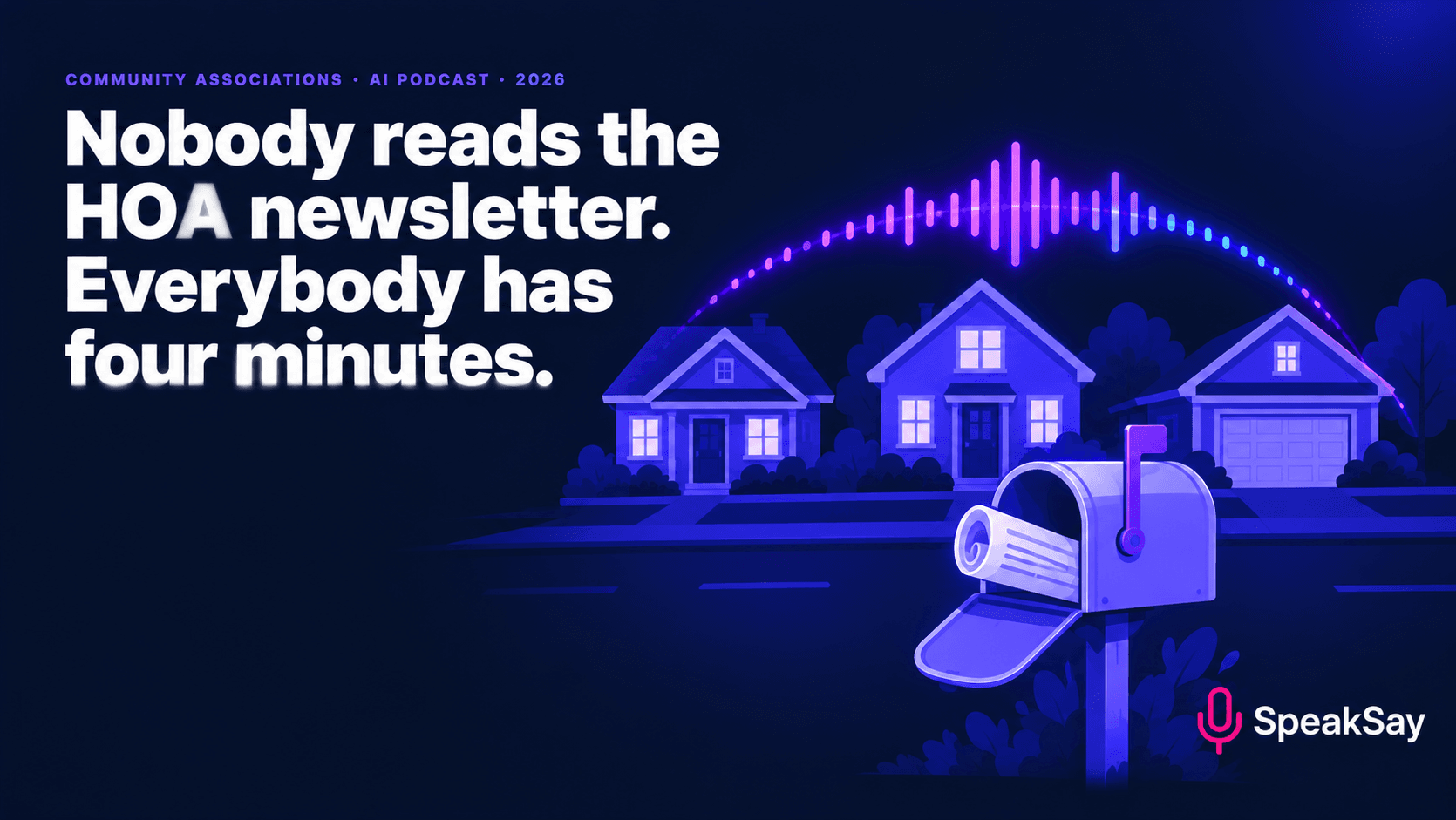
HOA and community-association guides agree on the shape of the problem. A management-company article on newsletters describes them as either "a wall of text or a flashy PDF with no real substance", and says generic subject lines like "May Newsletter" underperform. It also advises monthly rather than irregular contact, because residents who hear nothing tend to assume the worst, and suggests summarising each board decision in one or two sentences instead of sharing full minutes. (That guide offers no formal statistics, and neither do we; treat it as practitioner advice.)
- Residents are busy and the content is dry. Reserve funds, landscaping contracts and parking rules matter, but they do not look urgent until they affect someone.
- Email is a weak channel. Bulk mail from a generic address is easy to ignore.
- Boards write for the record, not the reader. Minutes are accurate and unreadable by design.
A digest does not make residents care. It makes the news easy to take in during a commute, a dog walk or a washing-up session, so the people who would never open a PDF actually hear it.
2) Why Audio Suits a Community Association
- Audience mix: older residents, busy parents, second-language readers and people who dislike long emails all have an easier time with a short recording.
- Consistency: the same voice, same length, same day each month builds a habit that a changing PDF cannot.
- Neutral tone: a calm voice reading a short script removes the "who wrote this and what is their agenda" feeling that long board emails can carry.
- Low effort for volunteers: the digest is made from material the board already has, in under an hour a month.
If you have read our piece on audio recaps of council and school board meetings, this is the same idea scaled down for a neighbourhood: shorter, friendlier, and focused on what changes for residents.
3) The 4-Minute Episode Format
Four minutes is roughly 600 words at a comfortable pace. Keep the structure the same every month so listeners know where they are.
- Cold open (15 seconds): "This is the March update for Maple Court. Four minutes, three things you should know."
- Top three (90 seconds): the three decisions or changes that most affect residents, one to two sentences each. Lead with what changes for them.
- Dates (45 seconds): next meeting, payment deadlines, scheduled work, community events. Say each date and repeat the most important.
- One practical tip (45 seconds): a seasonal reminder, such as clearing gutters before autumn, bin-day changes or how to submit a maintenance request.
- Where to ask (30 seconds): one email address, one phone number, and where to find the full minutes.
- Close (15 seconds): thank residents and repeat the next meeting date.
A recurring "ask the board" slot works well if you have a question that three different residents raised. Do not name the residents.
4) Build It From the Notes You Already Have
The digest is a rewrite, not a recording of the meeting. Start with the approved minutes or the board's summary, not the raw discussion.
- Pick the three items. Ask: what changes something in a resident's month?
- Write each in plain speech. "The board approved a new landscaping contract starting June 1. Mowing days stay the same; the visits get a little longer."
- Create the episode. Paste your approved script or notes into the SpeakSay AI podcast tool, choose the style that fits, and listen for anything that sounds like a promise the board did not make.
- Have a second board member listen. Their job is to catch any sentence that overstates a decision.
- Publish a transcript with the audio. Accessibility and searchability both improve.
Make your first monthly digest
Take last month's board summary, shorten it to three items and turn it into a 4-minute episode. If it takes you under an hour, the monthly rhythm is realistic.
5) What Stays Out of the Episode
A community digest is a public-facing summary, so treat it with the same care as the newsletter. Check your governing documents and any state or local rules on official notices; an audio digest is a convenience, not a replacement for a legally required notice.
- Individual owners: no names, unit numbers, payment arrears, fines or violation details.
- Legal matters and disputes: leave out anything under counsel's guidance.
- Personnel and vendor disputes: keep these in closed session.
- Predictions and promises: report what was decided, not what the board hopes will happen.
- Advice: do not give legal, tax or insurance advice. Point residents to the right professional.
Say the voice is AI-generated in the first or last line. A short note is enough.
7) Is It Working? Three Simple Checks
- Play counts. If you host the audio on your site, track plays per month. A rising trend after three issues is a good sign.
- "I didn't know" messages. Count how many residents write in to say they were unaware of a decision. This should fall.
- Meeting attendance and form returns. If a deadline was in the digest, compare returns against last year's equivalent.
Give it four issues before you judge. If plays stay flat, change the channel or the subject line first, then the length.
Keep the monthly digest running all year
A twelve-issue year is easier when the cost is predictable. See the plans, or the lifetime option for boards that rotate volunteers but keep the same tools.
8) Frequently Asked Questions
Can an audio digest replace the official notice?No. Use it as a supplement. Your governing documents and local rules decide how official notices must be given, so keep sending those the required way and add the audio as a convenience.
Who should be the "voice" of the digest?A consistent AI voice is the simplest choice, because it avoids making one board member the face of every decision. Tell residents the voice is computer-generated.
How often should we publish?Monthly is a good default. Quarterly can suit a small community or a board that meets rarely. Consistency matters more than frequency.
How long should it be?Aim for three to five minutes. If you routinely run over, you are including items that belong in the minutes.
What if a resident disagrees with something in the digest?Link the full approved minutes and give one contact. The digest should always be traceable to a decision the board actually recorded.
One-Page Checklist
- Start from approved minutes or the board summary, not raw discussion.
- Choose three items that change something for residents.
- Use the same six-part structure every month; keep it to four minutes.
- Leave out names, unit numbers, arrears, fines, legal matters and personnel issues.
- Have a second board member check every sentence for overstatement.
- Publish audio and transcript together; say the voice is AI-generated.
- Use a specific subject line, the same day each month and a QR code on the notice board.
- Judge it after four issues, not one.