The Annual Notice of Change Arrived for Mom: Turn the Plan Letter Into a Short Audio Summary the Whole Family Can Hear (Medicare Open Enrollment 2026)
Medicare plan letters arrive by September 30, open enrollment runs October 15 to December 7, and in many families the adult child ends up reading the fine print. Here is how to turn the Annual Notice of Change into a three-minute audio summary a parent and the whole family can hear, without storing identifiers or recommending a plan
1. Why the letter is hard to hear second-hand
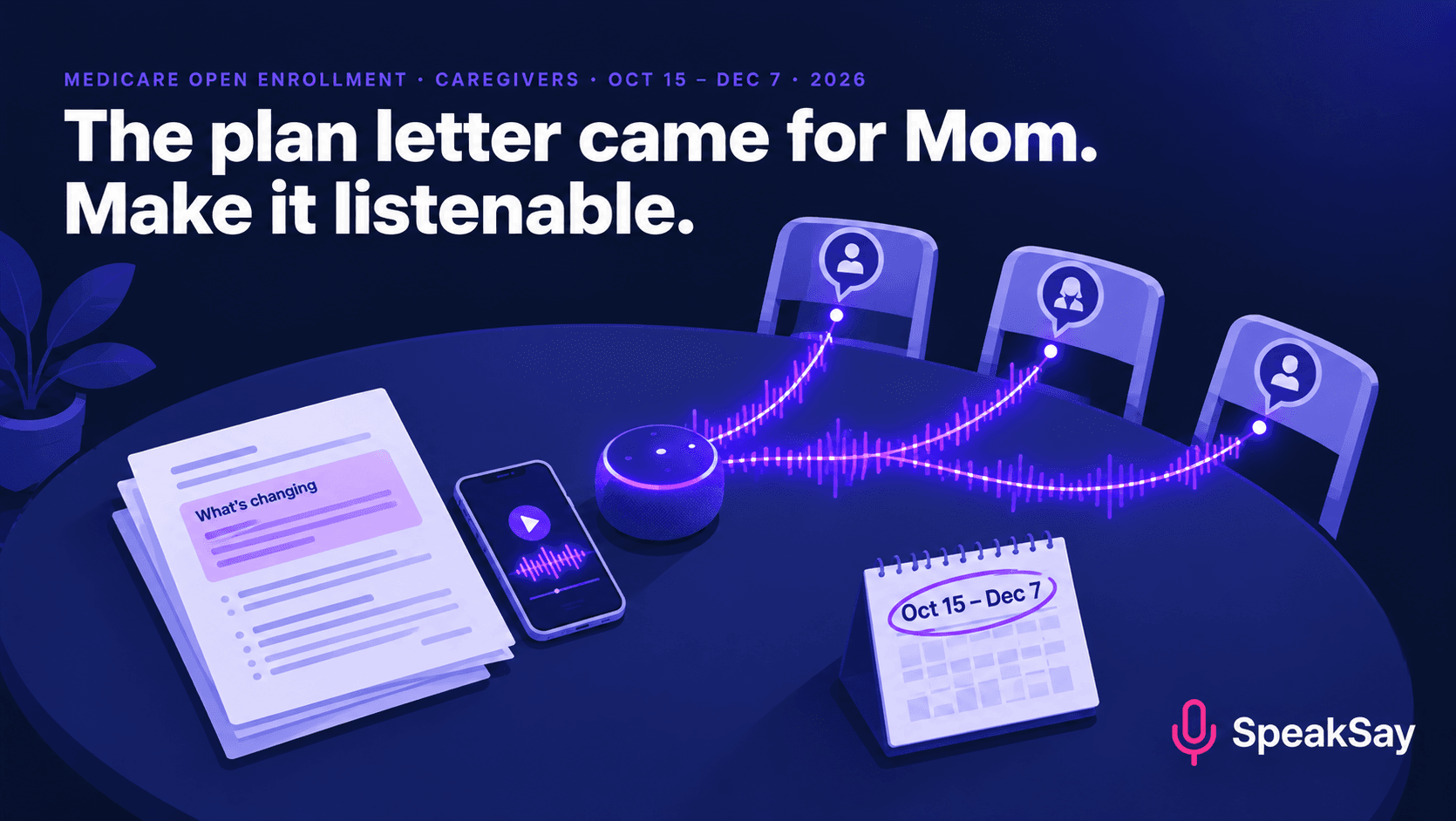
An ANOC lists what is changing in a plan for the coming year. Typical items are higher copays, doctors or hospitals leaving the network, and medications being removed or moved to a different cost tier. Those are exactly the details a person wants to check against their own life: this pharmacy, that cardiologist, these four prescriptions.
The problem is the hand-off. The adult child reads twelve pages, then relays it on the phone from memory. A parent with low vision can't re-read the letter. A parent with hearing loss may miss half of a phone call. A sibling in another city gets a different version of the story. By the time the family talks about it, there are three accounts of one letter.
A short recorded summary fixes only one thing: it makes the retelling identical and replayable. That is worth doing because the decision window is short.
2. The dates that matter
| When | What happens |
|---|---|
| By September 30 | The ANOC and the Medicare & You handbook should arrive. |
| October 15 to December 7 | Open enrollment (the Annual Election Period): enroll in, switch or drop plans. |
| December 7 | Last day to submit a plan change for next year. |
| January 1, 2027 | New coverage takes effect. |
Those dates come from Kiplinger's 2027 Medicare open enrollment guide. Check Medicare.gov for anything that applies to your parent's specific situation. Some other notices, such as a plan non-renewal or termination notice, can arrive separately and carry their own deadlines, so open every envelope.
3. What to keep out of any tool
A plan letter contains personal and sometimes sensitive information. Before you type or paste anything into a text-to-speech tool, remove it.
- Leave out identifiers. No Medicare number, member ID, Social Security number, birth date or address.
- Summarize, don't paste. Write your own short fact sheet from the letter, rather than pasting whole pages.
- Keep medical detail to what you need. "Her blood-pressure medication moves to a higher tier" is enough. A full medication list isn't needed in an audio file that gets forwarded.
- Treat the audio file as private. Share it only with the people who are helping, and delete it after open enrollment ends.
- Get your parent's okay. It is their coverage. Tell them what you're making and why.
4. Step 1: Pull out only what changed
You don't need a recording of the entire letter. You need the changes. Go through it with a pen and fill in this sheet:
| Section of the letter | What to write down | Question it raises |
|---|---|---|
| Premium and deductible | This year versus next year, in dollars. | Is the monthly cost changing, and by how much? |
| Copays and coinsurance | Doctor visits, specialists, hospital stays. | Which visits does she actually use? |
| Drug coverage | Any medicine removed or moved to a different tier. | Are her regular medicines still covered at the pharmacy she uses? |
| Provider network | Doctors or hospitals leaving or joining. | Is her primary doctor still in the network? |
| Extra benefits | Dental, vision, hearing, transport: added or removed. | Does she use any of these? |
If a section says nothing is changing, note that too. "No change to the monthly premium" is useful news.
5. Step 2: Write the script
Keep it to about 450 words, which is roughly three minutes at a calm pace. Use short sentences and put numbers in plain language ("twenty dollars more each visit", not "$20.00 copay differential"). A structure that works:
- Opening (15 seconds). "This is a summary of the plan letter that arrived in September. It covers what is changing for next year. It is not advice about which plan to pick."
- The three biggest changes (90 seconds). Cost, medicines and doctors, in that order, or whichever matter most to your parent.
- What isn't changing (20 seconds).
- The dates (20 seconds). "Open enrollment runs from October fifteenth to December seventh. New coverage begins January first."
- Questions to ask (30 seconds). Read out the questions from your sheet.
- Who to call (15 seconds). The plan's number, and the state counselling program in your area.
Spell out how numbers and dates should be spoken. Our guide to numbers, dates and prices in text-to-speech shows why "$1,250" and "12/7" can be read wrongly if left raw, and names of drugs and clinics are worth a quick pronunciation check too.
6. Step 3: Make the audio
- Paste your script into SpeakSay Text to Speech.
- Choose a calm, clear voice from the voice library. Slower and warmer is better than brisk here.
- Listen to the whole recording once yourself, with the letter in front of you. Check every number against the page.
- Fix anything that sounds off by rewriting the sentence, not by arguing with the voice.
- Name the file with something plain, like "Mom plan letter summary, Oct 2026".
Make the summary once, play it as often as you need
Turn your fact sheet into a clear, replayable audio summary in a voice that's easy to follow.
7. Step 4: Listen together and collect questions
- Play it on a speaker, not over a phone line. Sound quality matters if hearing is a problem.
- Pause after each section. Ask: does this match how you use your care?
- Write the questions down as they come up. These become the list you take to a counselor or the plan.
- Send the same file to siblings. It keeps everyone on one version of the facts.
If your family also works in a company or community group that explains Medicare to others, our post on audio explainers for brokers and community organizations covers that side.
8. Where real answers come from
An audio summary tells you what the letter says. It can't tell you whether a plan is right. For that, use people who are qualified to look at your parent's situation:
- The plan itself, using the number on the member card.
- Medicare.gov and the official 1-800-MEDICARE line.
- Your state's State Health Insurance Assistance Program (SHIP), which offers free, unbiased counselling in most areas.
- A licensed broker, if your parent chooses to use one. Ask how they are paid.
This is general information, not insurance, legal or financial advice. Rules and plan details vary by plan and county.
Planning to help more than one parent?
If you'll be recording several summaries between now and December, a lifetime plan can be simpler than counting credits.
9. FAQ
What is the Annual Notice of Change?It is a letter from a Medicare Advantage or Part D plan listing changes to the plan for the coming year, such as costs, covered drugs and the provider network. It is expected to arrive by September 30.
When is Medicare open enrollment for 2027 coverage?October 15 to December 7, 2026. New coverage starts January 1, 2027.
Does my parent get an ANOC with Original Medicare?The ANOC comes from a Medicare Advantage or Part D plan. Someone on Original Medicare without a drug plan may not receive one, but should still check the Medicare & You handbook and Medicare.gov.
Is it safe to put my parent's plan letter into a text-to-speech tool?We recommend you don't paste the letter. Write your own short summary with no Medicare number, member ID, address or birth date, and delete the audio when enrollment ends.
Can the audio tell us which plan to choose?No. It only repeats what the letter says. For a recommendation, speak to a SHIP counselor, the plan or a licensed broker.
How long should the audio summary be?About three minutes, or 450 words. Longer than that and listeners lose track of the numbers.