Can You Still Monetize Faceless YouTube Channels with AI Voiceovers in 2026?
YouTube's 2025 policy update scared faceless creators into thinking AI voiceovers kill monetization. They don't. Here's exactly what's allowed, what gets you demonetized, and how to keep your AI-narrated channel ad-safe in 2026.
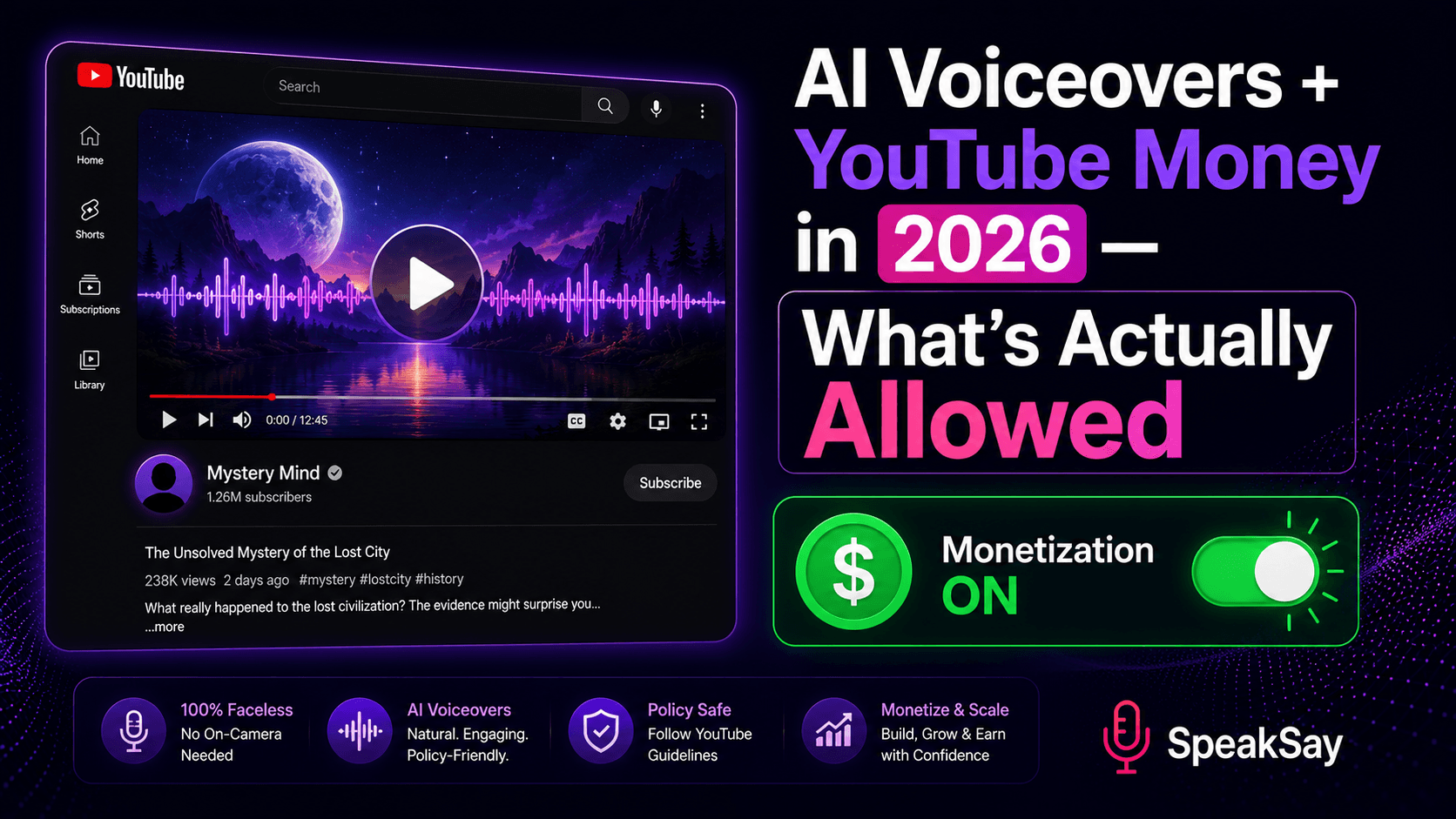
1) Is AI Voiceover Actually Allowed on YouTube?
Yes. YouTube's policies do not ban text-to-speech or AI-generated narration. You can publish faceless videos with an AI voice and join the YouTube Partner Program. The platform has never required your literal voice or face.
What YouTube does care about is whether the video is original, valuable, and transformative. An AI voice is just a production tool — the same way a microphone or an editing suite is. The narration method is not the thing being judged; the content is.
2) What Changed in 2025 (and Why Creators Panicked)
In mid-2025, YouTube clarified its Partner Program rules around "inauthentic" and "mass-produced" content. Headlines made it sound like AI narration was being targeted. It wasn't. The update sharpened enforcement against channels that:
- Upload templated, near-identical videos at scale with only swapped wording.
- Stitch together repurposed footage and slideshows with a generic narration on top.
- Add no meaningful commentary, analysis, or original structure.
Notice the common thread: none of those is "used an AI voice." A faceless documentary channel with original scripts, real research, and a consistent narrative voice sits comfortably inside the rules. A bot farm pumping out 30 reskinned videos a day does not.
3) The Real Demonetization Triggers
The actual risks for faceless channels in 2026 are:
| Trigger | Why it hurts you |
|---|---|
| Reused/duplicated content | Flagged as inauthentic; YPP rejection or limited ads. |
| Same narration over copied formats | Pattern detection treats it as spam at scale. |
| Personal-use-only AI voice license | Copyright/usage strike — separate from AI policy. |
| Copyrighted background music | Claims and strikes regardless of your voice. |
| Zero original input | "No real human input" is the exact language enforcement targets. |
Fix these and your AI-narrated channel is on solid ground. The single most overlooked one is the voice license — which deserves its own section.
4) The License Trap Nobody Talks About
Many free or consumer TTS tools grant a personal-use-only license. The moment you run ads on a video using that voice, you may be violating the provider's terms — a copyright problem that exists completely independently of YouTube's AI rules. You can do everything else right and still get hit.
Before you scale, confirm your TTS provider grants commercial and monetization rights for the voices you use. This is non-negotiable for a channel that wants ad revenue.
Use voices you're actually allowed to monetize
SpeakSay's AI voices come with commercial-use rights, so your faceless channel's revenue isn't built on a license you'll regret. Generate studio-quality voiceovers and keep the rights to your content.
See SpeakSay plans →5) A Monetization-Safe Faceless Workflow
- Original script first. Research, structure, and write something that didn't exist before. This is 80% of your protection.
- Commercial-licensed AI voice. Pick a consistent narrator from a provider that allows monetization. Generate your English voiceover here.
- Human-paced delivery. Add pauses and varied sentence length so it doesn't read like a robot (see our guide on making AI voice sound human).
- Licensed or original music. No random copyrighted tracks.
- Real editing & visuals. B-roll, charts, on-screen sources — evidence of human effort.
- Consistent upload cadence. Quality over volume; 2–3 strong uploads a week beats 30 reskins.
6) Why Voice Variety Protects You
Pattern-detection thrives on sameness. Channels that use the exact same robotic voice over copy-paste formats are easy to cluster and flag. Giving your channel a distinct, branded narrator — and varying voices across series or hooks — makes your catalog read as a real media operation, not a content farm.
Browse SpeakSay's voice library for a signature narrator, or use Voice Remix to craft a custom voice that becomes part of your brand identity.
7) Ad-Safe Checklist
- Scripts are original and researched (not reworded copies).
- AI voice has explicit commercial/monetization rights.
- Music and footage are licensed or original.
- Each video adds commentary, analysis, or unique structure.
- Narration is human-paced, not flat and robotic.
- Upload cadence prioritizes quality over volume.
Build a channel that gets paid
Start free, then upgrade when you're ready to scale. SpeakSay gives you monetization-safe voices, multiple languages, and the consistency a faceless brand needs.
Start with SpeakSay →8) Frequently Asked Questions
Will using an AI voice get my channel demonetized?No. AI voiceovers are allowed and monetizable. Demonetization comes from duplicated, low-effort, or templated content — not from the narration tool itself.
Is text-to-speech allowed on YouTube?Yes. YouTube's terms don't restrict TTS. The video just needs to be original and add real value.
Do I need a commercial license for the AI voice?If you monetize, yes. A personal-use-only voice can trigger a copyright/usage issue separate from YouTube's AI policy. Confirm your provider grants commercial rights.
How many videos can I safely upload?There's no magic number, but avoid mass-producing near-identical videos. Consistent, original uploads are safer than high-volume reskins.