Prepping for a Guest You Haven't Had Time to Read: Turn Their Book, Articles and Past Interviews Into a Briefing You Can Listen to on Your Commute (AI Podcast Method, 2026)
Good interviews depend on host prep, and prep takes time hosts don't have. This guide shows how to turn a guest's public work into a private audio briefing, what to put in it, how to check it for errors, and how to turn it into better questions.
1. Why prep audio works
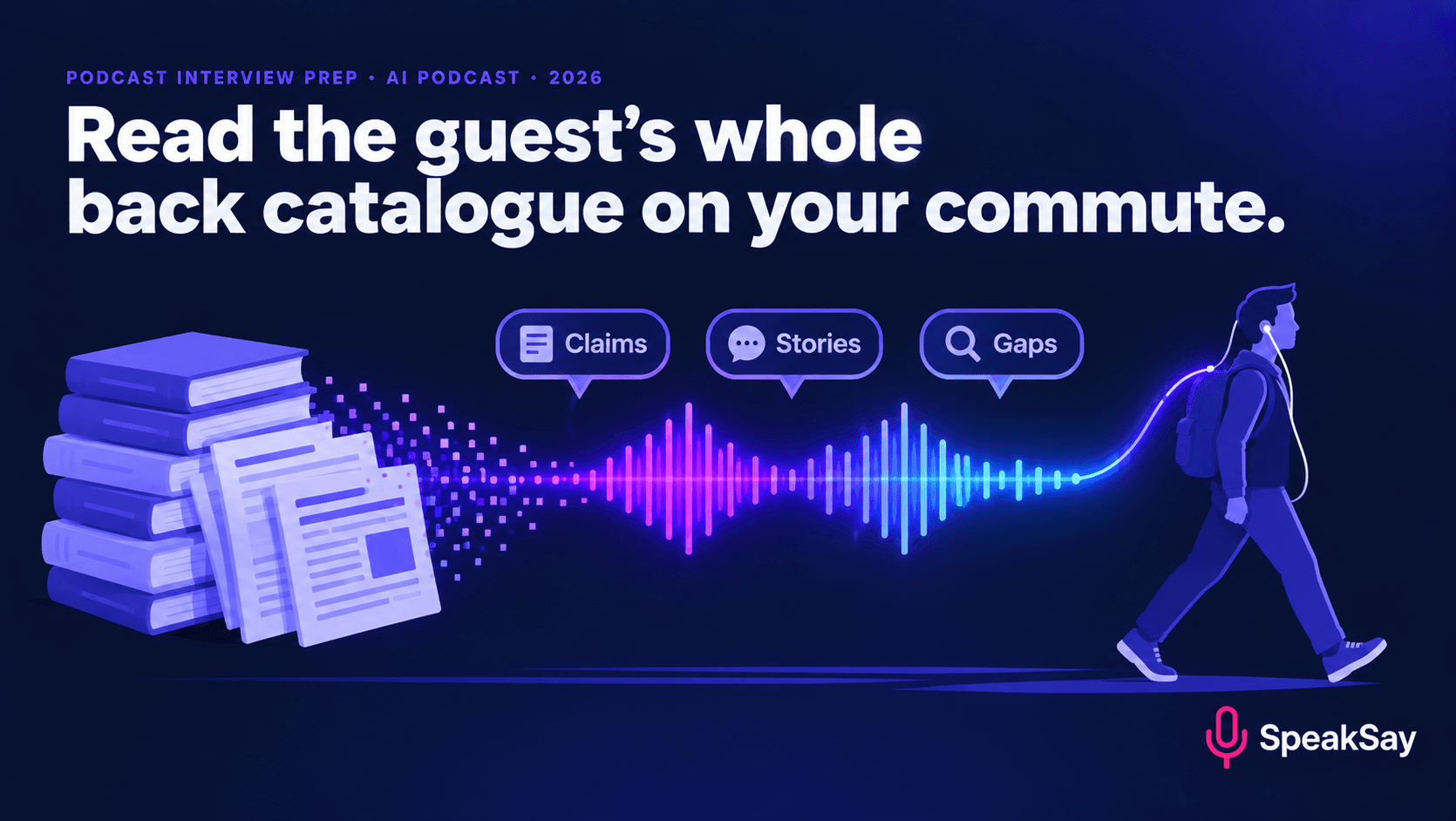
Most hosts do their prep in the gaps: in the car, on a run, while cooking. Audio fits those gaps and text doesn't. A ten-minute briefing you hear twice sticks better than a twenty-page document you plan to read tonight and don't.
It also helps with the most common interviewing mistake, which is asking questions the guest has answered fifty times. If you know the stories they always tell, you can ask about what comes after those stories.
2. Build the source pack
The briefing is only as good as what goes in. Collect:
- The guest's own work. A book you own (use a copy you are entitled to use, such as a purchased ebook), key articles, newsletter posts and their website's "about" page.
- Two or three past interviews. Transcripts are best. Choose interviews of different kinds: one long-form, one short, one from a hostile or sceptical host if you can find it.
- Criticism and responses. Reviews, replies, corrections. Not to attack the guest, but to know where the debate is.
- Anything recent. A launch, a new job, a news item. Your listeners will expect you to know.
Keep it to public material. Do not dig into a guest's private life, and do not upload anything you don't have the right to use. If a document is confidential, such as a media kit marked private, use it only as the guest intended.
3. What the briefing should contain
A good briefing is short and structured so you can listen for details. Ask for these sections, in this order:
| Section | What it covers | Why you want it |
|---|---|---|
| 1. Who they are | Two or three sentences: role, background, why they matter now. | Your introduction, and a sanity check. |
| 2. Five main claims | The core ideas, each in one sentence with the source. | The spine of the conversation. |
| 3. Stories they always tell | The anecdotes that show up in every interview. | So you can skip or twist them. |
| 4. Where they've changed their mind | Earlier positions versus later ones. | Often the best questions. |
| 5. Where critics disagree | The strongest objection to each main claim. | Respectful challenge. |
| 6. What hasn't been asked | Gaps: topics touched on but never explored. | Your original angle. |
| 7. Names, terms and dates | People, places and jargon to pronounce and understand. | So you don't stumble on air. |
Ask for every claim to be tied to a named source. A briefing without sources is a rumour.
4. Make the audio
- Put the source pack and the section list into your AI podcast tool. Ask for a single-host briefing rather than a chatty two-host show; you want information density, not banter.
- Set the length to 10 to 15 minutes. If the guest's work is huge, make two briefings: one on the book, one on the interviews.
- Pick a voice that is easy to hear in a car. Calm, clear, not too fast. You can speed it up later.
- Save the transcript. You will need it for the next step.
If you already use AI audio for your team, you may recognize the pattern from our guide to audio briefings for employee communications. The format is the same; the audience is you.
5. Check it before you trust it
This is the step that matters most. AI summaries can be wrong in small, convincing ways: a date off by a year, a claim attributed to the wrong person, a nuance flattened into its opposite. On air, a mistake like that is yours.
- Spot-check every number, date and quote against the original source.
- Verify every claim you plan to repeat. If the briefing says the guest "argues X", find the page.
- Treat missing sources as unverified. Delete or confirm them.
- Never say "according to my research" about something you didn't confirm.
The briefing tells you where to look. It is not the source.
Make your first briefing
Upload a guest's article or transcript and generate a short audio summary to hear what comes out. Check it against the source as described above.
6. Turn it into questions
After listening twice, open the transcript and write your questions in three groups:
- Opening (2 questions): easy to answer, shows you did the work. "In your book you describe X; what did people get wrong about it?"
- Core (4 to 6 questions): drawn from "where they've changed their mind" and "where critics disagree". "You said in 2019 that X. What changed?"
- Fresh (2 questions): from "what hasn't been asked". These are the ones listeners will quote.
Print them on one page and keep it nearby. You don't need to ask them all. The point is to have somewhere good to go when the conversation stalls. For the opening of the episode itself, see our guide to the first minute of a podcast.
7. Limits and good manners
- Don't use the briefing as the script. Listeners can tell when a host is reading research back at the guest.
- Stay with public material. A guest's willingness to be interviewed isn't permission for you to investigate their private life.
- Be open if asked. You are not required to announce that you used AI to prepare, but if a guest asks, answer honestly.
- Keep the briefing private. It contains summaries of other people's work. Don't publish it.
Turn prep into a repeatable habit
If you interview someone every week, a plan that covers regular AI podcast generation pays for itself in hours saved. Compare options.
8. FAQ
How do I research a podcast guest quickly?Collect their own work, two or three past interviews and any recent news, then turn that pack into a short audio briefing with a section for main claims, repeated stories and gaps. Verify anything you plan to repeat on air.
Is it okay to use AI to prepare for an interview?Yes, as a preparation aid, as long as you check facts against the original sources and don't present unverified claims as your own research.
Can I upload a guest's book?Only if you have the right to use that copy, such as an ebook you bought. Don't upload pirated or confidential material.
How long should a prep briefing be?Ten to fifteen minutes is enough for most guests. For a guest with a large body of work, make two shorter briefings instead of one long one.
Should I tell my guest I used AI to prepare?You don't have to, but answer honestly if asked. The AI helps you read; the questions and the conversation are still yours.