You Recorded the Whole Script With a Cold: Publishing in Your Own Voice When Your Voice Is Gone (2026 Voice Remix Guide)
The entire voiceover internet answers "I have a cold and I publish Thursday" with "reschedule." That is not advice, it is a shrug. A cold breaks your timbre and usually leaves your performance completely intact — which means the take you just recorded is more salvageable than it sounds.
1. A cold breaks two different things, and only one of them matters
Play back a take you recorded while ill and the instinct is to file it under one heading: bad. It is not one thing. It is two, and they have completely different prognoses.
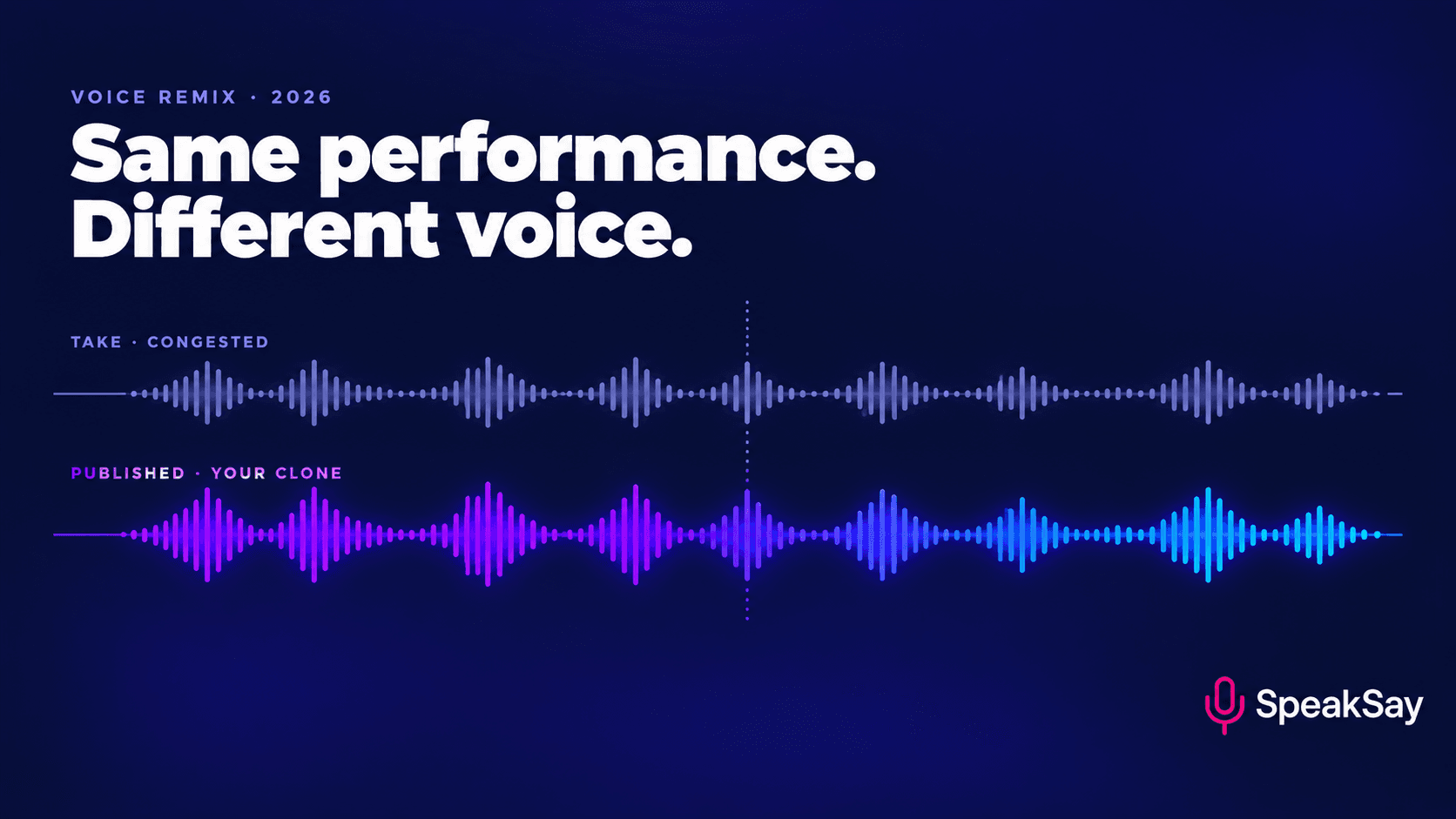
The first is timbre — the physical colour of the sound. Congestion closes off the nasal cavity that does a surprising amount of your resonance, so the voice goes flat and boxy. Inflammation thickens the vocal folds, so pitch drops and edges fray into hoarseness. Everything sits back in the throat. This is the part that makes you sound like a different person, and it is the part listeners consciously notice.
The second is performance — timing, emphasis, where you lean in, where you let a beat sit, the small rises that tell a listener a sentence is not finished yet. This is the part that took you two years to get good at. And here is the thing almost nobody checks: a head cold frequently leaves it completely intact. You still know where the joke lands. You still hit the contrast on "but." Your phrasing is your phrasing whether or not your sinuses are open.
Which means the take you just dismissed may contain the expensive half of the job, done correctly, wrapped in the cheap half, done badly. The published advice to reschedule treats those as one object. They are not. Separate them and the question changes from "can I rescue this recording" to "can I keep this performance and put a different voice on it" — and that question has a yes.
2. What is physically happening to your voice
Worth knowing precisely, because it tells you which artefacts are recoverable and which are baked in. Voiceover coaching is blunt about the mechanics: congestion makes a voice sound nasal and blocked, throat inflammation produces hoarseness, and coughing and sneezing add noise that has nothing to do with your read — while fatigue quietly drains the energy that holds a long session together.
| What is happening | What it does to the audio | Recoverable? |
|---|---|---|
| Nasal congestion | Loss of upper resonance; boxy, "held-nose" quality; consonants muddy | Yes — pure timbre |
| Vocal fold swelling | Lower pitch, roughness, breaks on sustained notes | Mostly — timbre, unless it forces you to re-phrase |
| Dry or sore throat | Clicks, dry mouth noise, more swallowing between lines | Yes — editable, or replaced with the timbre |
| Reduced breath support | Running out mid-clause; breaking sentences in the wrong place | No — this is performance damage |
| Fatigue | Flat energy, dropped emphasis, monotone drift over a long take | No — this is performance damage |
| Coughing and sneezing | Isolated noise events | Yes — cut them, re-record the affected line only |
The pattern is clean. Everything in the "yes" column is about the sound of your instrument. Everything in the "no" column is about the shape of your read. If your cold has only cost you resonance, roughness and some mouth noise, you have a take. If it has cost you breath control and energy, you have a bad take, and no amount of processing invents a performance that is not on the tape.
3. The five-minute triage: is this take salvageable?
Do this before you decide anything. Pull a 60-second stretch from the middle of the take — not the start, where you were still warming up, and not the end, where you were tired even when healthy.
- Listen for phrasing, not for sound. This is hard and worth the effort. Ignore how you sound. Ask only: are the breaks in the right places? Is the emphasis where I would put it on a good day? Would I be happy with this read if it were coming out of a voice I liked?
- Count mid-clause breaths. Mark every place you took a breath somewhere a breath does not belong — in the middle of a phrase rather than between phrases. More than about two per minute means your breath support is gone and the read is structurally compromised.
- Check the last third against the first third. If the energy has visibly collapsed, fatigue was driving by then. A remix will faithfully reproduce a tired performance in a healthy voice, which is not what you want.
- Find the unintelligible words. Congestion smears consonant clusters. List every word you cannot make out with your eyes closed. Under five in a minute is a re-record-those-lines problem. Twenty is a different problem.
- Score it. Phrasing good, breath intact, energy consistent, few smears → salvageable, go to section 4. Any two of those failing → re-record when you are better, or write a shorter script and record that instead.
Note what this triage does not ask about: whether you sound ill. That is the one thing you are not deciding on, because it is the one thing that can be replaced.
Your performance is the part worth keeping
Voice Remix takes the take you already recorded and carries its timing, emphasis and phrasing into a different voice — including a clone of your own healthy voice. Same read, without the cold.
4. How keeping the performance and replacing the voice actually works
The mechanism is worth understanding, because it explains the limits better than any list of caveats.
Text-to-speech starts from a script: you hand over words and the model invents a delivery. Voice-to-voice conversion — what SpeakSay calls Voice Remix — starts from audio: you hand over a performance and the model keeps the delivery while substituting the voice. Your timing survives. Your emphasis survives. Your pauses, your acceleration into a punchline, the little drop you do before a reveal — all of that is in the input and comes out the other side. What changes is whose throat it appears to be coming from.
For the specific problem of being ill, that has an obvious and slightly uncanny application: the target voice can be you. If you have a cloned version of your own voice made while healthy, a sick take goes in and your normal channel voice comes out, doing exactly the read you just gave. Not an approximation of your voice. The one your audience already knows, because it was built from recordings of it.
Three practical notes on doing this well:
- Clean the input first, lightly. Cut coughs, throat clears and the worst swallows before converting. Conversion models are not confused by noise so much as they are influenced by it — a cough can produce a strange artefact in the output. A light noise gate and manual cuts are enough. Do not compress or EQ heavily; you are not trying to fix the timbre, you are handing it over to be replaced.
- Re-record the unintelligible words, not the paragraph. Congestion smears specific consonant clusters. If "strict" came out as "stric" the model has nothing to work with. Punch in on those words only, even if they sound equally bad — what matters is that the phonemes are present and distinguishable.
- Check the output for the wrong kind of faithfulness. The model is not diagnosing you, so if a line is sluggish because you were sluggish, the output will be sluggish in a healthy voice, which reads as an oddly flat delivery. Spot-check the lines you remember struggling with.
The one thing this does not do is let you skip having a clone. Converting to a generic stock voice solves the "sounds ill" problem and creates a worse one — your channel now has two narrators, and your audience will notice the stranger far more sharply than they would have noticed a cold. See section 7.
5. How to record deliberately while sick, so the take survives
If you already know you are going to convert the take, you can record differently — and a take recorded for conversion is substantially more usable than one recorded despite a cold.
- Prioritise phrasing over sound. Stop flinching at your own voice. You are recording a performance, not a master. Give the read full commitment even though it sounds terrible in your headphones; the commitment is the part being kept.
- Record in short blocks. Four to six sentences, then stop. Fatigue is the one thing conversion cannot repair, and short blocks keep energy up. Yes, this is slower than a healthy session. It is still faster than a three-day wait.
- Breathe where the writing breathes. Because your breath support is reduced, plan the breath points on the page before you start. A breath between phrases is invisible. A breath mid-clause is a structural flaw.
- Get closer, not louder. Pushing volume through an inflamed throat makes the roughness worse and costs you the back half of the session. Move in on the mic and perform quietly.
- Keep the mic and room identical to your normal setup. Conversion output is influenced by input conditions. Changing rooms because you are recording from the sofa adds a variable you do not need.
- Do the worst-sounding section first. Your voice deteriorates across a sick session. Front-load the material you most need to be intelligible.
One more, less obvious: note the timestamps where you struggled. Thirty seconds of notes during the session saves twenty minutes of hunting in the output.
6. Where this does not work, stated plainly
Four situations where the honest answer is that you should not be trying this.
| Situation | Why remix does not save it | Do this instead |
|---|---|---|
| Laryngitis or near-total voice loss | There is no usable performance on the tape — whisper and croak carry almost no prosodic information | Text-to-speech from the script with your clone, and direct it manually |
| Chest infection, heavy coughing | Coughs land inside phrases, not between them; the read is fragmented | Reschedule, or publish a shorter script |
| Genuine fatigue | Flat energy is performance data and is reproduced faithfully | Rest, then record; fatigue is the one symptom that ruins the salvageable half |
| Client work with delivery terms | Contract, not craft — some contracts specify an unprocessed human recording | Ask. Most clients would rather be told than receive odd audio |
And the one that has nothing to do with audio: if you are ill enough that recording is making you feel worse, the video is not worth it. A publish streak is a habit, not an obligation. Every creator who has run one for years has skipped weeks.
There is also a disclosure question, and it is smaller than it feels. Using your own cloned voice to carry your own performance is not passing off someone else as you. But if your channel has made a point of being unprocessed, or you are in a market with labelling rules that reach this kind of production, say so in a line. Audiences are markedly more forgiving of "I had a cold, so this is my voice clone doing my read" than of being quietly puzzled.
One voice, whatever kind of week you are having
Browse the voice library to hear what a consistent narrator sounds like across long-form, Shorts and audiobook-length material — then decide whether yours should be a cast voice or your own.
7. The bigger problem: your channel voice versus your Tuesday voice
Zoom out and the cold is a symptom of something structural. A human voice is not a constant. It changes with sleep, hydration, allergy season, how much you talked that day, the room, the mic, and age. Over a long catalogue that variance is real and audible, and listeners read it — not consciously — as production quality. Consistency is one of the few things audiences reliably register without being able to name it.
Which is why "I had a cold" and "I recorded that one in a hotel" and "that was the week I lost my voice at a conference" are all the same problem wearing different clothes. They are all variance in the input. And the useful thing about having a clone of your own voice is not that it lets you skip recording — plenty of creators still perform every line themselves — it is that it gives you a fixed reference version of your own timbre that today's throat cannot move.
That reframes the whole decision. A voice clone is not primarily a labour-saving device for people who do not want to talk. It is a consistency instrument for people who do.
- Weekly publishers get a schedule that survives illness, travel and a bad allergy month.
- Multi-year channels get a catalogue that does not audibly drift with the narrator's life.
- Anyone doing long-form gets an eight-hour audiobook that sounds like one session, because a cloned timbre does not tire across chapters.
If you are weighing whether a clone of your own voice or a cast stock voice is the right foundation for your channel, that is a genuinely separate decision with its own trade-offs — but for the specific purpose discussed here, only a clone of your voice works. A stock voice solves the cold and introduces a stranger.
Clone your voice while it is healthy
The safety net only exists if you build it before you need it. A few minutes of clean recording today gives you a fixed version of your own voice to fall back on all winter.
8. Build the safety net before cold season, not during it
The catch in everything above is that it assumes you already have a clone of your healthy voice. Cloning while congested produces a congested clone, permanently, which is a genuinely annoying mistake to make. So this is a thirty-minute job to do on a good day.
- Pick a day when you sound normal. Not your best-ever voice — your normal voice. A clone built from an unusually resonant Sunday will not match your Wednesdays.
- Record your standard setup. Same mic, same room, same distance, same treatment you always use. The clone should match your published sound, not a studio ideal you never actually achieve.
- Read material that covers your range. Not one flat paragraph. Include a fast section, a slow section, a question-heavy section, one where you are enthusiastic and one where you are serious. Include the names and jargon your channel says constantly.
- Verify by A/B, not by vibes. Convert a 30-second stretch of an old published video into the clone and compare. If a regular viewer could not tell which is which, you are done.
- Archive the source recording. Keep the raw training audio somewhere permanent with the date in the filename. If you ever need to rebuild the clone, you want to rebuild it from the same voice rather than from whatever you sound like in three years.
- Write yourself a one-page runbook. Three lines: where the clone lives, the conversion settings you use, the checklist from section 3. You will be reading this while ill, which is not the time to be making decisions.
Then forget about it until the Tuesday you wake up and cannot hear yourself properly — at which point the difference between a lost week and a normal publish day is a file you made in half an hour on a day you felt fine.
9. FAQ
Can I just record a voiceover with a cold and publish it as-is?Sometimes, and it depends on the content. Congestion is more forgivable in a casual vlog or a chatty podcast than in a tutorial, a brand video or an audiobook, where the timbre change reads as a production failure. If the material is instructional or paid, do not ship it congested — either convert the take or reschedule.
Will a voice conversion make me sound healthy if I sound terrible?It replaces the timbre, so yes for congestion, hoarseness and roughness. It does not replace the performance, so no for low energy, broken breath support and fragmented phrasing — those come through faithfully in the new voice, which is the main reason a conversion can sound "off" even when the voice itself is clean.
Do I need a clone of my own voice, or can I use a stock voice?For this purpose, your own clone. Converting to a stock voice fixes the cold and swaps your narrator for a stranger mid-catalogue — a change your audience notices far more than illness. A stock voice is a reasonable channel foundation if you have used it from the start; it is a poor emergency substitute for a recognisable human host.
Should I tell my audience the episode used a voice clone?A line in the description costs nothing and generally lands well, especially if your channel is built on your presence. If you operate where AI-audio labelling rules apply to your content, check whether your production falls in scope. Using your own clone to carry your own performance is a mild case, but disclosure is cheap and misplaced confusion is not.
What if I get sick before I have made a clone?Then the options are worse but not empty: re-record a shorter script in blocks, publish text-first with a short audio note, run an episode from existing material, or skip the week. Then make the clone the moment you are better — the whole point is that this is a problem you only have once.
Is cloning my voice while slightly congested a problem?Yes, more than people expect. The clone captures whatever it is given, so a mildly blocked training set produces a permanently slightly-blocked voice that you will then be matching against forever. Wait for a normal day.