Your Co-Writer Sang the Demo and AI Turned It Into the Artist's Register: Who Gets Credited? Split Sheets and AI Credits for Songwriters (2026)
AI credit fields arrived in music metadata in 2026, and most songwriters' split sheets still have no line for a converted demo vocal. Here is what to write down before you pitch: who performed, which tool changed it, what the split sheet should say and what it should not claim. Not legal advice.
1. The gap between the split sheet and the metadata
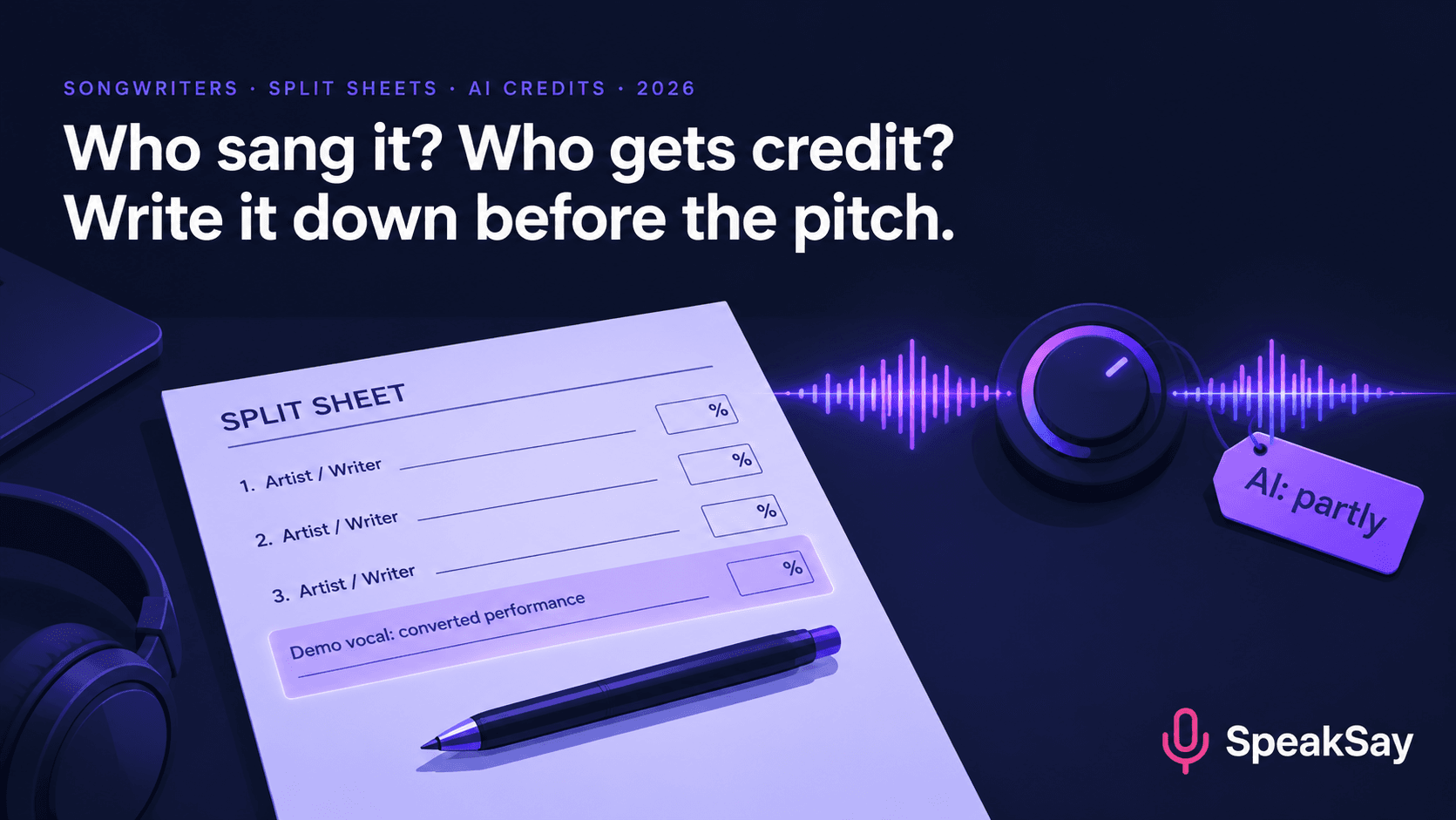
A split sheet is the document songwriters sign to record who wrote what share of the song. It's about the composition. A demo vocal belongs to the recording, which is a separate asset. For decades that distinction didn't matter much, because a demo was a rough recording by a session singer and nobody tracked it.
Two things changed. First, a writer can now sing a guide vocal and convert it into a different voice in the register an artist needs, a workflow we covered in our songwriter demo guide. Second, platforms and distributors began asking whether AI was involved in a record. Spotify announced support for the DDEX AI disclosure standard in September 2025 and, according to Sound Credit's announcement, began a disclosure beta in April 2026. Article 50 of the EU AI Act, which covers transparency for AI-generated content, began to apply on August 2, 2026; see our plain-English guide to Article 50.
If you pitch a demo today and the song is cut next year, someone will ask what is on the demo. The best time to have an answer is before anyone asks.
2. What AI Credits and DDEX flags actually record
According to Sound Credit's announcement:
- Any standard credit role (vocals, guitar, drums, lyrics, production, mixing) can be marked as an AI contribution.
- Each AI contribution is tied to a tool type from a catalogue covering full-song generation, voice and vocal generation, and text and lyric assistance. Writers can add a tool that isn't listed.
- The recording gets an All, Partly or None status derived from the participant list, matching the DDEX ContainsAI values.
- The feature targets tools that generated part of the record, not routine processing such as noise reduction or pitch correction.
- Contributors who are entirely AI are left out of the splits workflow and of union form exports.
The last point matters. Credits and splits are separate systems. A tool can be listed in the credits without receiving a share, and a person gets a share without being a credit. Keep the two documents straight.
3. Where a converted demo vocal sits
A demo whose vocal was sung by a person and then converted to a different voice is a grey area. A person performed it, so it's not a fully generated vocal. A tool changed how it sounds, so it isn't a plain human recording either. We aren't aware of an official category for "human performance, voice converted", and the right label may depend on the platform. Until that's settled, the safest course is to describe what happened in plain words and let whoever reads it decide.
That means three facts, recorded where the whole writing team can see them:
- Who sang the guide vocal.
- Which tool converted it, and into what kind of voice (for example, an original synthetic voice, not a real person's).
- That the converted vocal is a demo, and whether anyone intends it for release.
4. A one-page addition to your split sheet
Add this section below the writer shares. Adapt it for your situation; it isn't a legal template.
| Field | Example entry |
|---|---|
| Guide vocal performed by | [Writer name] |
| Demo voice created with | Voice conversion tool: [name and version]. Output is an original synthetic voice, not an imitation of a real person. |
| AI contribution | Voice conversion of a human performance. No AI-generated melody, lyric or arrangement. |
| Intended use | Pitch demo only, labelled "AI-converted demo vocal". Not for commercial release. |
| If the song is cut | Demo vocal to be replaced by the artist's recording. Demo audio is not licensed for release. |
| Who may pitch the demo | [Names of writers and any publisher] |
| Date and signatures |
Two lines in this table do the real work: the AI contribution line, because it says what the tool did and what it didn't do, and the "if the song is cut" line, because it settles in advance what happens to the demo.
5. Composition, recording and demo: three different things
- The composition (melody and lyrics) is what the writer shares cover. A demo vocal, human or converted, does not create a composition share.
- The demo recording is a recording. Who owns it depends on who made it and on what the writers agreed. State it in the sheet.
- The final released recording is the artist's and the label's business and has its own credits.
If a co-writer made the guide vocal and another made the conversion, say so, and say whether either expects anything for it beyond their writer share. A line of agreement now prevents the argument when the song is cut. This is general information, not legal advice; for anything with money attached, ask a music attorney or your PRO.
6. A workflow that keeps the paperwork clean
- Record the guide vocal cleanly. A clean take converts better. Remove room noise with the free noise remover and even out the level with the audio normalizer.
- Convert it. Use SpeakSay Voice Remix to turn the guide into an original demo voice in the range you need.
- Fill in the page. Complete the table in section 4 on the same day. Memory fades quickly.
- Label the file. "SongTitle_DEMO_AI-converted-vocal.wav". Put the same words in the pitch email.
- Keep a copy of the guide vocal. It proves a person performed it and lets you remake the demo if a tool changes.
- Check the rules before release. If the song becomes a record, platform and distributor rules about AI disclosure will apply. Our post on Spotify's AI badge and disclosure explains what those rules look like today.
One guide vocal, a clean paper trail
Clean your guide take with the free tools, then convert it into an original demo voice with SpeakSay Voice Remix.
7. FAQ
What is a split sheet?A document signed by co-writers that records each person's percentage share of a song's composition. It's usually signed at or soon after the writing session.
What are Sound Credit's AI Credits?A feature announced on August 11, 2026 that lets music makers mark which credited roles involved AI and which tool was used, shown separately from the human credits.
What is the DDEX ContainsAI flag?A field in the DDEX metadata standard used to tell platforms whether AI is part of a recording. Sound Credit derives an All, Partly or None status that uses the same values.
Do I have to disclose a converted demo vocal?There is no single rule for demos. Disclosure rules apply mainly to released recordings and differ by platform and region. For pitches, labelling the file honestly costs you nothing and avoids surprises.
Does the person who sang the guide vocal get a writing share?Not automatically. A performance is not authorship of the song. Whether that person is also a writer depends on what they contributed to the melody and lyrics, not who sang.
Should the demo voice imitate a real artist?We recommend against it. Several laws, including Tennessee's ELVIS Act, address voice simulation, and a demo that sounds like someone else can cause problems. An original voice in the right range is safer.