Songwriters Are Pitching With AI Sound-Alikes of the Artist. Here's a Demo That Gets the Song Heard Without Borrowing Anyone's Voice (2026)
Some songwriters now put an AI copy of the target artist's voice on their pitch demos. It's quick and cheap, but it's legally exposed under laws like Tennessee's ELVIS Act and it pitches the wrong thing. Here's how to make a demo in the right register and gender with your own sung guide vocal and Voice Remix, and when a human demo singer is still the better call.
1. What songwriters are doing, and why
Pitching a song means convincing an artist, producer or A&R person that it's right for a particular singer. A demo with the wrong voice makes that harder. They have to imagine past the vocal to hear the song.
For years, writers solved this by hiring demo singers who could sound like the artist, at roughly $200–500 a cut, according to producer Bobby Owsinski writing on Music 3.0 in 2023, summarising Billboard's reporting. Then voice-conversion tools arrived. A demo singer's vocal, or the writer's own, could be mapped onto an AI model of the artist's voice, so the artist literally heard themselves singing the song. In 2024, country artist and writer Niko Moon confirmed publicly that AI use was widespread among Nashville songwriters.
The argument in favour is simple: the sound-alike demo is never released, so who's harmed? The rest of this guide explains why that argument is weaker than it looks, and what to do instead.
2. Why the sound-alike demo is a bad bet
- The law has moved. Tennessee's ELVIS Act, in force since July 1, 2024, adds voice to the state's right of publicity and covers AI simulations of a voice, with civil claims and criminal penalties for unauthorised use. Whether a privately sent pitch demo counts is untested, which is exactly the problem: you don't want your song to be the test case. Elsewhere, the Tokyo District Court's September 2026 ruling in a voice actor's case treated a voice's commercial appeal like a face's. Our Tokyo voice-rights explainer covers what it means for creators. This isn't legal advice. If you're unsure, ask a music lawyer.
- Demos don't stay private. They get forwarded between managers, producers and assistants, and they leak. A file with an artist's cloned voice on it, circulating without their permission, is a problem for everyone whose name is attached to it.
- The artist's team may not like it. Some artists will find it useful. Others will find hearing their cloned voice on a stranger's demo uncomfortable or offensive. You don't know which until you've already sent it.
- It pitches the voice, not the song. An artist hearing their own voice may react to the novelty of the impersonation. You want them reacting to the melody, the lyric and the hook.
- It ties the demo to one artist. If they pass, the sound-alike demo can't be pitched to anyone else without redoing the vocal.
3. What a pitch demo actually needs
Strip the sound-alike away and ask what problem it was solving. Usually it's one of these:
| The real need | Does it require the artist's voice? | What solves it |
|---|---|---|
| The song in the artist's key | No | Transpose the track and sing in that key |
| The right register and gender (e.g. a male writer pitching to a female artist) | No | An original demo voice in that register |
| The right genre feel (country twang, R&B runs, pop breathiness) | No | Phrasing and production choices, plus a suitable demo voice |
| A polished, confident vocal | No | A good guide performance, conversion and a clean mix |
| "Hear yourself on it" | Yes | That's the one thing you shouldn't fake |
Four out of five needs can be met with an original voice. The fifth is the one carrying the legal and reputational risk.
4. The workflow: sing it, then remix it
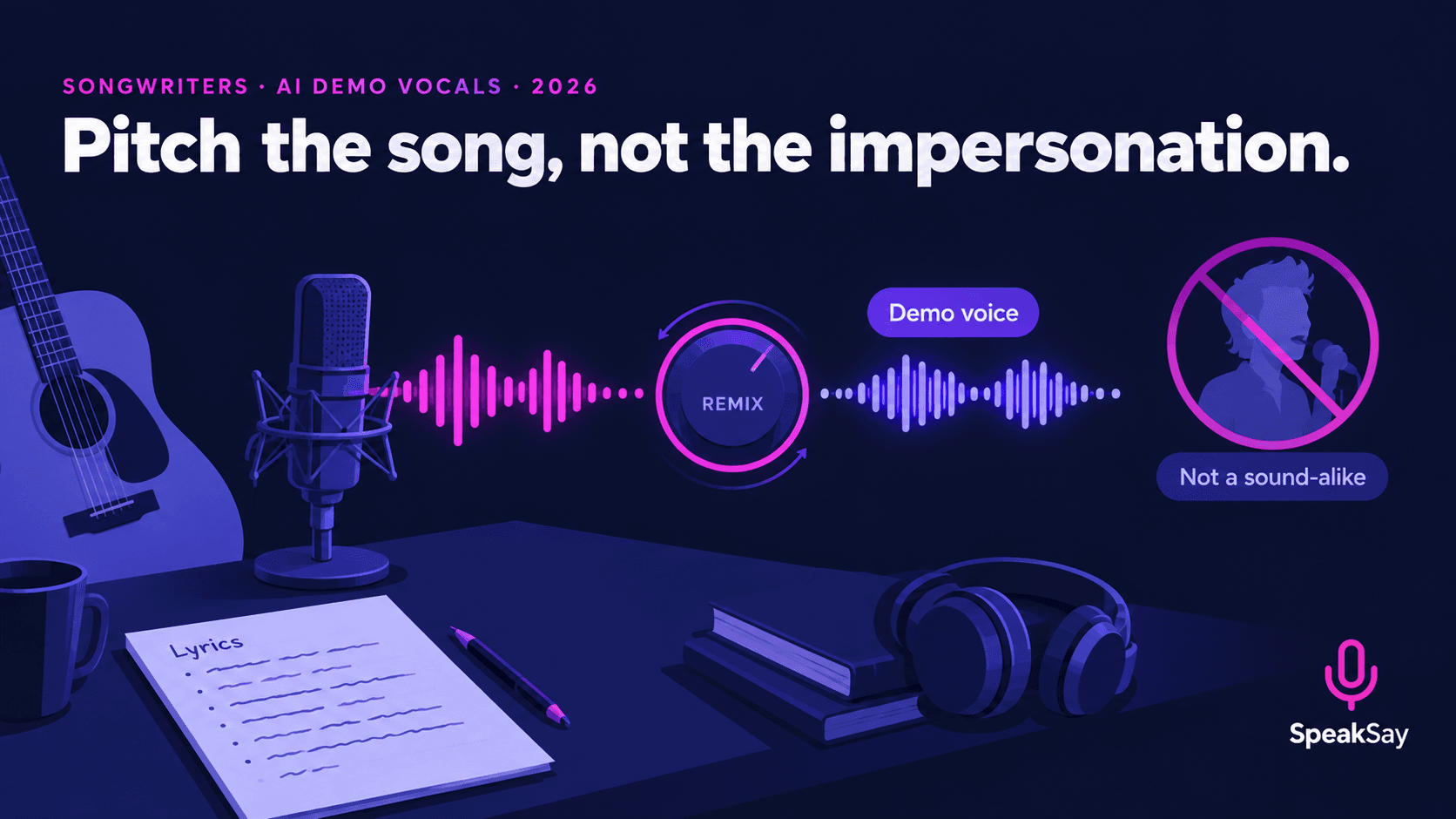
Voice Remix changes the voice in a recording while keeping your timing, pitch and phrasing. That means you sing the song the way it should go, and the conversion supplies a voice in the right range and character.
- Find the target artist's comfortable key from their recent songs and transpose your track to it.
- Sing the guide vocal in that key, as well as you can, in tune and with the phrasing you want. If the key is outside your range, sing it an octave down or up and correct the octave before converting, or ask a friend whose range fits to sing the guide.
- Record it dry: no reverb, no doubling, minimal compression, in a quiet room. If you're working from an old demo with music on it, separate the vocal first with SpeakSay's free vocal remover.
- Pick an original demo voice in the register and character you need, from SpeakSay's voice library. Choose a voice, not an artist.
- Convert one chorus first in Voice Remix and listen closely: high notes, long held vowels, fast runs. Adjust and convert again before doing the whole song.
- Convert the full vocal, then mix it into the track like any other vocal: EQ, compression, reverb and harmonies.
- Keep the stems: your original guide, the converted vocal and the music. If the artist wants to hear a different key or a different voice, you can redo it in minutes.
One demo can now go to several artists. Change the key and the demo voice for each pitch, keep the same song.
Try it on one chorus
Separate your vocal with the free vocal remover, then convert a chorus into an original demo voice with SpeakSay Voice Remix and hear the difference before committing the whole song.
5. Craft notes for better conversions
- Conversion keeps your performance. If you're flat, the demo is flat. If you rush the second verse, the demo rushes. Fix pitch and timing in the guide, not after.
- Range matters. A male guide converted to a female voice works best when the guide is sung in the target key, not an octave below and shifted. Test both ways on a chorus.
- Belted high notes and long sustained vowels are where conversions most often wobble. Listen to those moments first.
- Consonants carry the lyric. Sing clearly. A mumbled guide becomes a mumbled demo, and the lyric is half the pitch.
- Harmonies: convert backing vocals into a different demo voice from the lead, so the stack sounds like more than one person.
- Know the limits of speech clones. A voice cloned from speech usually can't sing well; see why your voice clone can't sing. Conversion of a sung performance is a different process, which is why this workflow starts with singing.
- For the gender-swap side specifically, our male-to-female voice guide explains why simple pitch-shifting sounds wrong and conversion doesn't.
6. When to hire a human demo singer instead
AI conversion isn't always the right tool. Hire a session singer when:
- The song depends on a vocal performance you can't deliver yourself, such as big runs, a gospel climax or a delicate falsetto.
- It's a high-stakes pitch to a major artist and the budget allows it.
- You want a collaborator's interpretation, not just your own phrasing in a different voice.
- The demo might become the released recording, or a reference for one, and you want a human performance with clear credit.
Plenty of writers will use both: conversion for quick versions and first-round pitches, a human singer for the cut that matters most.
7. Ground rules for AI demo vocals
- No artist sound-alikes, no "in the style of" a named singer's voice, no cloned voices of people who haven't agreed.
- Label it. Put "Demo vocal (AI-converted)" in the file name or the pitch email. Nobody should think it's a session singer's performance or a real artist.
- Use a voice you have the rights to use for demos, such as a library voice or your own clone.
- Keep your guide vocal and session files. They show the performance and the song are yours. Our voice provenance guide explains how to keep a clean record.
- Don't upload demos to public platforms without thinking about how they'll be labelled and claimed. If you do make covers or releases, see our AI song covers guide for how to avoid strikes.
- If an artist asks to hear themselves, that's their call to make with their own voice, through their own team. Let them do it.
One song, a demo voice for every pitch
SpeakSay Voice Remix turns your sung guide into an original demo voice in the register you need, so the same song can go to every artist on your list.
8. FAQ
Can I use AI to make my demo sound like the artist I'm pitching to?Some songwriters do, but it's risky. Laws such as Tennessee's ELVIS Act protect artists' voices against AI simulation, demos leak and the artist's team may object. An original demo voice in the artist's key and register gets most of the benefit without the risk. This isn't legal advice.
How much does a demo singer cost?Soundalike demo singers have typically charged around $200–500 per song, according to industry reporting. Rates vary by city, singer and session length.
How do I make a female vocal demo if I'm a male songwriter?Transpose the song to the target artist's key, sing the guide vocal as cleanly as you can, then convert it to an original female demo voice with Voice Remix. Test a chorus first and listen closely to high notes.
Will AI-converted vocals sound as good as a real singer?Conversion keeps your timing, pitch and phrasing, so the result is only as good as your guide performance. For demanding vocals or the most important pitches, a human session singer may still be the better choice.
What is the ELVIS Act?A Tennessee law in force since July 1, 2024 that adds voice to the state's right of publicity and covers AI simulations of a person's voice, with civil and criminal remedies for unauthorised use.
Should I tell the artist the demo vocal is AI?Yes. Label it as an AI-converted demo vocal in the file name or pitch email. It's honest, and it keeps attention on the song.