A Tokyo Court Says a Voice Can Be Protected Like a Face: If Your AI Narrator Sounds Like a Famous Voice Actor, Change It Before You Monetize (2026)
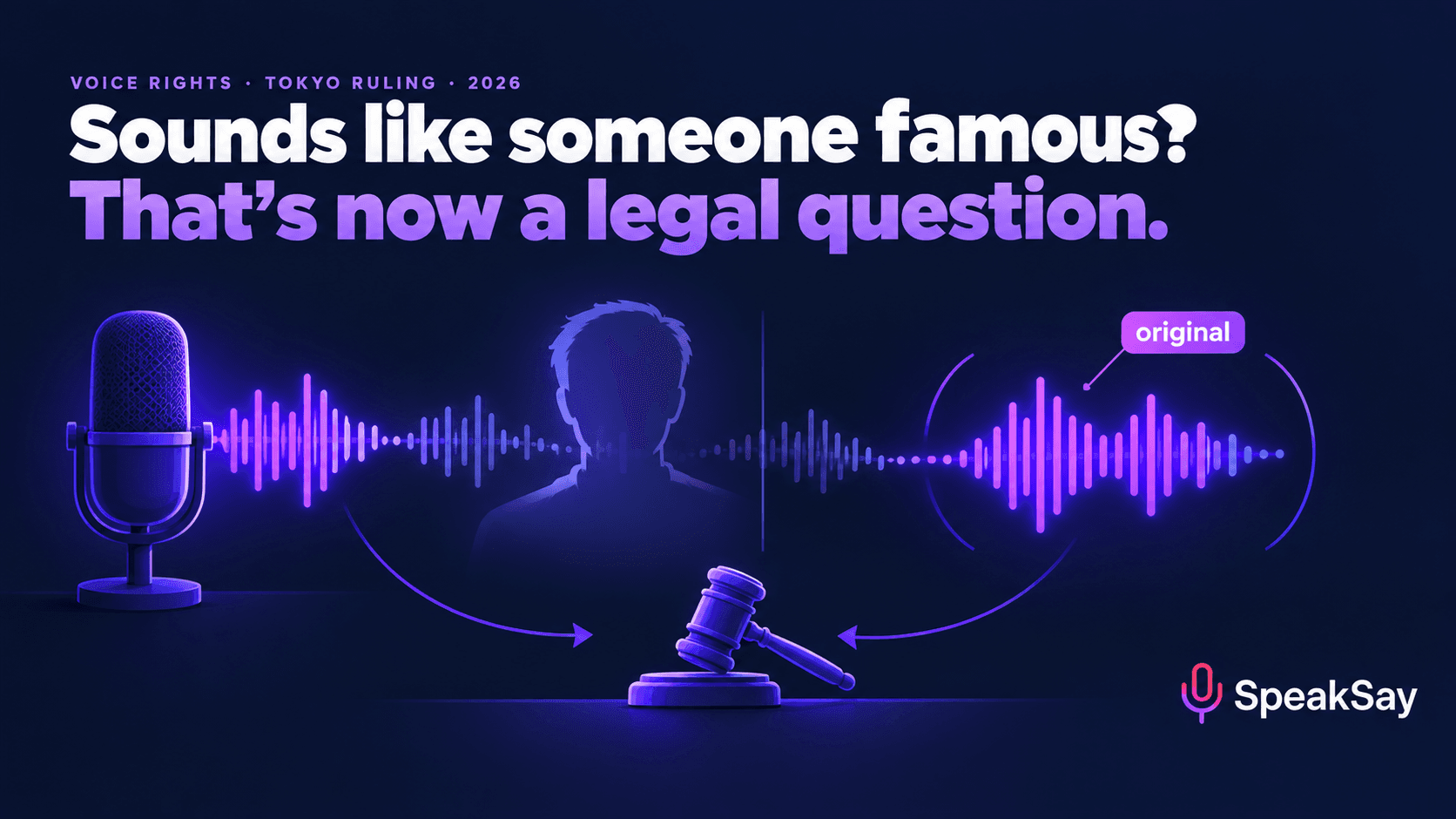
On September 30, 2026, a Tokyo court recognised that a voice can be protected by publicity rights when it's used for its commercial appeal. The case involved a monetized narration account in a very common faceless niche. Here's what was decided, why "it's a generic voice" isn't a plan, and a six-check audit to make sure your narrator is yours.
1. What the Tokyo court decided
Kenjiro Tsuda is a well-known Japanese voice actor. His roles include Kento Nanami in Jujutsu Kaisen, and he has worked in the Yu-Gi-Oh! franchise. He sued TikTok in the Tokyo District Court over videos he said used an AI imitation of his voice. Reporting by AFP, the Guardian, The Next Web and others gives these facts:
- The account posted 188 videos between July 2024 and September 2025, mixing images with AI narration about urban legends, the occult and conspiracy theories.
- Its profile picture resembled a character Tsuda voices. At one point it had more than 200,000 followers.
- Tsuda's side argued the account earned more than ¥500,000 a month and gained traction only because the narration sounded like him.
- TikTok argued the videos used a "generic male voice" and that any similarity was subjective.
- Presiding judge Aya Takahashi held that unauthorised use of a performer's voice can infringe publicity rights when the voice is used for its commercial appeal. She compared a voice to a portrait as a symbol of personality.
- The court declined to order removal, because the anonymous uploader had already deleted the videos. Tsuda's lawyer said the ruling "ended up making both sides look victorious."
So the court didn't hand down a big penalty, and it didn't declare every similar-sounding voice illegal. What it did was establish, for the first time in Japan, that a voice can be a protected part of someone's identity. Voice actors there have campaigned on this for two years under the banner "No More." This ruling gives them a legal footing.
This article explains a court decision and creator practice. It isn't legal advice. If you have a specific concern, talk to a lawyer in your country.
2. Why faceless narrators should care
Look at the facts again from a creator's point of view. It wasn't a deepfake of a politician or a scam call. It was a faceless storytelling account, in the same niche as countless paranormal and mystery channels, with a narrator people liked. Our own paranormal and mystery narrator playbook is written for exactly that audience.
The defence was also one many creators would reach for: it's just a generic deep male voice. The court's test doesn't ask whether the voice is technically a clone. It asks whether a recognisable person's voice is being used for its commercial appeal. If viewers watch partly because the narrator sounds like a famous actor, and the channel is monetized, you're close to that line, whatever tool produced the voice.
3. It isn't only Japan
Sound-alike cases are older than AI.
- United States. In Midler v. Ford (1988) and Waits v. Frito-Lay (1992), US courts held that deliberately imitating a distinctive singer's voice in advertising can violate their right of publicity, even when no recording of them is used. Tennessee's ELVIS Act (2024) explicitly covers voice, including AI simulations. A federal NO FAKES Act is still being debated in Congress.
- Platforms. YouTube is adding voice to its likeness detection tools. Our explainers on enrolling in YouTube voice detection and handling a likeness claim cover what to expect. Other platforms remove content after impersonation reports.
- Audiences. Even with no legal claim, comments like "is this [actor]?" invite the reports that get videos taken down.
The practical result is the same everywhere. A narrator who borrows a famous person's voice gives you a channel that someone else can switch off.
4. How channels end up with a sound-alike by accident
Most creators don't set out to copy anyone. It happens gradually:
- Preset names. Community voice libraries are full of voices labelled with a famous name, a character or "v2 of" someone. Picking one because it sounds good is the most common route.
- Prompted design. Typing "sounds like [actor]" into a voice-design prompt, or describing their signature traits so precisely that the result is them.
- Remix targets. In speech-to-speech or voice remix, choosing a target voice that was itself modelled on a real person.
- Fan requests. Viewers ask for "the [character] voice," and the channel leans in.
- Context. Thumbnails, avatars or channel art referencing the actor's best-known role. In the Tokyo case, the profile picture resembled a Tsuda character. Context like that turns "a deep voice" into "his voice."
5. The six-check resemblance audit
Run this on every voice your channel earns money from. It takes about an hour.
| Check | How to run it | Fail means |
|---|---|---|
| 1. Name check | Read the voice's name, description and tags in whatever library or tool it came from. | It references a real person, character or "inspired by" someone. Replace it. |
| 2. Comment check | Search your comments for "sounds like," "is this," "voice of" and actor names. | Viewers name the same person repeatedly. Treat that as a likeness signal. |
| 3. Blind listen | Play 10 seconds to three people who don't know your channel. Ask, "Does this remind you of anyone?" | Two or more name the same person. |
| 4. Context check | Review avatar, banner, thumbnails and titles. | Anything points to the person's roles or brand. |
| 5. Money check | Ask honestly whether people would watch as much with a clearly different narrator. | The resemblance is part of the appeal. That's the commercial-appeal question the court asked. |
| 6. Provenance check | Try to document where the voice came from: tool, settings, licence, date. | You can't explain its origin. |
One fail is a warning, and three or more means switch now. A pass on all six doesn't guarantee anything legally, but it puts you a long way from where the Tokyo account was.
6. Fixing it without losing your channel's sound
The fear is that a new narrator will kill the channel. Usually, what viewers attach to is the pacing, the tone and the writing, not the exact timbre. You can keep those and change the identity.
- Option A: perform it yourself, remix it into an original voice. Record the script in your own delivery, then use voice remix to turn it into a target voice with clean provenance that references no real person. Your timing, pauses and emphasis stay. Our guide to recording a performance and swapping the voice walks through it.
- Option B: design a voice from a description. Describe age range, texture, pace and mood, never a person. Our voice design guide covers prompt wording that stays original.
- Option C: clone your own voice. It's the only voice you own outright. It's also the strongest answer to a likeness claim.
Then manage the switch. Post a short community update ("new narrator, same stories"). Re-voice your 10 highest-earning videos first, because those carry the most risk. Give the new voice a consistent sign-on line so it becomes the channel's sound. Our post on building a signature brand voice covers making a voice recognisably yours.
Keep your delivery, change the identity
SpeakSay Voice Remix turns your own recorded performance into an original voice. You keep the pacing and emphasis your audience likes, without borrowing anyone's voice.
7. Keep a voice provenance file
If a claim ever arrives, you want to answer it in minutes, not days. Keep one document per voice:
- Where the voice came from: tool, voice ID or prompt text, remix target and date created.
- The licence or terms that applied on that date (screenshot them).
- A statement that no real person was referenced or targeted, plus your blind-listen results.
- For a cloned voice: whose voice it is and their written consent.
- Settings, so you can reproduce the voice exactly.
Our guide to proving your audio's provenance covers content credentials and watermarking too. If you're the one being imitated, see what to do when your voice is cloned without permission.
8. What not to do
- Don't rely on a "parody" label. Parody is a narrow defence, it varies by country, and a monetized narration channel usually isn't commenting on the person it imitates. Our guide on celebrity voices and original parody characters explains the difference.
- Don't use the person's characters, art or name in thumbnails, titles or tags.
- Don't fulfil "make it sound like X" requests from viewers or clients.
- Don't assume a famous voice is fine because the tool offered it. A library listing doesn't give you the person's permission.
Start from voices with clean provenance
Browse SpeakSay's voice library for narrators that aren't modelled on anyone, then make one your channel's own.
9. FAQ
What did the Tokyo court decide in the Kenjiro Tsuda AI voice case?On September 30, 2026, the Tokyo District Court recognised that a person's voice can be protected under publicity rights when it is used for its commercial appeal. It declined to order removal because the videos had already been deleted. It's believed to be the first ruling of its kind in Japan.
Is it illegal to use an AI voice that sounds like a famous person?It depends on the country and the use. Using a recognisable person's voice to attract an audience or sell something, without permission, can infringe publicity rights in Japan and in many US states. Courts there have found sound-alike imitations unlawful even without the original recording. Get local legal advice for your situation.
My narrator is a "generic deep voice." Am I safe?That was TikTok's argument in the Tokyo case. The question is whether people recognise a specific person in it, and whether that's part of why they watch. Run the six-check audit: name, comments, blind listen, context, money and provenance.
Will changing my narrator hurt my channel?Usually less than creators fear. Viewers attach to pacing, writing and tone. Keep those, for example by performing the script yourself and remixing it into an original voice, and re-voice your top earners first.
Does this apply to voice remix and speech-to-speech?Yes. The tool doesn't matter, the result does. Choose remix targets that aren't modelled on a real person, and keep records of where they came from.
What should a voice provenance file include?The tool and voice ID or prompt, creation date, licence terms at the time, a no-reference statement, blind-listen results and, for clones, the consent of the person whose voice it is.