A Cloned Voice Helped Move €95 Million: Run a Consent-Based Voice-Clone Fraud Drill on Your Finance Team (2026)
A cloned voice helped persuade an Italian private bank to move €95 million. The lesson isn't "learn to spot fakes"; people can't reliably. It's "make the callback happen every time". Here's how a small business can run a consent-based drill using a clone of its own executive's voice, with legal sign-off, no money at risk and a no-blame debrief.
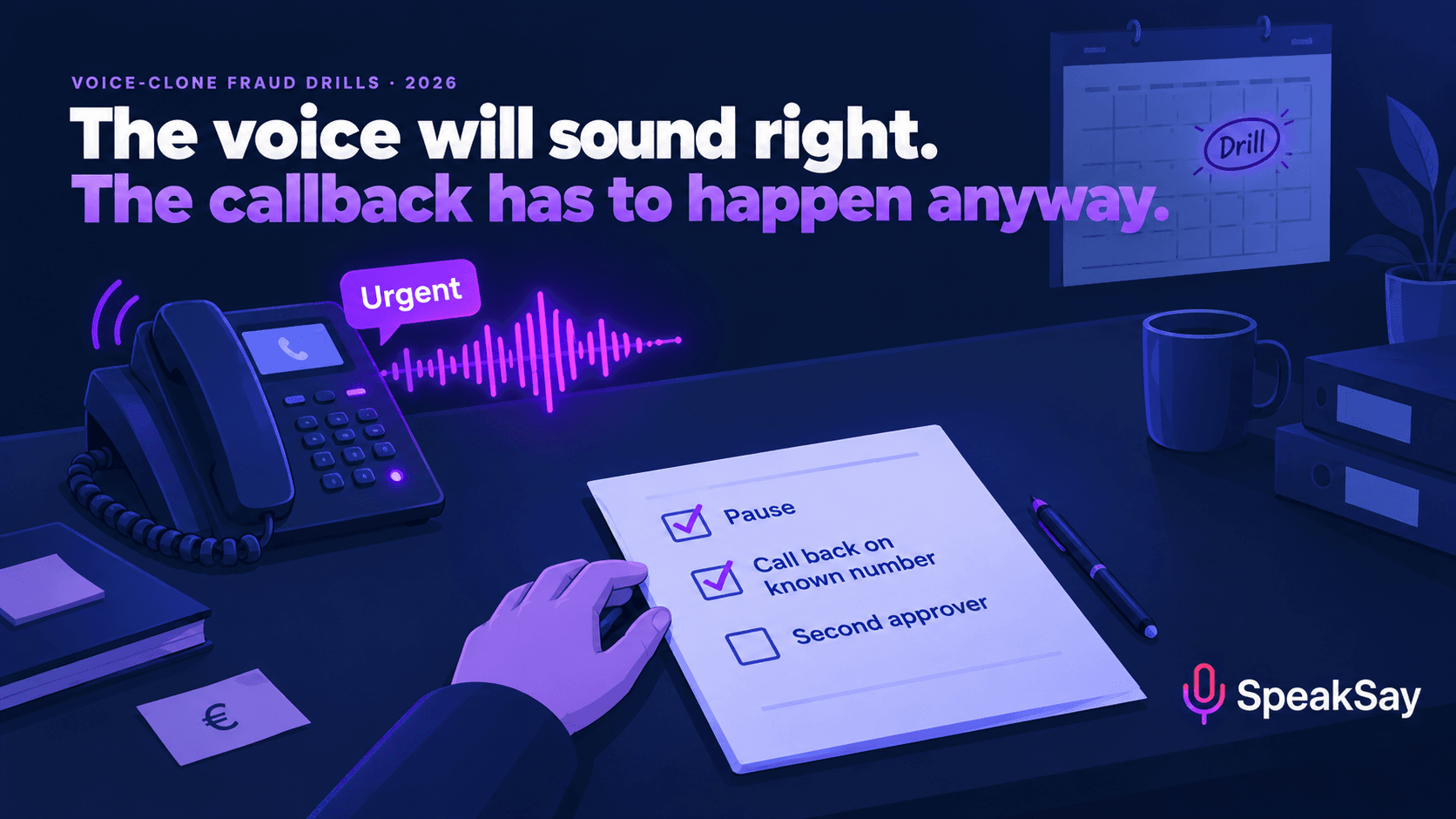
1. The lesson isn't "spot the fake"
Most voice-fraud training tells people to listen for robotic tone, odd pauses or unnatural breathing. That advice is going out of date. A 2026 Veriff study with Kantar found US respondents scored barely above random chance at telling deepfakes from real media. In one video comparison, 70% picked the fake as authentic. Our own guide to telling whether a voice is AI-generated lists the clues that still help, but you can't build a defence on listening alone.
The Fideuram case shows the real weakness. Several channels reinforced each other: a text message, then a voice, then an instruction from a senior person to the finance team. Each step made the next seem more legitimate. What should have stopped it is a rule that doesn't depend on judgment: high-value or unusual payment requests are verified through a separate, known channel before anything moves, however convincing the request is.
Most companies already have that rule. Adaptive Security, which runs deepfake simulations, says tabletop exercises "consistently reveal that callback protocols exist on paper and are skipped" when the requester sounds senior and urgent. The drill exists to find out whether yours gets skipped.
2. Why drill with a real clone at all
You could run the drill with a colleague doing an impression, or a generic AI voice claiming to be the CEO. Both test something weaker than the real threat:
| Drill voice | What it tests | What it misses |
|---|---|---|
| Colleague doing an impression | Whether staff follow process with an obvious fake | The moment it sounds right, which is when people skip the check |
| Generic AI voice "from the CEO" | Response to the claim of authority | Familiarity, which is the attacker's strongest tool |
| Consented clone of your own executive | Whether the callback happens even when the voice is convincing | Nothing important, if consent and safeguards are in place |
Attackers can clone a voice from public clips: conference talks, podcasts, earnings calls, social video. Your drill should be at least as convincing as what they can make. The difference is that you have permission and they don't.
3. Ground rules before you record a word
A drill that damages trust costs more than the risk it reduces. These safeguards aren't optional:
- Written executive consent. The person whose voice is cloned signs a short document covering what the clone will be used for (this drill only), who can access it, where audio is stored and the date it will be deleted. Cloning a voice without documented consent can create biometric privacy exposure in some US states. Adaptive Security cites Illinois' BIPA and similar laws in Texas, Washington and New York.
- Legal and HR review. Before you design anything, have counsel and HR approve the plan, scope and wording. This guide isn't legal advice.
- Announce the programme, not the drill. Tell everyone in finance that the company runs periodic fraud drills, including voice drills, and that nobody is disciplined for the result. Don't say when.
- No fake bad news. Never pretend a termination, pay change, disciplinary matter, health issue or family emergency. Research presented at NDSS 2025 found simulations built on severe personal consequences caused backlash and lasting damage to trust.
- Exclude people in sensitive situations. Anyone in an HR process, on leave or recently bereaved is left out.
- Work channels only. Use company phones and work messaging, not employees' personal numbers.
- No money can move. See section 6. This is built into the setup, not left to good intentions.
Clone a voice with consent built in
SpeakSay Voice Cloning is built for voices you have the right to use. Record a short consented sample from your executive, render the drill script, and delete the voice when the exercise ends.
4. Pick the control you're testing
A drill tests one control, not general "awareness". Write down which one before you design the scenario:
- Callback to a known number: does the employee hang up and call the executive back on the number in the company directory, not the one that called?
- Second approver: does a payment above the threshold get a second sign-off, even when the "CEO" says there's no time?
- Bank-detail change hold: does a request to change a supplier's bank account trigger the waiting period and verification your policy describes?
- Escalation: does the employee report the call to the right person, quickly?
Most small businesses should start with the callback. It's the control the Fideuram case was missing, and it's the one that gets skipped when the voice sounds right.
5. Design the scenario
Keep it realistic and limited to work:
| Element | Guidance |
|---|---|
| Pretext | A plausible business request: a confidential acquisition deposit, an urgent supplier payment, a change of bank details for a known vendor. Never personal hardship. |
| Channel mix | Real attacks layer channels. A short work message followed by a voicemail or call in the cloned voice is realistic. Keep the number of steps the same each quarter so results can be compared. |
| Pressure | One clear reason for urgency ("before the bank closes") and one request for secrecy ("don't loop anyone else in yet"). These are the cues you want people to learn to treat as triggers. |
| Length | A 20–40 second voicemail or a short scripted call. Long monologues sound unnatural. |
| Off-ramp | If the employee says "I'll call you back on your usual number", the drill ends right away. That's a pass. |
Have the executive read the script once in their own voice and check it sounds like them: their phrases, their greeting, the way they sign off. Then render it with the clone. They should hear the final audio and approve it in writing.
6. Run it with no money at risk
Build the safety net into your systems before the call:
- Use a drill-only payee. Use a vendor record or account that doesn't exist, flagged in your finance system so it can't be paid. If someone tries to pay it, the attempt is logged and blocked.
- Brief the executive. They know the drill window. If the employee calls them back on the known number, they say: "Thanks for checking. That was a drill and you did exactly the right thing." That moment teaches more than any slide deck.
- Have a facilitator watching. One person from finance leadership or security knows the drill is running and can stop it at any point.
- Set a hard end time. If nothing has happened within the window, the facilitator ends the drill and tells the participant on the same day.
7. The no-blame debrief
Hold it within 24 hours, privately first, then as a team summary without names. The questions are about the process, not the person:
- At what point did the request feel real?
- Did you know the callback rule? Where is it written down?
- What would have made verifying easier? A directory link, a script for pushing back on a senior person, a named person to call?
- Did the urgency or secrecy request change what you did?
The most common finding is that people know the rule but feel awkward applying it to a senior voice. The fix is cultural: the executive tells the whole team, in their real voice, "If I ever call you asking for an urgent payment, I expect you to hang up and call me back. I'll thank you for it." Some companies record this as a short audio message and replay it at onboarding.
If you already use recorded role-play for customer calls, the same no-audience practice works here. See our difficult-customer role-play guide.
8. Metrics and cadence
| Metric | What it shows | Target direction |
|---|---|---|
| Verification rate | Share of participants who called back on a known number or used the second-approver step | Up |
| Time to verify or report | Minutes from the call to the callback or report | Down |
| Payment attempts on the drill payee | How far the request got before a control stopped it | Down to zero |
| Process gaps found | Missing directory numbers, unclear thresholds, no named escalation contact | Found and fixed each round |
Adaptive Security suggests quarterly exercises for most organisations: often enough to build habit, not so often that people get tired of them. Vary the pretext each time, but keep the control you're measuring the same so the numbers can be compared.
9. After the drill: the clone itself
An executive voice clone is a valuable asset to an attacker, so treat it that way:
- Delete it on the date in the consent document, or keep it only under named access if the executive agrees to future drills.
- Don't reuse drill audio for anything else: not marketing, not internal comms.
- Record the deletion and tell the executive.
- Reduce what attackers can collect. Our guide to protecting your voice from cloning scams covers public-audio hygiene, and the voice-provenance guide explains how to prove which recordings are really yours.
Run drills for the whole finance team
Quarterly drills, several scenarios and the executive's "call me back" message add up. Pick a SpeakSay plan that covers cloning and rendering for your team.
10. FAQ
How do I train staff against voice-clone CEO fraud?Train the process, not the ear. Make callback verification on a known number and second-approver rules mandatory for unusual payment requests, then test with consented drills and debrief without blame.
Is it legal to clone my CEO's voice for a training drill?With the executive's documented, explicit consent and a legal review, many organisations do. Biometric privacy laws in some US states, such as Illinois' BIPA, make consent and data-handling records essential. Get your counsel's sign-off first.
What happened in the Fideuram voice-clone case?According to reports on October 2, 2026, a fake WhatsApp message appearing to come from Intesa Sanpaolo's CEO, followed by a cloned-voice call from a supposed law-firm partner, led Fideuram's then-chairman to instruct transfers of about €95 million. More than half was recovered.
Should employees be told a drill is coming?Tell everyone that drills happen and that nobody is disciplined for the result. Don't announce the date. That keeps it realistic while being fair.
What counts as passing the drill?Pausing the request and verifying it through a separate, known channel, such as calling the executive back on their directory number or getting a second approver, before taking any action.
How often should we run voice-fraud drills?Quarterly is a common cadence. Change the pretext each time but measure the same control so you can see improvement.


