Everyone Hates Role-Play: Build a Difficult-Customer Call Library Your Team Can Practise Alone (Voice Remix, 2026)
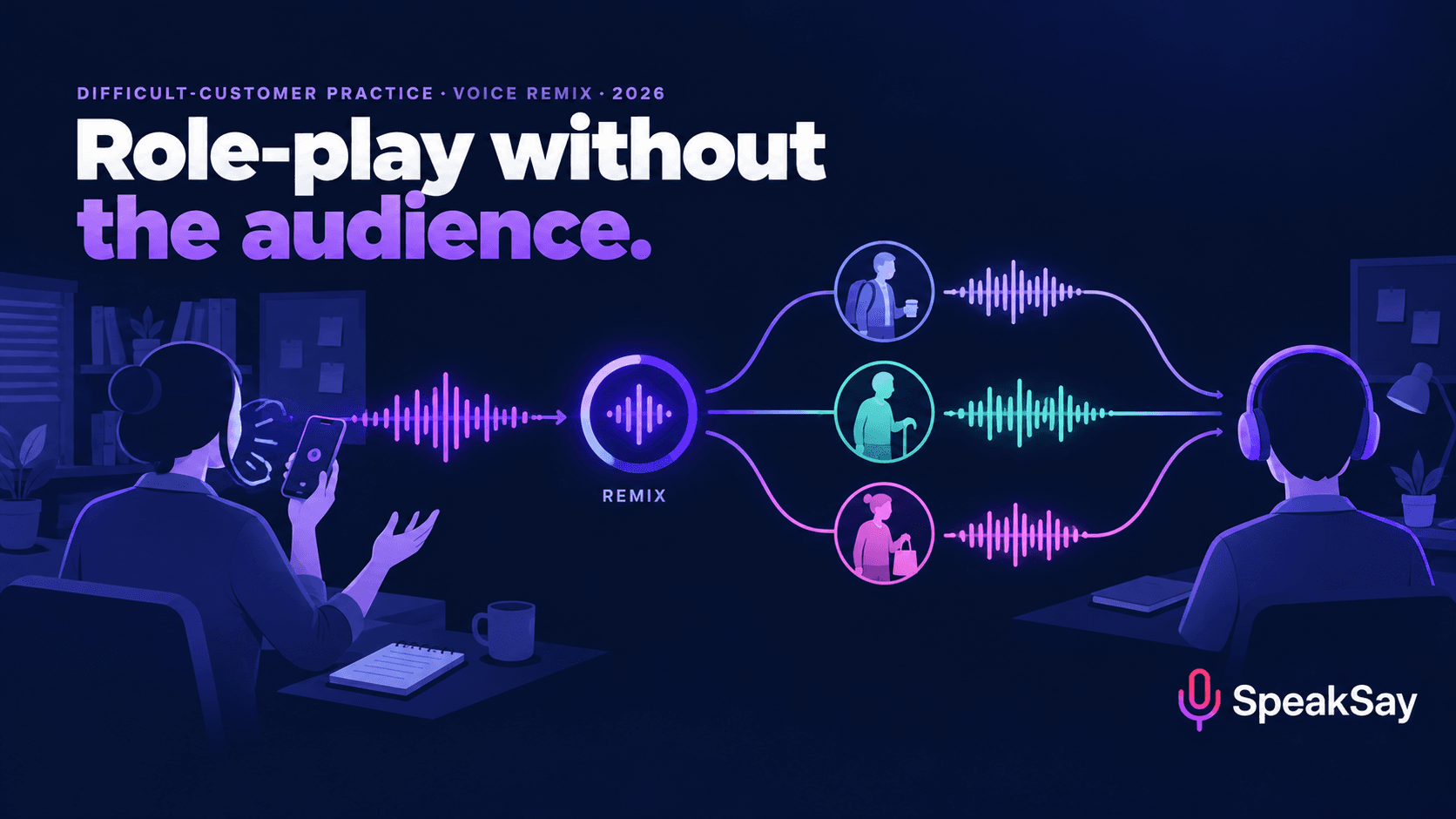
Role-play is the training method everyone groans at. It's exposing in front of colleagues, and the "customer" is obviously a co-worker. Here's a different way: the trainer performs realistic difficult customers, Voice Remix turns each performance into a stranger's voice, and trainees practise their replies privately. Includes scenario design, a casting table, the pause-and-respond format and a simple scoring sheet.
1. Why live role-play fails
| Complaint | What's actually going wrong |
|---|---|
| "It's embarrassing" | The trainee is performing for colleagues, so they protect their image instead of trying the hard sentence |
| "The customer isn't realistic" | Everyone knows the voice. Colleagues go easy on each other or overact for laughs |
| "The scenarios are soft" | Nobody wants to be genuinely rude to a co-worker, so the hardest calls never get practised |
| "We do it once a quarter" | It needs a room, a time slot and a partner, so it rarely happens |
| "Every session is different" | Two trainees get two different customers, so you can't compare progress |
Interactive AI role-play platforms exist and address some of this, and for large sales teams they can be worth it. For a 10-person support team, a clinic front desk or a small sales team, there's a cheaper first step that fixes the biggest problems: the audience and the familiar voice.
2. The method: performed, remixed, practised alone
- The trainer, or a good actor on the team, performs the customer side of a realistic call or counter conversation. They say the angry, rambling, interrupting or evasive lines and leave gaps where the employee would speak.
- Voice Remix converts that performance into a voice that doesn't belong to anyone on the team. The performance stays: the timing, sighs, rising frustration and the moment the customer cuts in.
- Trainees play the scenario on their own, on a phone with headphones, and speak their reply into the gaps, recording themselves if they like.
- They listen back, score themselves, and bring one recording to a coach instead of performing in front of a room.
This keeps what role-play is good at, which is saying the hard sentence out loud under pressure. It removes what people hate about it.
3. Why Voice Remix and not plain text-to-speech
You could type the customer's lines into a text-to-speech tool. For calm scenarios that works. For difficult ones it falls short, because what makes a customer hard to handle is rarely the words:
- Interruptions. Real angry customers talk over you. A performer can cut in at exactly the wrong moment, and typed TTS lines tend to wait their turn.
- Escalation. Frustration builds across a call. A performer ramps it up naturally across lines rendered as one take.
- Hesitation and mixed signals. The customer who says "fine" in a tone that means it isn't. That's performance, not text.
- Speed. A trainer can record ten scenarios in an hour by just playing them, without writing every line in advance.
Voice Remix is the step that makes the performance usable. Without it, every scenario sounds like the trainer. With it, the same trainer can be a dozen different customers. If a scenario is calm and scripted, such as a customer asking routine questions, plain text-to-speech is quicker. Use both.
Try it on one scenario
Record yourself playing the hardest customer you've dealt with this month, leave the gaps, and run it through a free SpeakSay tool to hear it come back as someone else.
4. Designing the scenario library
Build the library from real situations your team faces, not generic training-manual ones. Ask the team: "What's the call you dread?" Then organise by type and difficulty:
| Scenario type | Level 1 | Level 2 | Level 3 |
|---|---|---|---|
| Complaint | Polite but disappointed | Frustrated, repeats the problem | Angry, interrupts, threatens to leave a review |
| Price objection (sales) | "It's a bit more than I expected" | "Your competitor is cheaper" | "I'm cancelling unless you match it today" |
| Confused customer | Doesn't understand a bill | Mixes up two products, gets defensive | Confused and upset, keeps going back to the start |
| Bad news | Delivery is late | Item is discontinued | Refund refused under policy |
| Off-script | Chatty, won't get to the point | Asks for a manager immediately | Asks something you're not allowed to answer |
Fifteen scenarios, three levels across five types, is a solid library. Each one runs 60 to 120 seconds of customer audio with three to five response gaps. Start with level 1 for new staff. People move up when their recordings are consistently good, not when the calendar says so.
For each scenario, write a one-paragraph brief before recording: who the customer is, what they want, what will calm them down, and what will make it worse. The trainer performs from the brief, not from a full script. That's what keeps it sounding real.
5. Casting the customers
Your customers aren't all the same age, pace or temperament, and your library shouldn't be either. Remixing lets one or two performers cover a realistic range:
| Customer | Voice direction | Performance note |
|---|---|---|
| The hurried professional | Mid-range, brisk | Short sentences, sighs at any delay, interrupts with "yes, yes" |
| The older, careful customer | Older-sounding, slower | Asks for things to be repeated, gets upset if rushed. See voice-age casting for doing this respectfully |
| The stressed parent | Mid-range, distracted | Background noise, loses the thread, apologises then snaps |
| The quiet-angry customer | Low, even | Never raises their voice, polite words, cold tone. Often the hardest to read |
| The expert | Confident, fast | Knows more than the trainee about one detail and uses it |
Two cautions. Avoid accents or voices that turn a group of people into "the difficult customer." Vary difficulty across all voice types, so trainees learn that anyone can be a hard call and anyone can be an easy one. And don't make the "angry" voices all one gender.
6. The pause-and-respond format
Each scenario file follows the same structure, so trainees know what to expect:
- A neutral narrator sets up the scene (10–15 seconds). "You're on the support line. The customer's order arrived damaged for the second time." Use plain TTS for this so it's clearly not part of the call.
- The customer speaks. This is the remixed performance.
- A soft tone, then a gap of 15–25 seconds for the trainee to respond out loud. Make it long enough to answer and short enough to feel the pressure.
- The customer reacts. Record the reaction neutrally enough to follow most reasonable replies, or record a "calmer" and an "angrier" version and let trainees pick the one that matches what they said.
- Repeat three to five times, then a closing line from the narrator: "End of call. Listen back to your replies."
The calmer/angrier fork is the cheap version of interactivity. It takes twice the recording but teaches the most important lesson: what you say changes how the customer responds.
7. Scoring and feedback
Trainees score their own recordings first, out of 2 on each line (0 = no, 1 = partly, 2 = yes):
| Check | What good looks like |
|---|---|
| Acknowledged the feeling first | "That's the second time, I'd be fed up too," before any explanation |
| Didn't argue with the facts | No "actually, our records show..." in the first reply |
| Said what happens next | A specific next step and a time |
| Kept within policy | No promises the business can't keep |
| Kept pace | Slower and calmer than the customer, not faster |
Then they bring one recording, their choice, to a five-minute coaching chat. Choosing which recording to share keeps the psychological safety that live role-play lacks. Track scores over time for the whole team, not to rank people. We cover measuring whether audio training is working in measuring audio training effectiveness.
The same performed-prompt-and-gap format works for other high-pressure speaking practice too. See how scripted creators use it to prepare for interviews in unscripted interview Q&A practice.
8. Ground rules: privacy, fairness and real recordings
- Don't use real customer call recordings as the source unless your legal or privacy team has confirmed you can. Even remixed, the words can identify a person. Write new scenarios inspired by real ones.
- Get consent from the performers. The trainer's performance is their voice before it's remixed. Agree in writing how the recordings will be used and stored.
- Trainee recordings belong to the trainee. Make it clear they don't go to HR or into performance reviews unless the trainee chooses to share them.
- Tell trainees the voices are remixed. The point is realism, not deception.
- Keep level 3 optional for new starters. Practising an abusive call before you've practised a disappointed one does more harm than good.
Build the whole library
Fifteen scenarios with calmer and angrier versions is a lot of remixing. Pick a SpeakSay plan that covers your trainer's performances and every voice you need.
9. FAQ
Why do employees hate role-play training?Mainly because it's exposing in front of colleagues, the "customer" is an obviously familiar co-worker, scenarios are too soft, and it happens too rarely to build skill.
How can I make customer service role-play less awkward?Remove the audience and the familiar voice. Record realistic customer scenarios with gaps for the employee's replies, use Voice Remix so the customer sounds like a stranger, and let staff practise alone and share one recording with a coach.
What are good difficult-customer scenarios to practise?Complaints at three levels of anger, price objections, confused customers, bad-news calls such as a refused refund, and off-script requests such as asking for a manager immediately. Base them on the calls your team says they dread.
Why not just use text-to-speech for the customer?TTS works for calm scripted scenarios. Difficult customers depend on interruptions, escalation and tone, which come from a human performance. Voice Remix keeps the performance and changes the voice.
Can I use real customer calls?Only if your legal or privacy team confirms you can. Even with the voice changed, the content can identify a person. It's safer to write new scenarios based on real situations.
How long should each scenario be?About 60 to 120 seconds of customer audio with three to five response gaps of 15 to 25 seconds each, so two to four minutes in total.


