How to Turn a Workbook or Self-Help Book With Exercises Into an Audiobook People Can Actually Use: Spoken Prompts, Pauses and a Companion PDF (AI Narration, 2026)
Exercises, tables and fill-in-the-blank pages don't survive a straight read-aloud. This guide shows how to rewrite a workbook for the ear: spoken prompts, built-in pauses, a companion PDF and a clear split between listening and doing, with a before-and-after example.
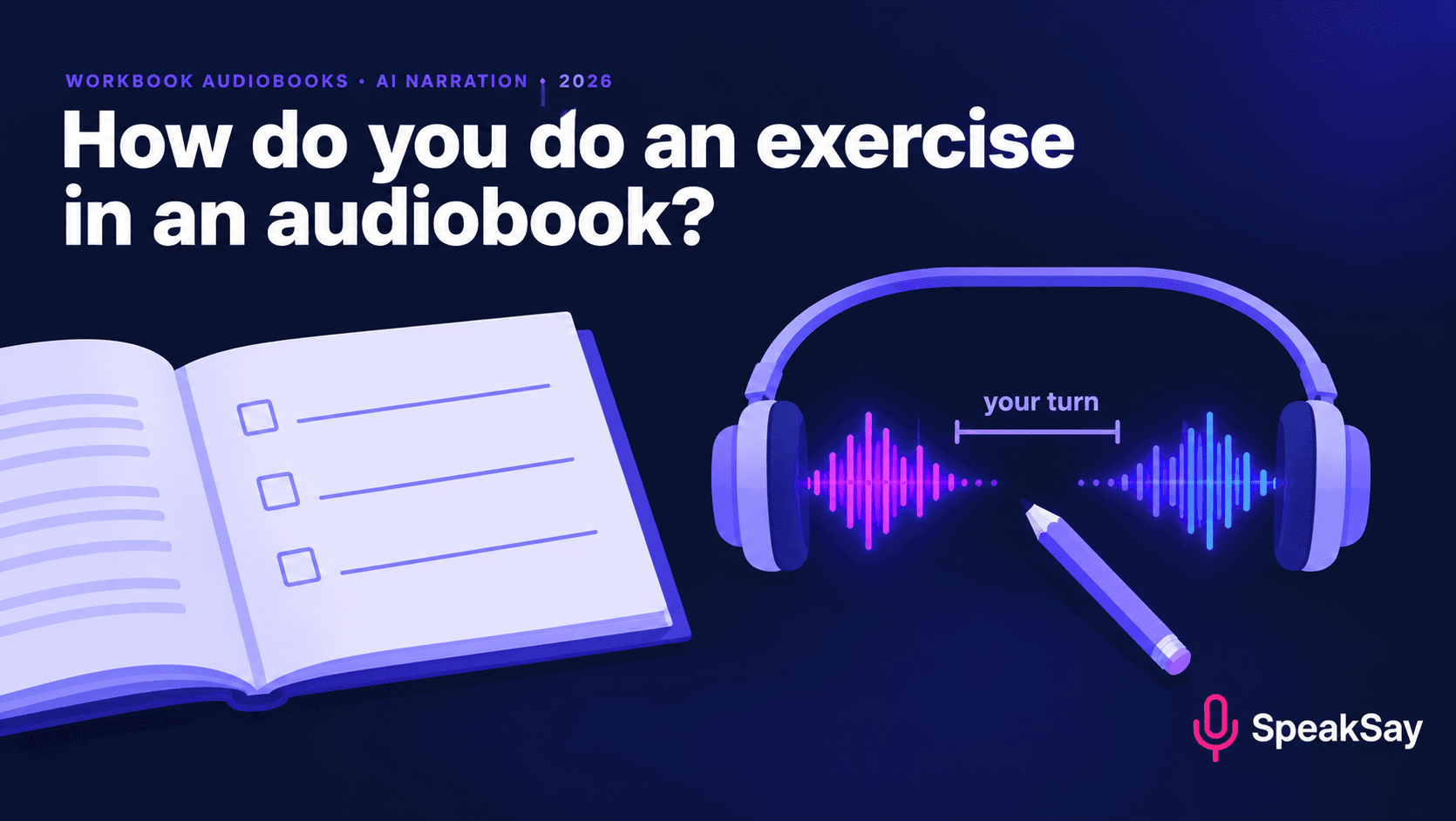
1. What breaks when you read a workbook aloud
- References to the page. "As shown in the table above" means nothing in audio.
- Tables and grids. Reading rows and columns aloud is slow, confusing and tiring.
- Fill-in prompts. There is nowhere to write while driving.
- Checklists and scales. "Rate each statement from 1 to 5" for twenty statements is a lot to hold in your head.
- Visual layout cues. Boxes, sidebars and callouts have no sound.
Most of these have a fix. A few exercises have no good audio form, and the honest answer is to point listeners to the PDF.
2. Three ways to handle an exercise
| Mode | What the listener does | Best for |
|---|---|---|
| Do it in your head | Listens, pauses for thought, answers mentally. | Reflection questions, visualizations, short prompts. |
| Do it later | Listens now, writes in the PDF or a notebook afterwards. | Longer exercises, lists, planning tasks. |
| Do it right now | Presses pause and writes or does something. | Short written tasks for people at a desk or at home. |
Decide the mode for each exercise in the book, and tell the listener at the start. A short orientation chapter ("how to use this audiobook") saves a lot of confusion.
3. Rewrite print instructions for the ear
Here is a print exercise, followed by an audio version.
Exercise 4.2: Look at the table on page 62. In column A, list three situations that cause stress. In column B, rate each from 1 to 5. In column C, write one small action you could take.
Audio
Exercise 4.2. This one works best with a pen, so you may want to do it later with the companion PDF. If you'd rather do it now, think of three situations that stress you this week. I'll wait while you choose them. Now, for the first one, give it a score from one to five, where one is mild and five is overwhelming. Next, what is one small thing you could do about it? Just one. We'll come back to the other two in the next exercise.
Notice what changed:
- The page reference is gone, replaced by a clear "now or later" choice.
- Three columns became one item at a time.
- Numbers are spoken as words and the scale is restated.
- The listener is told what comes next, so they don't need to remember everything.
Spoken numbers matter too. See our numbers and units normalization pass for how to check them before you generate audio.
4. Build pauses that work
A pause is the audio version of white space. Used well, it gives listeners time to think. Used badly, it sounds like a mistake.
- Announce it. "I'll give you a moment" tells the listener that silence is intentional.
- Keep reflection pauses short: usually 5 to 15 seconds. A longer pause invites listeners to check whether the file has frozen.
- Use longer pauses only when you've said so. "Pause this recording and take two minutes" is an instruction, not a silence.
- Use a soft cue before and after. A short, gentle sound or a phrase such as "when you're ready" marks the boundaries.
- Don't stack pauses. More than two in a row feels like a trap.
Before you rely on long silences, check the technical requirements of the stores where you will publish, since some retailers have rules about files that contain extended silence. Test the finished file on a phone with the screen off.
Hear your exercise before you commit
Paste one rewritten exercise, pick a calm voice and listen to how the pacing feels. If it drags, shorten it. If it rushes, add a pause cue.
5. The companion PDF
Many authors make a PDF of the worksheets, tables and templates and offer it with the audiobook. Make it useful rather than a dump of the print pages:
- Number exercises the same way in audio and PDF. "Exercise 4.2" should be the same in both.
- Give a short link or a QR code, and say the address slowly in the audio. Put it in the first chapter and again at the end. Keep it short enough to type from memory.
- Make the PDF printable and fillable. Plain layout, plenty of space, readable on a phone.
- Check retailer rules on mentioning external files and links inside audio, and on delivering extras.
- Update both together. If you change an exercise, change it in the audio and the PDF, or listeners will notice the mismatch.
That last point is the same edition-drift problem we cover in our guide to read-along ebooks and audiobook editions.
6. Structure the book for listening
- Split teaching from doing. Put the explanation first, then the exercise, then a one-sentence summary. Listeners can skip back to the part they need.
- Shorten chapters. Ten to twenty minutes is easier to follow than a forty-minute block.
- Repeat the key idea. In print, readers can flip back. In audio, a quick reminder helps: "Remember, the goal is small steps."
- Name exercises clearly. "Exercise 4.2: Three stressors" is easier to find than a number alone.
- Cut what can't work. A 20-row self-assessment may belong only in the PDF.
7. Produce it with AI narration
Workbooks suit AI narration because the content is instructional and the voice should be calm and steady. A few practical notes:
- Choose a warm, even voice. Test it on an exercise, not a plain paragraph. Our guide to audiobook clarity has tips for keeping voices distinct if you include quoted examples.
- Write the audio script as a separate document. Don't edit the print manuscript in place.
- Mark pauses in the script with a consistent note such as [pause 10 seconds] so you can add them in the editor.
- Proof-listen the exercises first. They are the highest-risk parts. See our risk-first sampling method.
- Disclose AI narration where the retailer requires it.
And for budgeting, it helps to be realistic: our look at where AI narration savings leak applies to workbooks too, because rewriting and testing take time.
Planning several workbooks?
If you publish a series, a one-time plan can keep narration costs predictable across titles.
8. FAQ
Can a workbook be an audiobook?Yes, if you adapt it. Rewrite page references and tables as spoken instructions, add short pauses, and offer a companion PDF for exercises that need writing.
How long should pauses be?Five to fifteen seconds for reflection, announced beforehand. For longer tasks, tell the listener to pause the recording instead of leaving silence.
Do I need a companion PDF?Not always, but for exercises that involve writing, tables or checklists, it helps. Check retailer rules on extras and external links.
Should I read the whole print book aloud?Not word for word. Keep the teaching, adapt the exercises and cut what only works on a page.
Is AI narration suitable for self-help?It can be, especially for steady, instructional content. Test several voices on an exercise and disclose AI narration where required.