AI Narration Was Supposed to Cut Audiobook Costs by 90%. Producers Report 20–50%: Where the Savings Leak and How to Keep Them (2026)
Vendors promise 85–95% savings from AI narration. The Frankfurt Book Fair's 2026 white paper found producers reporting 20% in their second year of using AI and 50% in their third. The gap isn't a scam. It's everything around the narration that AI doesn't replace. Here's a stage-by-stage map of where audiobook money goes, five places savings leak, and how an indie author or small publisher keeps more of them.
1. What the white paper found
Who Is Narrating the Future? AI Adoption, Use and Outlook in Audio Production was published by Frankfurter Buchmesse in early September 2026. Dosdoce.com interviewed 85 industry professionals: 50% from audio production studios, 36% from publishers and 14% from streaming platforms and distributors, across Europe, Latin America, North America, Africa and the Middle East. As reported by Publishing Perspectives:
- 85% use AI somewhere in their audio production chain, but only 17% have built it into more than six phases.
- Vendors promise savings of 85% to 95%. Respondents reported about 20% in the second year and 50% in the third. The report suggests the gap comes from using AI in one or two stages rather than across the whole workflow.
- 86% named voice quality and rights transparency as vendor-selection criteria. 79% named data privacy.
- Half of the barriers to scaling AI came from limits set by literary agents, publishers and authors.
- 86% expect AI to drive moderate or disruptive industry growth over the next three years, mainly in backlist, academic, niche and non-English titles that weren't economically viable before.
Most respondents are publishers and studios, not solo authors. But the pattern applies at any scale: AI makes one stage dramatically cheaper and leaves the others roughly where they were.
2. Where the money in an audiobook goes
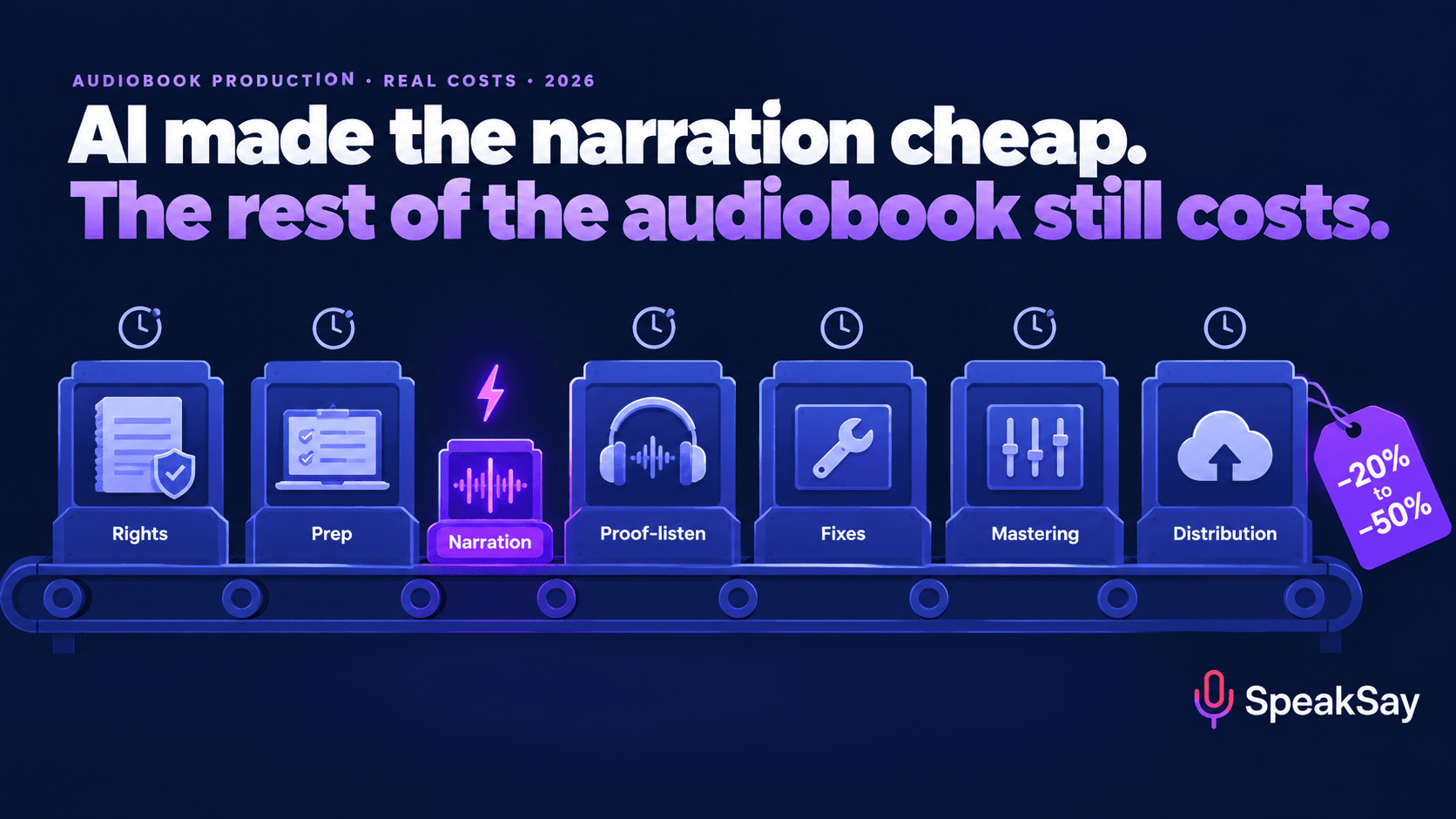
Here is a typical production broken into stages, with what AI narration actually changes at each one.
| Stage | What it involves | Does AI narration replace it? |
|---|---|---|
| Rights and contract | Confirming you hold audio rights. Checking agent, publisher and retailer terms on AI narration. | No |
| Manuscript prep | Audio edits (tables, footnotes, "see figure 3"), front and back matter, credits | No |
| Pronunciation guide | Names, places, invented words, foreign terms | No. It matters more with AI. |
| Casting | Choosing a voice, or one per character | Partly. It's faster, but someone still has to listen and decide. |
| Narration | Performing the text | Yes. This is where the big saving is. |
| Proof-listening | Listening to the whole book against the text | No. It still takes about as long as the book does. |
| Fixes and re-renders | Mispronunciations, wrong emphasis, misread dialogue | Partly. Fixes are cheaper, but someone still has to find them. |
| Editing and mastering | Room tone, chapter files, retailer loudness and format specs | Partly |
| Retail sample and metadata | Choosing the sample, writing the description, disclosure | No |
| Distribution and marketing | Uploading, pricing, promotion | No |
With a human narrator, the narration fee is the biggest line item, so cutting it looks like cutting everything. In practice, the stages AI doesn't touch now make up most of what's left.
3. Why the vendor maths says 90%
The 85–95% figure usually compares two numbers: a human narrator's per-finished-hour fee times the runtime, against the AI rendering cost of the same text. Measured like that, the saving is real. Our AI vs human narration cost math works through it per finished hour.
What that comparison leaves out is the work that doesn't move: your hours, or a contractor's, on prep, proof-listening, fixes and distribution. Also, with a human narrator, part of the quality control is the narrator's own job. They and their director catch errors as they record. With AI, that job comes back to you.
4. Five places the savings leak
- The proof-listen nobody budgeted. An 85,000-word novel is about nine hours of audio. Somebody has to listen to all of it against the text. At 1.25x with notes, that's still a working week of evenings. Our guide to listening for errors covers the technique.
- Pronunciation fixes after rendering. If you find out in chapter 14 that the main character's surname has been wrong all along, you're re-rendering 13 chapters. Fix it up front with a pronunciation list. Our pronunciation guide explains how.
- Re-rendering whole files for one line. Tools or workflows that can't fix a single sentence turn a two-second correction into a re-render of the whole chapter, plus another listen.
- Voice drift between sessions. If the voice or model changes between the first and last chapters, the book sounds like two narrators. Fixing that is expensive. See our guide to keeping an AI narrator consistent.
- Rights and contract delays. The white paper found half the barriers to scaling come from agents, publishers and authors. Discovering that after rendering that your contract or retailer doesn't allow AI narration wastes the whole production. Check first. Our guide to ACX voice-replica rules covers one major retailer.
5. How to keep more of the savings
The white paper's own explanation points to the fix. Savings grow when AI is part of the whole workflow, not just one stage of it. For an indie author or small publisher, that means:
- Clear rights first. Confirm your audio rights and the retailer's AI-narration rules before casting.
- Prepare the text before you render. Make audio-edition edits, run a numbers-and-dates pass using our normalization checklist, and build a pronunciation list. An hour here saves days later.
- Lock the voice and settings before chapter one and don't change them mid-book.
- Render one chapter, listen to all of it, adjust, then render the rest. Problems found in chapter one cost one chapter.
- Fix at sentence level. Correct and re-render only the line, not the file.
- Proof-listen with a notes template: timestamp, the problem and the fix. Batch the fixes.
- Reuse your setup across a series and backlist. The second book is where the savings grow, just as the white paper's year-three figure suggests. Our backlist conversion guide covers doing this at scale.
- Use a predictable cost model. Per-character billing turns every fix into a new cost. A flat plan makes re-rendering a line free to try.
Cast a narrator you can keep for the whole series
Choose a voice from SpeakSay's library, lock the settings and use the same narrator from book one to book ten.
6. Your own cost worksheet
Before you trust anyone's percentage, including ours, fill this in for one book. Value your own time at a real hourly rate.
| Line | Human narration | AI narration |
|---|---|---|
| Rights and contract check (hours) | Same | Same, plus AI-specific clauses |
| Manuscript audio prep (hours) | Some | More (pronunciation list, normalization) |
| Narration | Fee per finished hour × runtime | Plan or render cost |
| Proof-listen (hours) | Often shared with the narrator or producer | All yours: about the runtime ÷ playback speed, plus notes |
| Fixes | Pickup session | Your time plus re-render cost |
| Mastering and files | Often included | Your time or a contractor |
| Sample, metadata, disclosure (hours) | Same | Same |
| Total | Compare the totals, not the narration lines |
Most authors who fill this in honestly land somewhere in the white paper's range for their first book, and do better on the second. That's the realistic expectation to set, with a co-author, a publisher or yourself.
Stop paying per correction
The SpeakSay Lifetime Plan replaces per-character billing with a single payment, so re-rendering a line, a chapter or a whole series doesn't add a new cost each time.
7. Don't save money by spending trust
The white paper's author, Javier Celaya, framed the real question as whether growth comes with transparency. He warned that trust, once spent, is far more expensive to rebuild than any single title is to produce. Cutting the disclosure or the proof-listen to protect your margin is a false saving. Say the book is AI-narrated in the credits and the description. Our guide to AI audiobook opening credits shows how to do it without sounding apologetic. And ship a book you've listened to all the way through.
8. FAQ
How much does AI narration really save on an audiobook?Producers interviewed for the Frankfurt Book Fair's 2026 white paper reported savings of about 20% in their second year of AI adoption and 50% in their third, well below the 85–95% vendors promise. The narration stage gets much cheaper. Prep, proof-listening, fixes and distribution don't.
Why don't AI audiobooks save 90%?The 90% figure compares only the narrator's fee with the cost of rendering. It leaves out rights checks, manuscript prep, pronunciation work, a full proof-listen, fixes, mastering and distribution, and much of the quality control a human narrator would have done shifts to you.
What is the "Who Is Narrating the Future?" white paper?A 2026 study published by Frankfurter Buchmesse and researched by Dosdoce.com, based on interviews with 85 audio-industry professionals about AI adoption in audiobook, audio drama and podcast production.
What is the biggest hidden cost in an AI-narrated audiobook?The proof-listen. Someone has to listen to the whole book against the text, which takes roughly the book's runtime, adjusted for playback speed, plus time for notes and fixes.
How can I keep the savings from AI narration?Clear rights first, prepare the text and a pronunciation list before rendering, lock the voice, test one chapter, fix at sentence level, batch the proof-listen fixes and reuse your setup across a series.
Do I need to disclose that my audiobook is AI-narrated?Many retailers require it, and it's good practice everywhere. Put it in the opening credits and the product description.