Nobody Has Time to Proof-Listen a 9-Hour AI Audiobook at 1x: A Risk-First Sampling Method That Catches the Errors Listeners Actually Notice (2026)
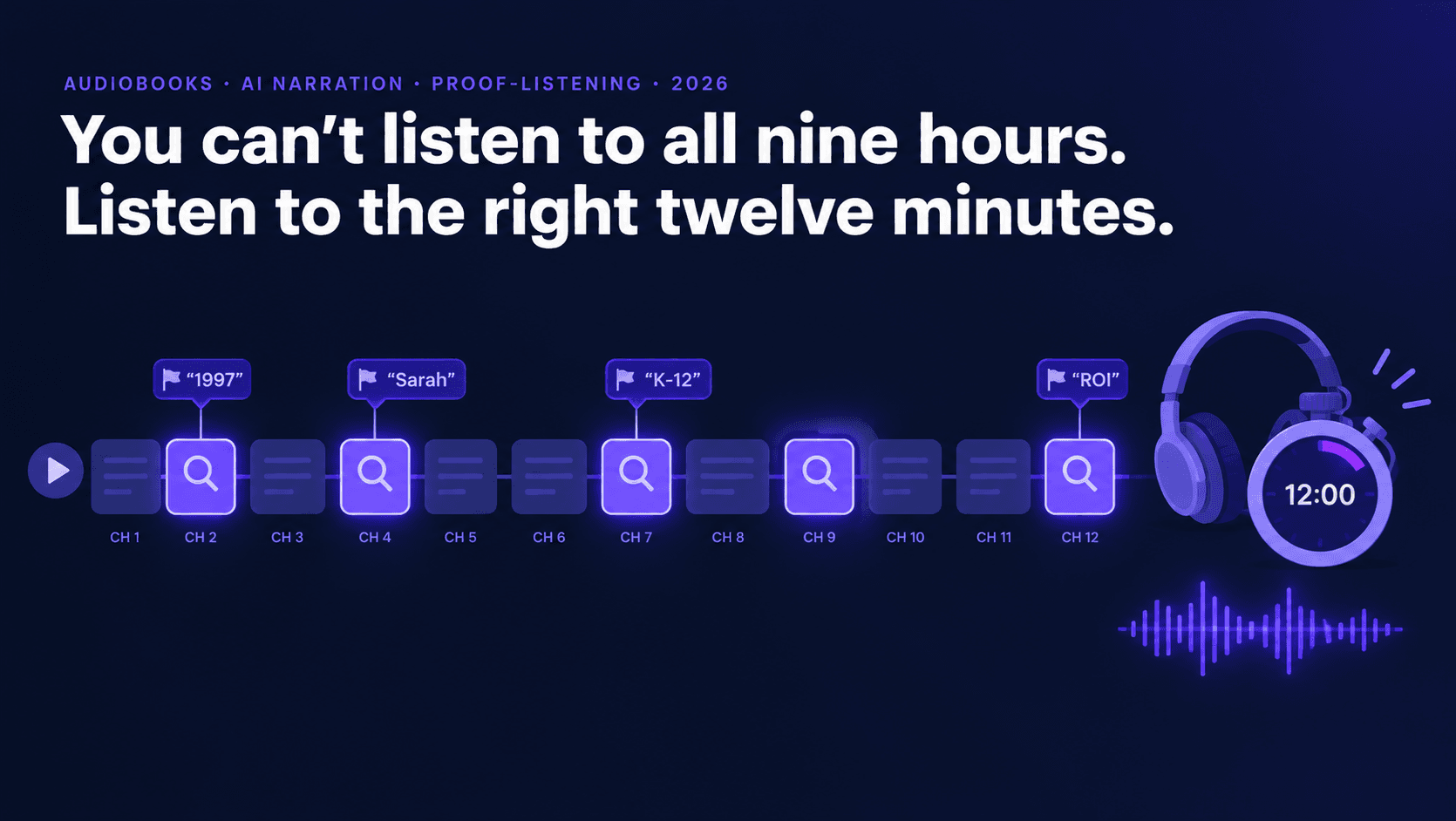
A nine-hour audiobook holds roughly 84,000 spoken words, and every mispronounced name or misread number is yours to catch before listeners do. Here is a risk-first sampling method for indie authors using AI narration: find the words most likely to go wrong, test them first, then listen to a planned sample instead of hoping.
1. Why full listening fails
Three things go wrong with the "I'll just listen to it all" plan:
- Attention drops. After an hour or two, you hear the story, not the words. A name pronounced oddly sails past.
- It runs out of time. A 9-hour book takes 9 hours at 1x, and every fix means another listen to the affected section.
- It finds the wrong things. You'll spot an odd breath and miss that "Dr." was read as "Drive" on page 212.
Errors cluster. Most of them come from a short list of word types. Aim at those.
2. Step 1: Find the risky words in the manuscript
Before generating or re-generating anything, search the text. Make a list of every item in these categories:
| Category | Examples | What goes wrong |
|---|---|---|
| Character and place names | Invented names, unusual spellings | Different pronunciation on different pages. |
| Acronyms and initialisms | NASA, GDP, a company name in capitals | Spelled out when it should be a word, or the reverse. |
| Numbers, years and units | 1,250, 1990s, 3/4, 5km | Read as the wrong kind of number. |
| Abbreviations | Dr., St., No., vs. | Expanded the wrong way. |
| Foreign words and phrases | French, Spanish or Latin terms | Read with the wrong accent. |
| Heteronyms | read, lead, live, wind | Wrong pronunciation for the sense. |
| Dialogue tags and unusual punctuation | Em dashes, ellipses, all caps | Odd pacing or emphasis. |
A simple search tool does the finding: search for capital-letter words, digits, abbreviations with periods, and any word you invented. A manuscript of 84,000 words usually reduces to a few hundred items to check.
3. Step 2: Build a pronunciation test sheet
Put each risky word into a short sentence that uses it the way the book does, then generate all of them as one test file, not the whole book.
- One sentence per item, taken from the manuscript.
- Group by category so you can hear patterns.
- Generate with the voice you chose from the voice library.
- Listen with the list in front of you. Mark each item pass or fail.
- For failures, respell the word phonetically or add a pronunciation rule. The approaches in our pronunciation fixes guide apply directly, and the numbers and dates normalization pass covers the number category.
A test file of 300 short sentences takes under half an hour to hear. It checks every high-risk word before you commit to a nine-hour generation.
Test the risky words before you generate the book
Try your narrator on a pronunciation test sheet in the SpeakSay voice library and pick the voice that gets your names right.
4. Step 3: Plan the listening sample
After the book is generated, you still need to listen, but you can choose where. A sample of about a dozen three-minute segments covers different kinds of risk:
- The first three minutes of chapter 1. Retailer previews and first impressions come from here.
- The last three minutes of the book. Endings are often rushed or truncated.
- The densest dialogue scene. Check who is speaking. Our guide to dialogue clarity explains what to listen for.
- The page with the most numbers. A table, a list of dates or a financial passage.
- A chapter with the most proper names.
- Any section with foreign words or quotations.
- Two random chapters from the middle. Pick them by dice roll, not by feel.
- Every chapter boundary, 15 seconds either side. Chapter titles and gaps are an easy place for glitches.
Listen at 1x for these. Speeding up hides the very errors you're checking for.
5. Step 4: Log, fix and re-check
Keep a simple log:
| Chapter and time | What you heard | What it should be | Fix | Re-checked |
|---|---|---|---|---|
| Ch. 7, 04:12 | "Kay-oh-ess" | "Chaos" | Respell | Yes |
| Ch. 11, 22:40 | "One thousand nine hundred ninety s" | "The nineties" | Rewrite as words | Yes |
When you find an error in the sample, search the manuscript for every other place the same word or pattern appears. One failed item usually means several. Fix them all, regenerate only the affected passages, and listen to each fix once.
6. What it costs in time
These are our own planning estimates for a roughly 84,000-word book, not measurements:
| Approach | Rough time |
|---|---|
| Listen to everything at 1x | About 9 hours, plus re-listening to fixes |
| Listen to everything at 1.5x | About 6 hours, with weaker error detection |
| Risk-first: test sheet, a dozen three-minute samples, fixes | Around 2 to 3 hours |
The risk-first route is not the same as full listening. It's a way of spending a limited amount of attention where errors are most likely. For the savings side of the same production decision, see our look at where AI narration savings leak.
7. What this method cannot promise
- It won't catch every error. A sample finds patterns, not every one-off slip.
- It doesn't replace a human check for high-stakes books. Medical, legal or technical titles may deserve a subject-matter listener.
- Retailer requirements are yours to check. Each platform sets its own rules for AI-narrated audiobooks and quality, and they change. Read the current terms before you publish.
If a reader or friend is willing to listen, give them a short list of what to listen for: names, numbers, speaker changes. A fresh ear catches things you've gone deaf to.
Keep every re-generation within budget
Fixing a few passages shouldn't cost a new subscription month. See the lifetime plan for a fixed one-time price instead of a monthly credit count.
8. FAQ
How many words are in a nine-hour audiobook?A commonly cited rule of thumb is about 9,300 words per finished hour, which puts nine hours at roughly 84,000 words. Actual pace varies with the narrator and the text.
Do I have to listen to my whole AI-narrated audiobook?There is no universal rule, but full listening is the most thorough check. If you can't do it, a risk-first sample catches the errors most likely to bother listeners. Check each retailer's current requirements too.
What are the most common AI narration errors?Names, acronyms, numbers and years, abbreviations, foreign words and heteronyms such as "read" and "lead".
Why test words before generating the whole book?Because you can fix a pronunciation rule once and it applies everywhere. Finding the same error on 40 pages after generating is slower and uses more credits.
Should I listen at higher speed?Not for proofing. Speeding up hides the pronunciation and pacing errors you're trying to find. Use 1x for the sample.
Can a friend proof-listen for me?Yes, and it helps. Give them a checklist of names, numbers and speaker changes to listen for, and the log sheet to fill in.