YouTube Says a Voiceover Doesn't Make a Clip Original: What Faceless Shorts Channels Must Change After the October 1 Update (2026)
On October 1, 2026, YouTube said the Shorts feed will cut reach for channels that mostly re-upload other people's clips, and that a voiceover describing what's on screen doesn't count as adding value. Here's what the update says and what it leaves unsaid. You'll also get a line-by-line "describe vs add" test for your scripts and a plan to move a clip channel onto original work.
1. What YouTube actually announced
On October 1, 2026, Rene Ritchie, YouTube's Creator Liaison, posted a video on the Creator Insider channel, and TeamYouTube put up a matching Help Community thread titled "Prioritizing original content on Shorts." Search Engine Journal and others covered it the same day. The main points:
- The Shorts feed will further prioritise original Shorts. Channels that mainly aggregate or re-upload other creators' clips "without significant changes" will likely see less distribution in the Shorts feed.
- The judgment is made at channel level. It looks at what a channel mostly does. One borrowed clip won't sink you.
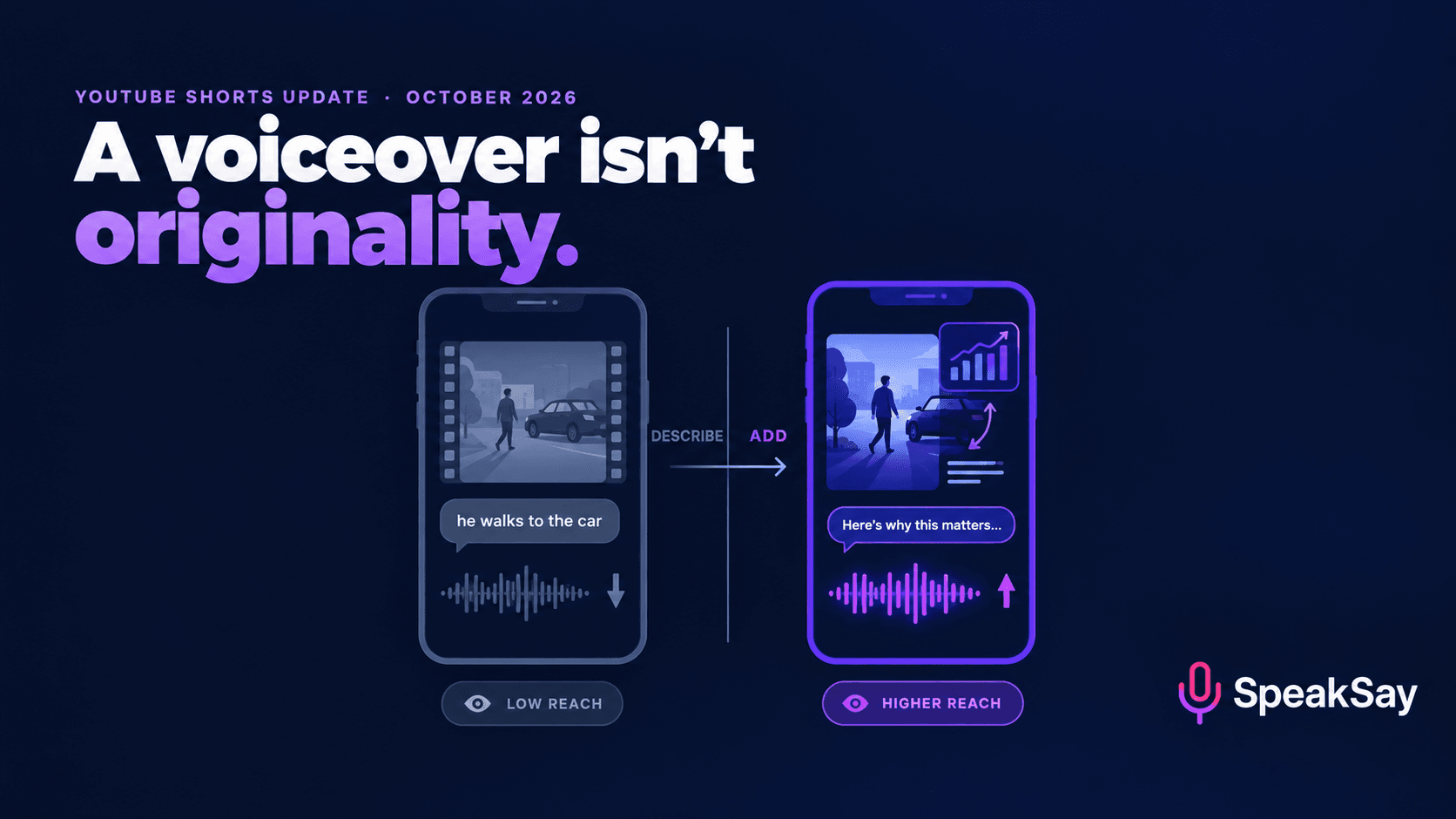
- Voiceover is called out by name. Ritchie said creators who remix another creator's clip need to add value of their own, "not just VO descriptions of what's happening on screen," minor technical edits, or template-based bulk changes. He asked for commentary, analysis and storytelling instead.
- There is a way back. Ritchie said that if a channel shifts toward original content, "the recommendation system will re-evaluate reach."
- Sharing someone else's video has a separate route. Creators who just want their audience to see another creator's video were pointed to the Posts tab, so viewers watch the original upload.
As AITuber's running log of 2026 changes puts it, this is the only confirmed ranking change YouTube has announced this year. The other 2026 changes affected labels, view counting or who can earn. This one affects who gets shown.
2. What YouTube didn't say
Don't plan around details nobody has given you. As of October 6, 2026, the announcement doesn't include:
| Open question | What we know | What to do about it |
|---|---|---|
| Start date | None given. Coverage dates the announcement to October 1 | Treat it as live now |
| How long re-evaluation takes | No timeline | Expect weeks, not days, and change the channel's mix rather than single uploads |
| Whether your channel was flagged | No Studio indicator | Watch Shorts-feed traffic share and engaged views on your recent uploads compared with your own baseline |
| Monetisation | The video is about recommendations only. The existing reused-content policy still says borrowed content must be changed "significantly to make it your own" | Assume both apply: one cuts reach, the other can cut pay |
| Cutting Shorts from your own long videos | Not discussed | Your own footage is your own work. This update is about other creators' clips |
Instagram already does something similar. Accounts that "primarily re-upload others' work" lose recommendation eligibility, and they can regain it when most of their recent posts over a rolling 30 days are original. YouTube hasn't published a window like that. Instagram's version is still a sensible model to plan against.
3. Who is hit, and who isn't
The update never mentions AI. A faceless channel with its own scripts and its own visuals is making original work, whether the voice is synthetic or not. The channels at risk are the ones whose footage belongs to someone else.
| Channel type | Risk after Oct 1 | Why |
|---|---|---|
| Movie/TV recap Shorts with narration over scenes | High | Borrowed footage plus a voice that mostly retells what's on screen is the case Ritchie described |
| Podcast-clip or interview-clip channels (someone else's show) | High | Aggregating other creators' clips is the target, even if you add captions |
| "Satisfying" or viral-video compilations with an AI narrator | High | Compilation plus description is a minor technical change |
| Sports or gaming highlights with play-by-play voiceover | Medium to high | Play-by-play describes. Analysis of why the play worked adds |
| Reaction or commentary where your take is the point | Lower | Commentary and analysis are what YouTube asked for, provided they make up most of the runtime |
| Scripted explainer with your own or generated visuals and an AI voice | Not the target | The work is original, and the voice is just how it's delivered |
| Shorts cut from your own long videos | Not the target | It's your footage |
Also look at your own templates. A channel that posts the same structure fifty times with one noun swapped isn't re-uploading anyone, but "template-based bulk changes" was one of the three things Ritchie listed. That overlaps with the July 2026 inauthentic-content groups we covered in our originality checklist.
4. The describe-vs-add test for every line
Ritchie's phrase gives you a simple test. Print the script, take two highlighters, and mark every sentence as one of two kinds:
- Describe: the sentence tells the viewer something they can already see or hear. "He opens the door." "The crowd goes wild." "She grabs the knife." With the sound off, the picture would carry the same information.
- Add: the sentence gives the viewer something the footage can't. Examples are a claim, a reason, a number from outside the clip, a comparison, a prediction, a verdict, a joke at the clip's expense, or a story that connects this clip to something else.
Then count the words. Here's a rough guide we use. It isn't a YouTube threshold:
| Share of "add" words | What the Short is |
|---|---|
| Under 30% | Narration over someone else's video. This is the case named on October 1 |
| 30–60% | Mixed. It depends on how much of the screen time is borrowed |
| Over 60%, and the borrowed footage is a minority of the runtime | Commentary. Your take is the reason to watch |
A second check: mute the footage and listen to the voice track alone. If it still makes sense and still says something worth hearing, you've made something. If it only makes sense with the picture, you've written captions.
5. Rewriting a "describe" script into an "add" script
Here's a typical 30-second recap script and a rewrite of the same beat. (The example is made up.)
| Describe version | Add version |
|---|---|
| "The detective walks into the room. He looks at the table. He sees the cup is still warm. He turns to the suspect." | "Watch the cup. Writers love this clue because it does two jobs at once: it sets the time of the crime and it makes the suspect lie on camera. Three seasons later, the same trick decides the finale." |
| "The striker runs past two defenders and scores." | "Everyone talks about the finish. Look at the run before it. He starts offside and walks back onside a second before the pass, which is why the defender stops." |
| "The host asks him about money and he laughs." | "He laughs because this is the third time he's dodged this question this year. Here's what he said the first two times." |
The rewrites share four habits:
- Open with your claim, not with the footage. "Watch the cup" tells the viewer you're about to show them something they'd miss.
- Use outside knowledge. Earlier episodes, a rule, a statistic, a past quote. The clip can't supply it, and you can.
- Take a position. A verdict or prediction belongs to you. A description belongs to whoever filmed the clip.
- Use less footage. When your voice is doing the work, you need five seconds of the clip, not forty.
That last point matters most. The test isn't only about the script. It's also about how much of what's on screen belongs to someone else.
Your take, in a voice that holds attention
Analysis scripts are denser than recap scripts, and they need a voice that can carry a claim without sounding flat. Try your rewritten script in a few SpeakSay voices and keep the one that sounds like it means it.
6. Moving from borrowed footage to your own visuals
A better script helps, but a channel whose screen is 90% someone else's video is still mainly a re-upload channel. Shift the footage mix over the next month:
- Diagrams and annotated stills. One still frame with arrows and labels, held while you explain, is your own visual and often reads better than a moving clip.
- Charts and timelines made for the specific claim you're making.
- Generated or illustrated scenes made for your script, not lifted from a film.
- Text-on-screen beats for numbers and quotes, timed to the voice.
- Short, cited clips only where the viewer has to see the moment for your point to land. Use a few seconds, not the scene.
If you've been running a pure clip channel, this is a real change of format, not a tweak. The channels that come through it usually end up as commentary channels with a recognisable point of view. That's also better protection against the next policy change.
7. Where the AI voice still fits
None of this is a case against AI voiceover. YouTube has said that AI labels don't affect recommendations or pay, and that the inauthentic-content rules look at sameness, not tools. The October 1 change is about whose work is on screen and whether your voice adds anything. A synthetic voice reading original analysis is fine. A human voice reading "he opens the door" over a film clip isn't.
What changes is the job the voice has to do. Recap narration can be flat because the footage carries the interest. Commentary has to carry the interest itself, so:
- Pick a voice that can sound sure of itself. Claims and verdicts need weight on the key word. Test voices on your most opinionated line, not your intro.
- Give each sentence one job. Analysis sentences tend to run long. Split them so the voice can land each point.
- Use a hook voice and an explainer voice where it helps. We explain why the same voice often fails at both in hook voice vs explainer voice.
- Keep one consistent voice for the channel. A recognisable narrator with a recognisable opinion is part of what makes a channel original rather than an aggregator.
8. A 30-day plan for a clip channel
- Days 1–3: audit. Run the describe-vs-add test on your last 20 Shorts. Estimate the share of borrowed screen time in each. Note which ones did best on engaged views, which YouTube now separates from public views. You'll usually find your best performers already had the most opinion in them.
- Days 4–7: pick your angle. Decide what your channel knows that the clips don't, such as rules, history, stats, craft or behind-the-scenes. That becomes the "add" in every script.
- Days 8–21: publish the new format. Every Short gets a claim in the first line, at least 60% "add" words, and borrowed footage cut to the seconds that prove the point. Use your own visuals for everything else.
- Days 22–30: stop the old format. Because the judgment is made at channel level, a mix that's still mostly re-uploads will still read as a re-upload channel. Unlist or stop posting the pure recaps.
- After that: measure against yourself. Compare Shorts-feed traffic and engaged views with your pre-October baseline. YouTube gave no timeline for re-evaluation, so judge over several weeks.
If Shorts are your whole channel, look at the February 2027 Partner Program changes too. We cover the Shorts-only trade-offs in the Shorts-first monetisation strategy.
Voice a whole season of original Shorts for one price
Commentary channels rewrite and re-render a lot. Check the plans and pick one that covers the volume of an analysis-first channel.
9. FAQ
Does adding a voiceover make a reused clip original on YouTube?Not by itself. In YouTube's October 1, 2026 Creator Insider video, Rene Ritchie said voiceover descriptions of what's happening on screen, minor technical edits and template-based bulk changes don't make another creator's clip your own. Commentary, analysis and storytelling do.
What did the October 2026 YouTube Shorts update change?The Shorts feed now further prioritises original Shorts. Channels that mainly aggregate or re-upload other creators' clips without significant changes will likely get less distribution. Channels that shift to original work will have their reach re-evaluated.
Is YouTube penalising AI voiceovers?No. The update doesn't mention AI. YouTube has also said AI labels don't affect recommendations. The target is borrowed footage with little added. A Short with your own script and your own visuals is original whether the voice is human or AI.
How do I know if my channel's reach was cut?YouTube hasn't added a Studio flag. Compare your Shorts-feed traffic share and engaged views on recent uploads against your own baseline from before October 1, over several weeks.
Does this affect monetisation?The October 1 video is about recommendations. YouTube's existing reused-content monetisation policy still applies and already requires borrowed content to be changed significantly. A channel can be affected by both.
Can I still post clips from my own long videos as Shorts?Yes. The update is about other creators' clips. YouTube didn't discuss cutting Shorts from your own uploads, and that footage is your own work.
How much commentary is enough?YouTube hasn't given a number. As a working rule, aim for most of your script to add something the footage can't, and for borrowed footage to be a minority of the screen time. The mute test helps: your voice track should make sense with no picture.