YouTube Will Test Three Cuts of Your Video: Make Three Intros in One Afternoon With Your Voice Clone (2026)
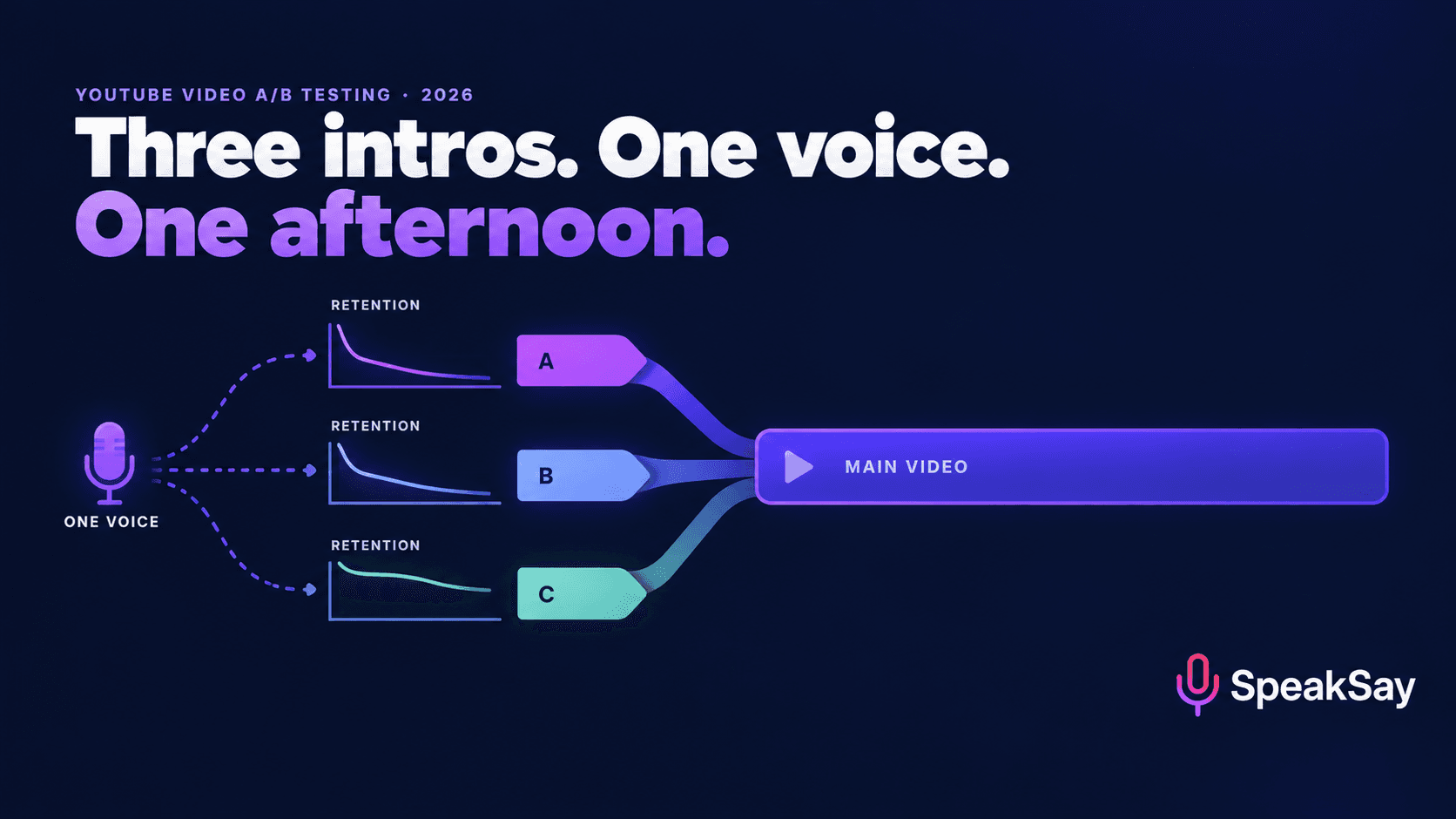
YouTube showed full-video A/B testing at Made on YouTube 2026: upload up to three cuts and see a retention curve for each. Most creators will test different openings, and re-recording three cold opens that match is the hard part. Here's what YouTube has confirmed so far, what to vary, and how a clone of your own voice lets you make intros B and C from text that match the rest of the video.
1. What YouTube has confirmed (and what it hasn't)
Here's what the September 23 YouTube blog post, the September 25 Creator Insider demo and PPC Land's breakdown of both tell us:
| Item | Status |
|---|---|
| Test up to three cuts of one video | Announced as "coming soon" in YouTube's written materials. The demo uses the present tense |
| Per-cut watch-time retention curves | Shown in the demo |
| Shorts | The narration says "shorts or long form." The video description mentions testing hooks for Shorts. The scope isn't settled |
| Release date and eligibility | Not given. PPC Land notes that last year's title testing reached creators 84 days after it was shown on stage |
| How traffic is split, test length, what happens to a losing cut's views and comments | Not stated |
| Whether YouTube applies the winner automatically | The demo says it "helps you select" the cut, which suggests you decide |
| Related: dynamic thumbnails (up to three, shown to different audience segments) and draft feedback on pacing | Shown alongside, also "coming" |
That means you have time to prepare before it reaches your channel. The most useful thing to prepare is a cheap, repeatable way to make alternative openings.
2. Why most tests will be intro tests
You can test anything across three cuts: pacing, segment order, a different ending. But the retention curve says the opening is where most of the decision happens. Strategist Paddy Galloway, who was at the event, wrote that he plans to "heavily use this with intros." Joycast's podcast newsletter made the same point: three cuts that differ only in the hook are, in practice, three cold opens.
There's also a counting reason. Since August 24, 2026, YouTube counts a public view from the first frame, while pay still follows engaged views. The first seconds now decide whether a start turns into a watch. For Shorts the case is stronger still: almost all Shorts views come from the feed, which shows no thumbnail, so the first seconds do the job a thumbnail does on long-form.
So the realistic test is the same video body with three different first 15 to 45 seconds.
3. The problem with re-recording three openings
Recording three intros sounds easy until you try to cut them onto a body you recorded last week:
- The room has changed. Different day, different mic distance, different background hum. The join between intro and body is audible, and viewers notice a jump in sound even if they can't say what it is.
- Your energy has changed. Intros recorded on their own come out hotter than the body, so each cut sounds like a trailer followed by a different video.
- The three takes differ in more than one way. If intro B is also louder and faster, you won't know whether the words or the delivery won.
- It takes a long time. Setting up, recording, re-recording the fluffed line and editing three times for every video adds up.
A clone of your own voice, built from clean recordings in your usual setup, solves the first three and cuts the fourth. You write the alternative hooks as text and render them in the same voice, at the same level and pace as the body.
4. The voice-clone workflow for three intros
- Build the clone from your real narration setup. Use the same mic, room and distance as your videos, so the clone matches your actual recordings. If you don't have a clone yet, our guide to cloning your own voice for narration covers the recording session.
- Record the video as normal, including intro A. Your real performance stays the default cut.
- Write hooks B and C as text. Keep them the same length as intro A, give or take five seconds. Make sure each one hands off cleanly into the first sentence of the body.
- Render B and C with the clone. Match the pace of your real body narration. Render each line two or three times and keep the take whose energy matches the first body sentence, not the most exciting one.
- Level-match. Bring all three intros to the same loudness as the body before export, so loudness isn't what you end up testing.
- Cut three versions that are identical after the intro. Same body, same end screen.
A practical tip: render intro A with the clone as well, as a control, and listen to it next to your real intro A. If you can hear the difference, viewers can too. Either use the clone for all three intros or re-record a better reference before trusting the test.
Build the clone once, then render hooks whenever you need them
A SpeakSay voice clone made from your normal narration setup can render a new opening line in minutes, so trying three intros costs one afternoon, not three sessions.
5. What to vary, one thing per cut
A test only tells you something if the cuts differ in one way. These are the variables that move early retention, with an example of each on a made-up video about why old bridges outlast new ones:
| Variable | Cut A (control) | Cut B | What it tests |
|---|---|---|---|
| Opening line type | Statement: "Roman bridges are still standing. Ours are falling down." | Question: "Why is a 2,000-year-old bridge safer than one built in 1970?" | Claim vs curiosity |
| Payoff timing | Promise the answer at the end | Give half the answer in the first 10 seconds | Whether viewers stay for the full answer once they've had a taste |
| Stakes | Engineering puzzle | "The bridge you drive over today might be one of them" | Abstract vs personal |
| Length of cold open | 40 seconds of setup | 15 seconds, then straight into the body | Patience |
| Proof first | Explain, then show | Show the cracked beam first, then explain | Evidence vs narrative |
Pick two variables per video at most: cut B changes one, cut C changes the other. Keep the voice, music, visuals behind the voice and loudness the same, unless one of those is the thing you're testing.
If your opening line and your explaining tone fight each other, read hook voice vs explainer voice. A hook that's very different from the body can win the first 10 seconds and lose the next 60.
6. Splicing clone lines into a real recording
If your intros mix real takes with cloned lines, or a cloned intro hands off to your real body, the join is where it can give itself away. Check these:
- Room tone. Record 10 seconds of silence in your normal setup and lay it under the cloned lines, so the background doesn't drop to digital silence and back.
- Breath at the join. Leave a natural breath gap, about 0.3 to 0.6 seconds, between the last cloned word and your first real word.
- Pitch at the join. End the cloned intro on a falling, finished sentence. A rising cloned line handing off to a flat real one sounds like two people.
- Same EQ and compression. Run the cloned lines through the same chain as your recorded voice.
- Check on a phone speaker. Joins that pass on headphones can show up on a phone, and that's where most Shorts are heard.
If your clone sounds a little different on every render, fix that before testing. Otherwise the test measures the drift. See fixes for voice-clone drift.
7. Reading the results without fooling yourself
- Look at the shape, not just the winner. A cut that wins at 30 seconds but drops below the others by the midpoint may have over-promised. A retention curve shows that, and a single number hides it.
- Keep a test log. For every video, record the variable, the three hooks and the result. After ten videos you'll see your channel's own patterns, which matter more than any generic rule about hooks.
- Don't over-read small channels. With low traffic, small differences between cuts can be noise. Treat a narrow win as "no difference" and pick the version you like.
- Make the winner your template, not your script. If questions beat statements five times in a row, start with questions, and keep testing the next variable.
This post is about testing what your opening says. If you want to test whether a different voice holds viewers better, that needs a different design. We cover matched pairs and stopping rules in how to A/B test an AI voice.
8. Ground rules: disclosure and sponsors
- Clone only your own voice, or a voice whose owner has agreed in writing. A co-host's voice in your test intros needs their yes.
- Disclosure. YouTube's AI disclosure is aimed at realistic altered or synthetic content that viewers could mistake for real. A cloned intro of your own voice saying things you'd say is a grey area. Check the current Studio guidance when you upload, and disclose if in doubt.
- Sponsored videos. PPC Land points out that YouTube hasn't said whether a video with a paid promotion can be entered into a cut test, or whether the disclosure label follows each cut. Keep the sponsor read identical in all three cuts, or test only unsponsored videos until YouTube says how this works.
- Don't promise in the hook what the body doesn't deliver. The curve will show it, and so will the comments.
Test every video for one up-front cost
Testing three hooks on every upload adds up to a lot of rendering. The SpeakSay Lifetime Plan covers your clone and your renders without a monthly bill.
9. FAQ
What is YouTube video A/B testing?A YouTube Studio feature announced at Made on YouTube 2026. It lets creators upload up to three cuts of the same video, shows them to different viewers, and reports watch-time retention for each, so you can pick the version that holds attention best. YouTube describes it as coming soon, with no date yet.
Is it the same as title and thumbnail testing?No. Title and thumbnail tests, available since late 2025, measure whether people click and then watch. Video cut tests measure where viewers leave inside the video.
Does it work for Shorts?The demo narration says Shorts or long-form, and the video description mentions testing hooks for Shorts. YouTube hasn't published final eligibility.
Why use a voice clone instead of recording three intros?Intros recorded on a different day rarely match the body's room sound, level and energy, so the test ends up measuring those differences rather than your words. A clone built from your normal setup renders alternative hooks that match.
How different should the three cuts be?Change one variable per cut, such as question vs statement, early vs late payoff, or short vs long cold open. Keep everything else, including voice and loudness, the same.
Do I need to disclose a cloned intro?YouTube's disclosure rules are aimed at realistic synthetic content that could mislead viewers. Check the current guidance in Studio when you upload, and disclose if in doubt. Only clone voices you have permission to use.