AI Voices Cost You Listeners Everywhere, but Three Times Less on Video: What Audio Primes vs Video Primes Means for an AI-Voiced Podcast (2026)
New audience research splits podcast fans into people who mostly listen and people who mostly watch. Both groups lean against AI voices, but listeners lean against them more than three times as hard. If you make an AI-voiced show, that changes where you publish first, what the screen has to do, and how you disclose.
1. The data: Audio Primes vs Video Primes
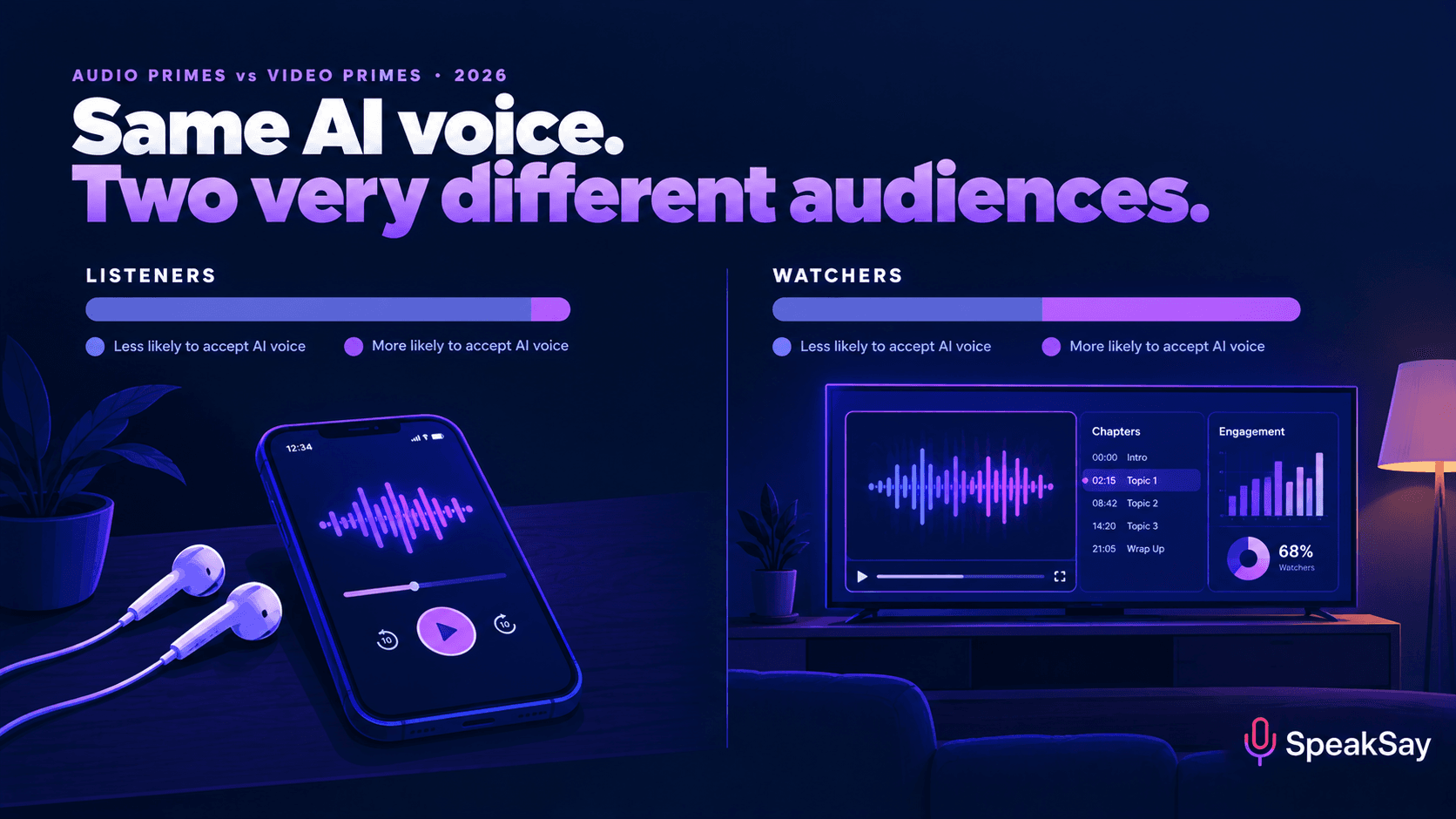
In April 2026, Sounds Profitable published a study called Audio Primes, built on data from its Podcast Landscape 2025 survey. It splits podcast consumers by how they consume, not by age:
- Audio Primes consume at least 75% of their podcasts as audio. They are about 22% of podcast consumers. Counter to the stereotype, they skew slightly younger than the overall podcast audience.
- Video Primes watch at least 75% of their podcasts.
Both groups were asked how they'd react if they learned that one of their favourite podcasts used AI-generated voices:
| Less likely to keep listening | More likely | Net (more minus less) | |
|---|---|---|---|
| Audio Primes (mostly listen) | 48% | 15% | −33 |
| Video Primes (mostly watch) | 40% | 30% | −10 |
The net figures are our own arithmetic on the published percentages. Tom Webster, who wrote up the finding, described the Video Primes' 30% "more likely" as double the enthusiasm of audio-first listeners.
One more data point from the same research group changes how much this matters. In The Podcast Landscape 2026, the smart TV became the most-used podcast device for 12% of podcast consumers, up from 8% in 2024. Counting first and second most-used devices together, it's named by 25%. It is the only device that has taken share from the phone. More podcast time is happening on a screen, often in front of a couch.
2. Read it honestly: a penalty everywhere, just not the same size
It would be easy to read the Video Primes number as "watchers like AI voices". They don't, on balance. Forty percent said less likely, which is more than the 30% who said more likely. The fair reading is:
- An AI voice costs you some audience in both groups. If a human voice is realistic for your show, the data doesn't say switch to AI.
- The cost is about three times larger among listeners (net −33 against −10).
- A real minority of watchers actively prefer it. Three in ten Video Primes said an AI voice would make them more likely to stay. That's a meaningful audience, not noise.
Two caveats. The question was hypothetical, about learning that a favourite show used AI voices, so it measures reaction to a change and a discovery, not to a show that was AI-voiced and disclosed from day one. And stated intent in surveys is not the same as behaviour. Use these numbers to choose a direction, then check them against your own analytics (section 8).
That "discovery" wording matters. We covered the related Edison finding in our post on why listeners feel deceived by AI host swaps: much of the anger is about the secret, not the sound.
3. Why watchers mind less
Webster offers an explanation that fits what creators see. Video-first audiences have spent years around synthetic content: AI narrators, avatars and voiceovers on YouTube and TikTok. They've already made peace with "this isn't a real person, and I don't mind." Audio-first listeners haven't, because in audio the voice is the whole medium. A synthetic voice there isn't one element among several. It replaces the thing they came for.
We'd add a practical point: on video, the voice shares the work. Charts, footage, captions and chapter titles carry part of the meaning and part of the personality. When attention is split between eyes and ears, the voice only has to be clear and consistent. In pure audio, it has to be the company too.
That gives you a design principle, not just a channel choice: the more the visual layer carries, the less the AI voice is asked to carry, and the smaller the penalty.
4. Where an AI-voiced show should publish first
If your show is AI-voiced (an AI-narrated explainer series, a research digest, a document-to-podcast show), the data points to a clear default: lead on video, and treat the audio feed as a second surface.
- Launch on YouTube as a video podcast. That's where the audience with the smallest penalty is, and where the fastest-growing device, the TV, is pulling consumption.
- Optimise for the big screen, not just the phone. Twelve percent of podcast consumers now use a TV most. Text has to be readable from across a room, chapters should be clean, and the visuals should work without anyone touching the screen for 20 minutes.
- Still publish the audio feed. Some watchers switch to audio in the car or at the gym. Just don't build your growth plan on audio-first discovery, because that's where your AI voice costs you the most.
If you haven't built the video side yet, our walkthrough on turning an AI podcast into a video podcast without a camera covers the mechanics.
Build the episode once, publish it twice
Generate your episode audio with SpeakSay's AI podcast tools, then pair it with visuals for YouTube and keep the same file for your audio feed.
5. Make the screen earn its place
Lead with video and you still lose if the "video" is a static cover image with a bouncing waveform. That's an audio podcast uploaded to a video platform, and watchers will treat it like one. The visual layer needs to do real work:
| Visual element | What it does for an AI-voiced show | Effort |
|---|---|---|
| On-screen sources and quotes | Shows the claim while the voice says it, which builds trust the voice alone can't | Low |
| Charts and numbers | Moves precision from ear to eye, so the narration can stay conversational | Medium |
| Chapter titles as full-screen cards | Helps TV viewers follow structure without a scrub bar | Low |
| Burned-in or styled captions | Covers mispronunciations and noisy rooms, and helps comprehension on a TV across the room | Low |
| A consistent visual host (illustrated character, set or graphic style) | Gives viewers something to recognise besides the voice | Medium to high |
| Static waveform on cover art | Nothing. Watchers notice | None |
A useful test: mute the episode and scrub through it. If a viewer could follow the gist from the screen alone, the visual layer is carrying its share. If they'd see the same image for 20 minutes, it isn't.
6. What to do about the audio feed
You'll still have audio-first listeners, and they're the most valuable listeners in podcasting. The Audio Primes report describes them as heavy listeners who recommend shows at higher rates. Three moves keep the penalty down with them:
- Disclose early and plainly. Say in the first 30 seconds, and in the show notes, that the show is produced with AI voices and who is responsible for the content. The survey measured reaction to finding out. Don't let anyone find out.
- Keep a human in the audio where it counts. A short human-recorded intro, a human-read listener mailbag, or a human co-host on some segments can change how the show feels. Our guide to building a listener community around an AI-made podcast covers the segments that work.
- Write for the ear, not the eye. Charts and on-screen sources don't exist in the audio feed. If a segment relies on them, add a sentence that describes what's on screen, or cut that segment from the audio version.
And if your show is host-led, meaning listeners come for a specific person, the data and the Edison research point the same way. Use AI around the host (editing, translation, show notes, corrections), not in place of them.
7. Decision table by show type
| Show type | AI voice fit | Lead surface | Note |
|---|---|---|---|
| Explainers, news digests, research summaries | Good | Video first | Visuals carry sources and data, and the voice carries clarity |
| Document-to-podcast (reports, courses, internal comms) | Good | Wherever the audience already is | Often a private or internal feed, where the public survey matters less |
| Fiction and audio drama | Mixed | Audio (it's the format) | Disclose clearly. Consider performance-led voice conversion over pure TTS |
| Personality or host-led conversation | Poor for the host role | Either | Keep the host human and use AI around them |
| Translated editions of an existing show | Good | Match the original | Listeners expect localisation tools. Say it's a translated edition |
8. Measure your own split
Survey averages are a starting point. Your audience may differ. Run your own check over 6–8 episodes:
- Retention by surface. Compare average percentage consumed on YouTube with completion rates in your audio host's analytics for the same episodes. If audio completion trails video by a wide margin, that's consistent with the listener penalty.
- Comment sentiment. Count comments that mention the voice, positive and negative, on each platform. On video, watch for "the voice is fine, the visuals are great". On audio, read your reviews.
- TV share. YouTube Analytics reports watch time by device type. If TV is a big share of your watch time, design for it: larger text, cleaner chapters.
- Disclosure test. If you haven't been disclosing, add a clear line and watch retention for the next few episodes. If listeners leave because of the disclosure, they were likely to leave when they found out anyway.
Produce for both surfaces without doubling the work
One script, one render, two versions. SpeakSay's plans are built for regular episode production, whether you publish weekly or daily.
9. FAQ
Do people actually listen to AI-voiced podcasts?Yes, but acceptance depends on how they consume. In Sounds Profitable's data, 48% of audio-first listeners said an AI voice on a favourite show would make them less likely to keep listening, against 40% of video-first viewers. A further 30% of video-first viewers said it would make them more likely to stay.
What are Audio Primes and Video Primes?They're Sounds Profitable's terms for podcast consumers who take at least 75% of their podcasts as audio (Audio Primes, about 22% of podcast consumers) or watch at least 75% of them as video (Video Primes). They describe consumption habits, not age groups.
Should my AI podcast be on YouTube or audio apps first?If the show is AI-voiced, the data favours leading on video. The penalty for an AI voice is smaller there, and smart-TV viewing is growing. Keep an audio feed too, but expect more resistance from audio-first listeners.
Does disclosing an AI voice hurt my podcast?The survey measured reaction to learning a favourite show used AI voices, so being found out is the scenario to avoid. Disclose early and plainly, and the people who stay are the ones who chose the show knowing what it is.
Is a waveform video enough for YouTube?No. A static image with a waveform is an audio podcast on a video platform. The visual layer should carry sources, data, chapters or a recognisable visual identity so the voice isn't doing all the work.
Is this data reliable?It comes from Sounds Profitable's Podcast Landscape research, a large survey of US podcast consumers. It measures stated reactions to a hypothetical, so treat it as a direction and confirm it with your own retention and comment data.