Grandma Does All the Voices: Record a Storybook Gift for the Grandkids and Voice Every Character Yourself (2026)
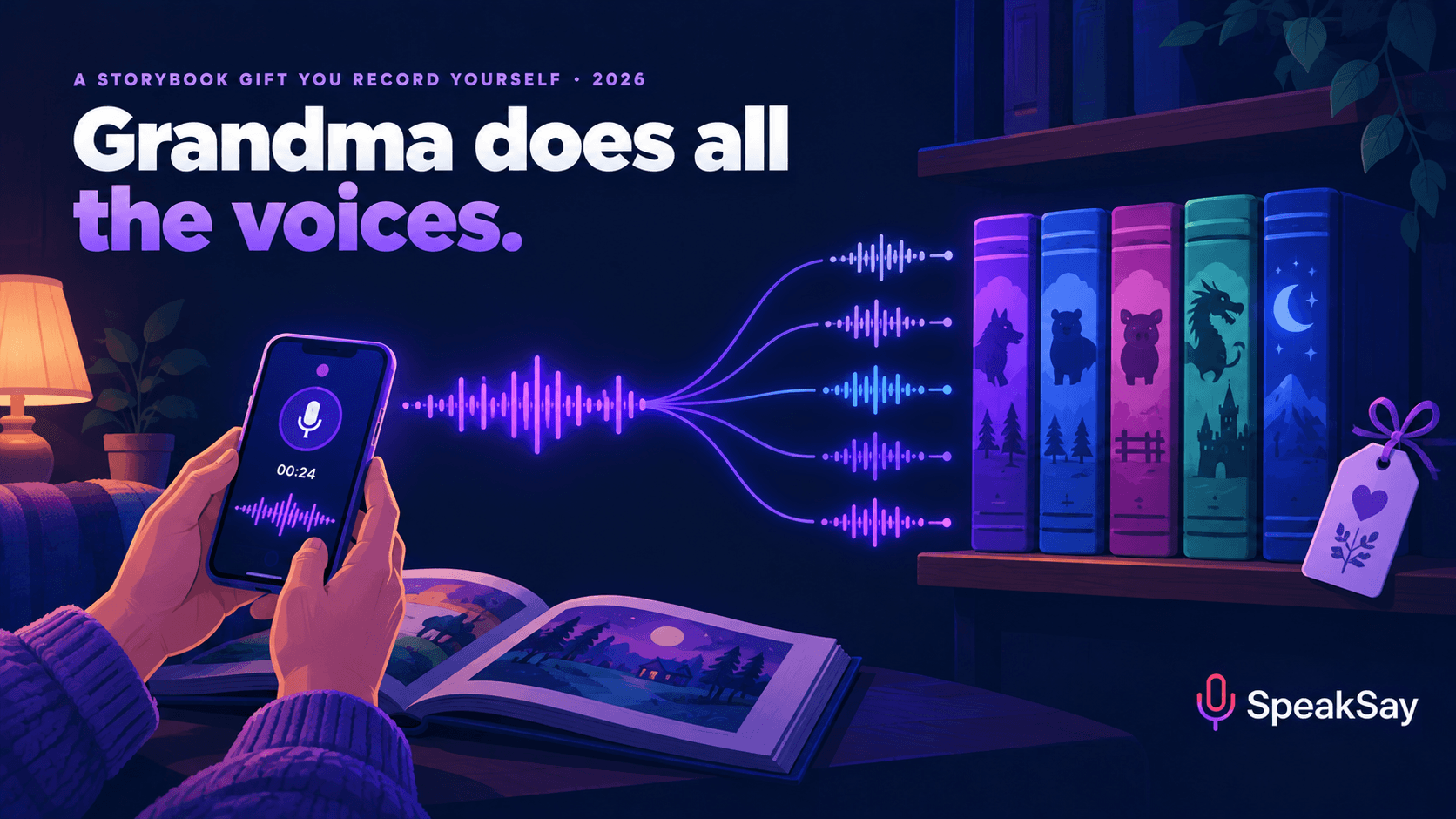
A recordable storybook holds one story. With a phone and an afternoon, a grandparent can record a whole shelf of bedtime stories in their own voice, and with Voice Remix they can voice the wolf, the bear and the dragon too while keeping their own timing. Here's how to choose the stories, record them, make the character voices, package the gift and finish before Christmas.
1. Recordable storybook vs a recorded story shelf
A 2026 buyer's guide from afterlife.ai puts good recordable storybooks at roughly $20 to $35, and Hallmark's sell for $39.99. They're simple, and the child holds the book while Grandma's voice reads it. Here's how they compare with recording stories yourself:
| Recordable storybook | Recorded story shelf | |
|---|---|---|
| Stories | One fixed text per book | As many as you record. Five to ten is a good gift |
| Cost | About $20–$40 per book | A phone you already own, plus any tools you use |
| Character voices | Only if the reader does them live | Read them yourself, then make them more distinct with Voice Remix |
| Personal touches | Limited to the printed text | Child's name, family jokes, your own made-up stories |
| Durability | Batteries and sound modules wear out | Files can be copied and kept for years |
| Holding the book | Yes, built in | Pair the audio with a printed copy, or not |
| Effort | Ten minutes | A few evenings |
The two aren't mutually exclusive. Plenty of families do both: a recordable book for the youngest, plus a shelf of recorded stories for bedtime.
2. Choosing the stories
Pick a mix of stories, for both enjoyment and practical reasons:
- A family story. How you met Grandpa, the day their parent was born, the dog you had as a child. These are the recordings families value most years later, and they belong entirely to you. We cover longer family stories in our guide to family-history podcasts.
- Classic fairy tales. Old folk tales such as the Three Little Pigs, Goldilocks or Little Red Riding Hood are traditional stories. Tell them in your own words, which also makes them sound like you.
- A story you make up. Put the grandchild in it. A dragon who's afraid of the dark, a cat who runs the bakery. Five minutes long is plenty.
- A favourite picture book. If you want to read a published book word for word, keep that recording within the family. Recording a book for your own grandchild at home is a different thing from posting it publicly, which can raise copyright issues. Don't upload it to YouTube or share it beyond the family. This isn't legal advice, so if you're unsure, stick to your own words.
Aim for 4–10 minutes per story for under-sixes. That's long enough to settle into and short enough to finish before sleep.
3. Recording on a phone
Most phones record good enough audio for this if the room is right. The room matters far more than the device:
- Pick a soft room. A walk-in wardrobe, or a small bedroom with curtains closed and a duvet over a chair, is better than a kitchen with hard surfaces.
- Use the built-in voice recorder app. Avoid messaging apps' voice notes for the final recordings, because many compress the audio heavily. Record locally, then send the file.
- Hold the phone at a steady distance. About a hand's width from your mouth, slightly to the side so your breath doesn't hit the microphone. Prop it on a book stack so it doesn't move.
- Start with a greeting. "Hello Maya, it's Grandma. This is the story of the dragon who was scared of the dark." Children love hearing their own name.
- Read slowly and leave gaps. Pause where you'd turn a page. If the gift includes a printed book, a gentle "turn the page" or a soft chime tells the child when to turn.
- Keep the mistakes you like. A laugh or a "Whoops, let me try that again" is part of the charm. Only re-record what would confuse a child.
If the grandparent isn't comfortable with technology, split the job. They read, and a son, daughter or older grandchild handles everything else in the next two sections.
4. Doing the character voices with Voice Remix
Many grandparents already do voices: a growly wolf, a squeaky mouse. The problem is that, in a recording, these often still sound like Grandma doing a funny voice. That's fine, and often lovely. But if you want the wolf to sound like a wolf, Voice Remix can turn your performance into a different voice while keeping your timing, pauses and emotion. It's still your performance, just in another character's voice.
This is the same workflow puppet teams use when one performer voices every puppet:
- Record the whole story straight through, doing the characters in a rough voice of your own. Don't stop to switch tools. The flow of the story matters most.
- Cut out each character's lines into separate short clips. Any free audio editor will do this. Keep the narration untouched.
- Remix each character's clips into a voice that fits: deep and gravelly for the giant, small and bright for the mouse. Use the same voice for that character every time.
- Put the clips back in place in the original recording, in the same gaps.
- Listen through once with a child in mind. Is anything too scary for this age? Make the wolf gruff, not terrifying. Bedtime is the goal.
Two rules keep it feeling like Grandma's gift:
- The narrator is always your real voice. Never remix the narration. The child should hear Grandma telling the story, with the characters as guests.
- Keep a voice sheet. Write down which voice you used for each recurring character. If the bear appears in three stories, he should sound the same in all three.
Try a character voice for free
Take one line you've recorded as the wolf or the giant and try it in SpeakSay's free tools. Hear the difference before you remix a whole story.
5. Packaging the gift
How you deliver the audio decides whether it gets played every night or sits in an email. Pick a format that fits how the family already does bedtime:
| Format | Best for | Notes |
|---|---|---|
| Children's audio player with blank cards or figures | Families who already own one | Several popular kids' players sell cards or figures you can load with your own recordings. Check that the player accepts custom audio before buying |
| Printed card with a QR code | Any family with a smartphone | Link to a private shared folder or unlisted playlist. Put a photo of Grandma on the card so the child knows whose voice it is |
| Printed book + matching audio | Your own made-up stories | Print a simple booklet of your story, with drawings from you or the grandkids, and pair it with the recording |
| USB stick or simple MP3 player | Families who want an offline copy | Name the files clearly, for example "01 The Dragon Who Was Scared of the Dark" |
Whatever format you choose, also give the parents a copy of the original files. Devices and links break, and these are recordings the family will want to keep for decades.
If you want to add a festive extra, our guide to a personalised Santa message made with Voice Remix uses the same technique.
6. If the grandkids want to join in
Once children hear the stories, some will want to record their own. That's wonderful. A few firm rules:
- Never clone a child's voice, and don't run children's recordings through tools you don't control.
- Get the parents' agreement before recording a grandchild, and let them decide where the recording goes.
- Keep children's recordings family-only. Don't post them publicly.
- Grown-ups' voices only for remixing. If a child wants to be the dragon, let them be the dragon in their own voice. That's the fun part.
And a note on cloning: some families clone a grandparent's voice so new stories can be generated later. That's a separate decision that needs the grandparent's clear, informed agreement, and we cover it in our guide to family voice cloning and voice banking. For this gift, we recommend the real thing: Grandma reading.
7. A timeline that finishes before Christmas
| When | What |
|---|---|
| Early–mid October | Choose 5–10 stories. Write or outline any original ones. Order a kids' audio player or blank cards if you need them |
| Late October–mid November | Record one or two stories per evening. Send files to whoever is doing the editing |
| Mid–late November | Cut character lines, remix them, reassemble and listen through |
| Late November–early December | Load the player or cards, print QR cards or booklets, wrap |
| By mid-December | Post or ship. Check your postal service's last recommended dates, which are often earlier than you'd expect for international mail |
If you're short on time, five stories is still a wonderful gift. You can add more for birthdays.
Ready to voice the whole cast?
Once you've tried a line for free, Voice Remix lets you turn every character in every story into a distinct voice, while the timing stays yours.
If you're making stories for several grandchildren, or plan to keep adding to the shelf through the year, compare plans before you start.
A shelf that keeps growing
Birthday stories, holiday stories, a new one every month. Choose a SpeakSay plan that fits how often you'll record.
8. FAQ
How can I record a story for my grandchildren?Use your phone's voice recorder in a soft, quiet room, hold the phone a hand's width from your mouth, start by greeting the child by name, and read slowly with pauses for page turns. Then send the file to the family or load it onto a kids' audio player.
What's a good alternative to a recordable storybook?A recorded story shelf: five to ten stories recorded in your own voice and delivered as audio files, on a kids' audio player, or via a QR code card. It holds more stories and lasts longer than a single sound-module book.
Can I record myself reading a published picture book?Recording a book for your own grandchild to hear at home is common. Keep it within the family and don't post it publicly, where copyright can become an issue. Fairy tales told in your own words, and your own stories, avoid the question entirely. This isn't legal advice.
What does Voice Remix do in a story recording?It turns your recorded performance of a character's lines into a different-sounding voice, while keeping your timing, pauses and emotion. The narration stays in your real voice, and the characters become distinct.
Do I need to clone my voice for this?No. This gift uses your real voice reading. Voice cloning is a separate choice that needs clear agreement, and we don't recommend it for this project.
How long should each bedtime story be?For children under six, aim for four to ten minutes. That's long enough to settle into and short enough to finish before sleep.
When should I start to have it ready for Christmas?Start choosing stories in October, record through mid-November, edit and remix in late November, and post by mid-December. Check international shipping deadlines, which are often earlier.