A 30-Second Sample Can Now Clone a Voice: What Those 30 Seconds Capture, What They Miss, and a Five-Line Test to Decide If You Need More (2026)
Google's new Gemini TTS can reportedly clone a voice from a 30-second sample. A short sample captures how you sound. It does not capture how you sound when you are excited, quiet, fast or reading for three hours. Here is what to expect from a short sample, how to record a good one, and a five-line test that tells you whether you need more audio
1. What changed, and what didn't
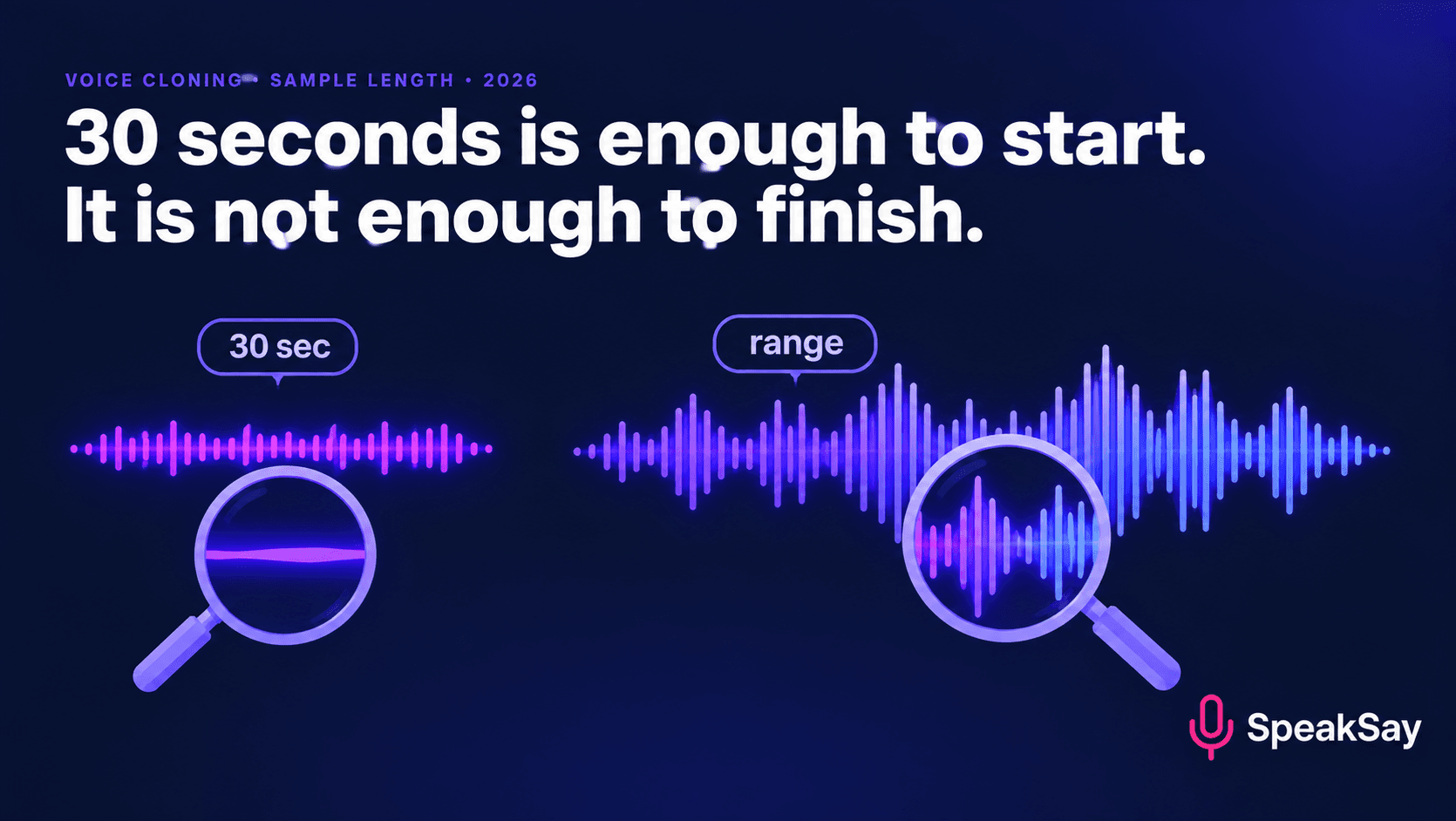
What changed is the entry point. Cloning used to mean reading a long script for a long time. Now at least one major provider says a 30-second sample is enough to create a voice, as long as the voice owner also records a verbal consent statement that matches the sample.
What didn't change is the physics. A voice is a pattern across many situations: calm and excited, fast and slow, a question and a statement, a whisper and a shout. A model can only learn what the sample shows it. The rest is guessed from what it learned from other voices.
That is not a flaw in any one product. It is the reason sample length and sample variety still matter.
2. What a short sample captures
- Timbre. The basic colour of your voice: the quality that makes friends recognize you on the phone.
- Typical pitch. Where your voice sits when you speak in a normal, conversational way.
- Accent, roughly. The main features of how you pronounce common sounds.
- Recording conditions. This one is a risk, not a benefit. Room echo, a fan, a cheap microphone and mouth noise can be learned along with your voice.
For a short social clip, a quick explainer or a voice message, that may be all you need.
3. What a short sample misses
- Emotional range. If the sample is flat and neutral, the clone will tend to be flat and neutral. Excitement, warmth and concern are hard to invent.
- Your pacing habits. How you pause, speed up on familiar words and slow down for emphasis.
- Stamina. A clone that sounds right for 20 seconds can drift over a ten-minute script or a nine-hour audiobook. Long-form is where small errors pile up.
- Other languages. The clone may carry your voice into another language, but the accent and rhythm in that language are the model's guess. See our guide to localizing a podcast with your cloned voice for how to check the results.
- Your quirks. A laugh, the way you say a catchphrase, the little breath before a punchline.
None of these matter for every project. They matter a lot for long-form, character work and anything where listeners know your voice well.
4. How to record the best 30 seconds
Quality beats length. A clean 30 seconds is better than two minutes in a noisy kitchen.
- Choose a quiet, soft room. A closet full of clothes, or a bedroom with a duvet, works better than a bathroom or an empty office.
- Keep your distance steady. About a hand's width from the microphone, and don't move while you read.
- Read, but don't perform. Speak the way you talk to a friend. Reading in a "radio voice" gives the model a voice you don't use.
- Use varied sentences. Include a question, a statement and a short exclamation. Include a number or two.
- Avoid music, fans and notifications. Turn the phone to silent.
- Don't process it. No noise suppression, auto-tune or heavy compression. If you need to clean the file, use a gentle tool such as a free noise remover and listen to the result.
- Play it back on headphones. If you can hear echo or hiss, record again.
Old recordings are a different problem: they are what you have, not what you would choose. Our guide to cloning a voice from old, poor-quality recordings explains the trade-offs.
5. The five-line test
Once you have a clone, don't judge it on the first sentence. Generate these five lines in it and listen with headphones. Replace the bracketed parts with your own words.
- Neutral: "Hi, this is [your name], and today I want to talk about [your topic]."
- Question: "Have you ever wondered why [something you care about] works the way it does?"
- Excited: "This is the part I'm most excited about, and I think you will be too."
- Slow and serious: "Before you go any further, one thing needs to be said clearly."
- Numbers and names: "On March 14, 2027, the price goes from $49 to $64.50, and [a name you often say]."
| What you hear | What it means |
|---|---|
| All five sound like you | The sample is enough for this kind of work. |
| Lines 1 and 2 sound right, 3 and 4 are flat | You need a sample with more emotional range. |
| The voice shifts character between lines | The sample was too short or too inconsistent. Add more, in one session. |
| Line 5 mispronounces names | This is a pronunciation issue, not a voice issue. See pronunciation fixes. |
| Hiss, echo or room tone appears | Record again in a better space. |
Then do a longer test: generate three minutes of real script and listen to the last 30 seconds. If the voice has wandered, you know you need more, or you need to break long scripts into shorter pieces.
Make a clone and run the five-line test
Record a clean sample, generate the five lines and listen on headphones. It takes less than ten minutes, and you will know whether a short sample is enough for your project.
6. Short or longer: a decision table
| Your project | Short sample may be enough | Plan for more audio |
|---|---|---|
| Short social clips and voice messages | Yes, if the sample is clean | Only if the clone sounds flat |
| Weekly explainer videos (5 to 10 minutes) | Possibly | Yes, if you want your natural energy |
| Podcast episodes | Test first | Yes, listeners know your voice well |
| Audiobook of several hours | Not as a starting point | Yes, and proof-listen carefully (see our risk-first sampling method) |
| Character or emotional work | No | Yes, with samples in each style |
| A voice you need to keep for years | Not alone | Yes, and refresh it over time |
The practical rule: start short, test, and add audio only where the test shows a gap. Adding recordings is cheap. Fixing a published series because the clone drifted is not.
7. Consent comes first
Google's design reportedly asks for a spoken consent statement and checks that it matches the voice in the sample. Whatever tool you use, the principle is sound: clone your own voice, or someone's voice with their clear permission, and keep a record.
- Write down what the clone may be used for and for how long.
- Record the owner saying so, in the same session as the sample.
- Keep the files together.
Our consent recording script template gives you ready-to-use wording. If you ever publish AI-voiced content, also read the disclosure rules for AI voiceovers.
Planning a long project in your own voice?
If you produce audio every week, a one-time plan can be cheaper than paying month after month. See what the Lifetime Plan includes.
8. FAQ
How much audio do you need to clone a voice?Some providers now say 30 seconds of clean audio can start a clone. For long-form, emotional or character work, more audio with more variety usually gives better results. Always run a test before committing to a project.
Is a longer sample always better?No. A short clean sample beats a long noisy one. Variety and quality matter more than minutes.
Why does my clone sound flat?Usually because the sample was flat. Record again with more natural energy, including a question and an exclamation, in one session.
Can I clone someone else's voice?Only with their clear, recorded permission, and for a defined purpose. Do not clone public figures or anyone who hasn't agreed.
Will my clone sound the same in other languages?The voice quality may carry over, but accent and rhythm in the other language are the model's guess. Have a fluent speaker check the result.