Google Now Requires a Spoken Consent Recording Before It Clones a Voice: How to Write and Record One (Scripts for Your Own Voice, Hired Talent, Clients and Family) (2026)
Google's new Gemini TTS will replicate a voice from 30 seconds of audio, but only after the voice owner records a spoken consent statement that matches the sample. Microsoft and ElevenLabs have similar checks. Here's what a good consent recording says, five scripts you can adapt, and the written record that should sit next to it.
1. What the platforms now ask for
| Platform | What it asks for | What it checks |
|---|---|---|
| Google Gemini 3.8 Flash TTS (voice replication) | A verbal consent recording from the voice owner | That the consent voice matches the reference sample. Every clip also carries a SynthID watermark, and replicated voices carry C2PA content credentials. |
| Microsoft Azure AI Speech (personal voice) | A recorded statement in the speaker's language, beginning "I [state your first and last name] am aware that recordings of my voice will be used by [state the name of the company] to create and use a synthetic version of my voice." | That the speaker in the statement is the speaker in the training audio |
| ElevenLabs (Professional Voice Clone) | Reading an on-screen prompt aloud within about 10 seconds | That the person verifying matches the voice in the uploaded data |
Google also notes that voice replication in AI Studio isn't available in Illinois, Texas, the EEA, the UK, Switzerland or India, which reflects how unsettled voice and biometric rules still are in many places.
The common thread: the platform wants to hear the voice owner say yes, in the same voice that's being cloned. That stops the most obvious abuse, which is someone uploading a stranger's podcast and cloning them.
2. What a consent recording proves, and what it doesn't
A spoken statement is strong evidence of one thing: the person whose voice is being cloned said, in their own voice, that they know it's happening.
It's weak evidence of everything else:
- Scope. A 15-second statement can't list every use. "Create and use a synthetic version of my voice" covers a lot.
- Duration. It doesn't say when permission ends.
- Payment and ownership. It says nothing about who owns the clone or what the speaker is paid.
- Withdrawal. It doesn't say how to take it back.
- Understanding. Reading a script aloud isn't proof the person understood it, especially if it was handed to them in a hurry or in their second language.
So treat the recording as a speaker-match check, and put the real agreement in writing next to it. This guide covers both. It isn't legal advice. For paid talent or commercial deals, have a lawyer review your written terms. Our guide to voice cloning law and consent covers the wider legal picture.
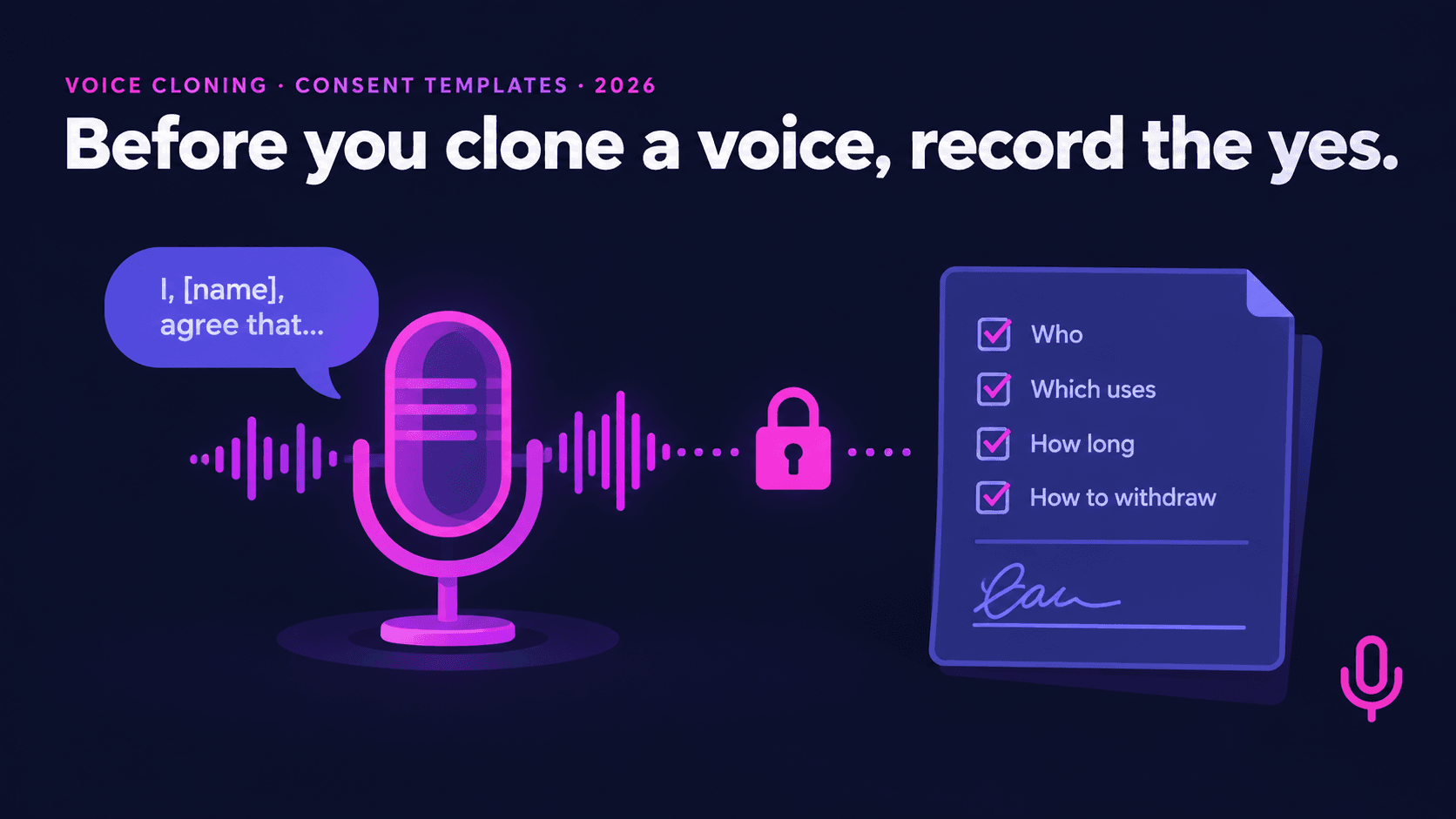
3. The seven things a good statement includes
- Full name, said by the speaker
- The date, said aloud
- Who will create and control the voice: a person, a company or both
- What it will be used for, in one plain phrase ("narration for my YouTube channel", "audio for Acme's training courses")
- That it's synthetic: the words "AI" or "synthetic version of my voice"
- That they agree freely
- That a written agreement has the details, including how to withdraw
Keep it under 30 seconds. Long statements get read in a flat, rushed voice, which is less convincing as a recording and makes the speaker-match check less reliable.
4. Five consent scripts to adapt
Replace the brackets. Keep the wording plain. If the speaker's first language isn't English, translate the script and have them record it in their own language.
Script A: your own voice
"My name is [full name], and today is [date]. I'm creating an AI clone of my own voice to narrate [my channel / my courses / my podcast]. I'm doing this by choice, and I control how it's used."
Even for yourself, it's worth recording. It helps if a platform asks you to prove ownership later, and it's the first file in your voice provenance folder.
Script B: hired voice talent
"My name is [full name], and today is [date]. I agree that [company or client name] will create a synthetic version of my voice using AI, for [project or use, e.g. 'e-learning narration for Acme']. I've signed a written agreement covering how it can be used, for how long, what I'm paid and how I can withdraw. I'm agreeing freely."
For talent, the written agreement is the main event. See our contract clauses guide for what it should cover.
Script C: a client's founder or spokesperson (agencies)
"My name is [full name], [role] at [client company], and today is [date]. I agree that [agency name] will create an AI version of my voice to produce [videos / ads / product updates] for [client company] only. I'll approve the scripts it reads. The written agreement explains how to stop its use."
Note "I'll approve the scripts". An executive's cloned voice saying something they never approved is a reputational risk, not just a legal one. Our agency voice-clone library guide covers approval workflows.
Script D: a co-host or collaborator
"My name is [full name], and today is [date]. I agree that [name or show] will create an AI version of my voice for [specific use, e.g. 'fixing small mistakes in episodes of our podcast', 'intros and ad reads']. It won't be used to say things I haven't approved, and it stops if I leave the show unless we agree otherwise in writing."
The "if I leave the show" line prevents the hardest conversation co-hosts have.
Script E: a family member
"My name is [full name], and today is [date]. I agree that [family member's name] can create an AI version of my voice for [reading bedtime stories to my grandchildren / family recordings]. It's for our family only, not for sale or public posting. [Optional: After I die, I want it to be (kept / deleted / used only for…).]"
The optional line matters more than it seems. Our guides on voice clone instructions after death and cloning a loved one's voice explain why to decide this while you can still ask.
Never record consent for a child's voice clone. A minor can't give meaningful consent to a reusable copy of their voice, and a parent's consent doesn't solve the problem of a voice the child will carry into adulthood. Don't clone children.
Clone a voice the right way
SpeakSay's voice cloning is built for cloning your own voice, or a voice you have clear permission to use. Record the consent first, then build a clone you can keep consistent across every project.
5. How to record it
- Use the same microphone and room as the cloning sample, or close to it. Platforms that compare the two voices will match more reliably.
- Record it in the same session as the sample, at the start, so the voice is the same voice on the same day.
- Let the speaker read the script before recording, and ask whether they have questions. Write down any changes they ask for.
- Speak naturally, not in a "reading voice". One clean take is enough. Don't edit it.
- Record video too, if it's a paid or commercial deal. A short phone video of the speaker saying the statement adds a face to the voice.
- Save the original file untouched (WAV or the platform's native export), with the date and name in the file name: "2026-10-10_consent_Jane-Doe.wav".
6. The written record that goes with it
A one-page record, signed by both sides, covers what the recording can't. Keep these fields:
| Field | Example |
|---|---|
| Voice owner | Full name, contact, signature, date |
| Who controls the clone | The person or company with access, plus who else may use it (editors, assistants) |
| Allowed uses | "Narration of the Acme onboarding course and its updates" |
| Excluded uses | Ads, political content, other clients, anything defamatory, sexual content, impersonation in calls |
| Approval | Who approves scripts before they're rendered |
| Disclosure | Whether and how listeners are told the voice is AI |
| Duration | A fixed term ("24 months") or "until withdrawn" |
| Payment | Fee, usage fee or none (for personal and family uses) |
| Withdrawal | How to withdraw (email address), how fast use stops, what happens to published content |
| Deletion | When and how the voice model and source audio are deleted |
| After death or departure | What happens if the owner dies or leaves the company or show |
If several people can use the clone, the access rules belong here too. Our guide to sharing clone access with an editor or team covers that.
7. Storage, review and withdrawal
- Store the recording and the written record together, in one folder per voice, with access limited to the people who manage the clone.
- Give the voice owner a copy of both. Consent they can't find isn't much use to them.
- Review once a year, or when the use changes. A new use (say, ads on top of training videos) needs new consent, not a stretch of the old one.
- When someone withdraws, act the same week: stop new renders, delete or disable the voice model, and note in the folder the date it was done. Agree in advance what happens to content already published.
- Keep the records after deletion. Proof that you had consent, and that you stopped when asked, is worth keeping.
8. Red flags: when to stop
- The speaker seems rushed, confused or pressured, or someone else is answering for them.
- You're asked to record consent "on behalf of" someone who isn't there.
- The voice is a child's.
- The voice owner has died and there's no record of what they wanted.
- Someone asks you to clone a voice that "sounds like" a celebrity or voice actor. That's a different problem; see our Tokyo voice-rights ruling explainer.
- The planned use is anything the speaker wouldn't say out loud in the recording.
If you find your own voice cloned without consent, our takedown guide explains what to do.
Build the clone once, with permission you can show
Compare SpeakSay plans for voice cloning, text-to-speech and the rest of the studio. Cloning starts with a voice you're allowed to use.
9. FAQ
What should a voice cloning consent statement say?The speaker's full name, the date, who will create and control the voice, what it will be used for, that it's an AI or synthetic version, that they agree freely and that a written agreement has the details, including how to withdraw. Keep it under 30 seconds.
Does Google require consent to clone a voice?Yes. For Gemini 3.8 Flash TTS voice replication, Google says users must provide a verbal consent recording from the voice owner that matches the reference speaker before a voice can be created.
Is a spoken consent recording enough on its own?No. It's good evidence that the voice owner knew and agreed, but it doesn't cover scope, duration, payment or withdrawal. Pair it with a short signed written record.
Do I need consent to clone my own voice?Legally you're the owner, but recording a short statement is still useful. Some platforms require it, and it starts a provenance record that helps if anyone disputes ownership later.
Can a parent consent to cloning their child's voice?Don't clone children's voices. A child can't meaningfully consent to a reusable copy of their voice, and parental consent doesn't address the risks they carry into adulthood.
What happens if someone withdraws consent?Stop new renders immediately, delete or disable the voice model, record the date, and follow what you agreed in writing about content already published.