Your Web Serial Updates Every Week and a Narrator Can't: How LitRPG and Web Serial Authors Can Offer Chapter Audio Without a Studio (2026)
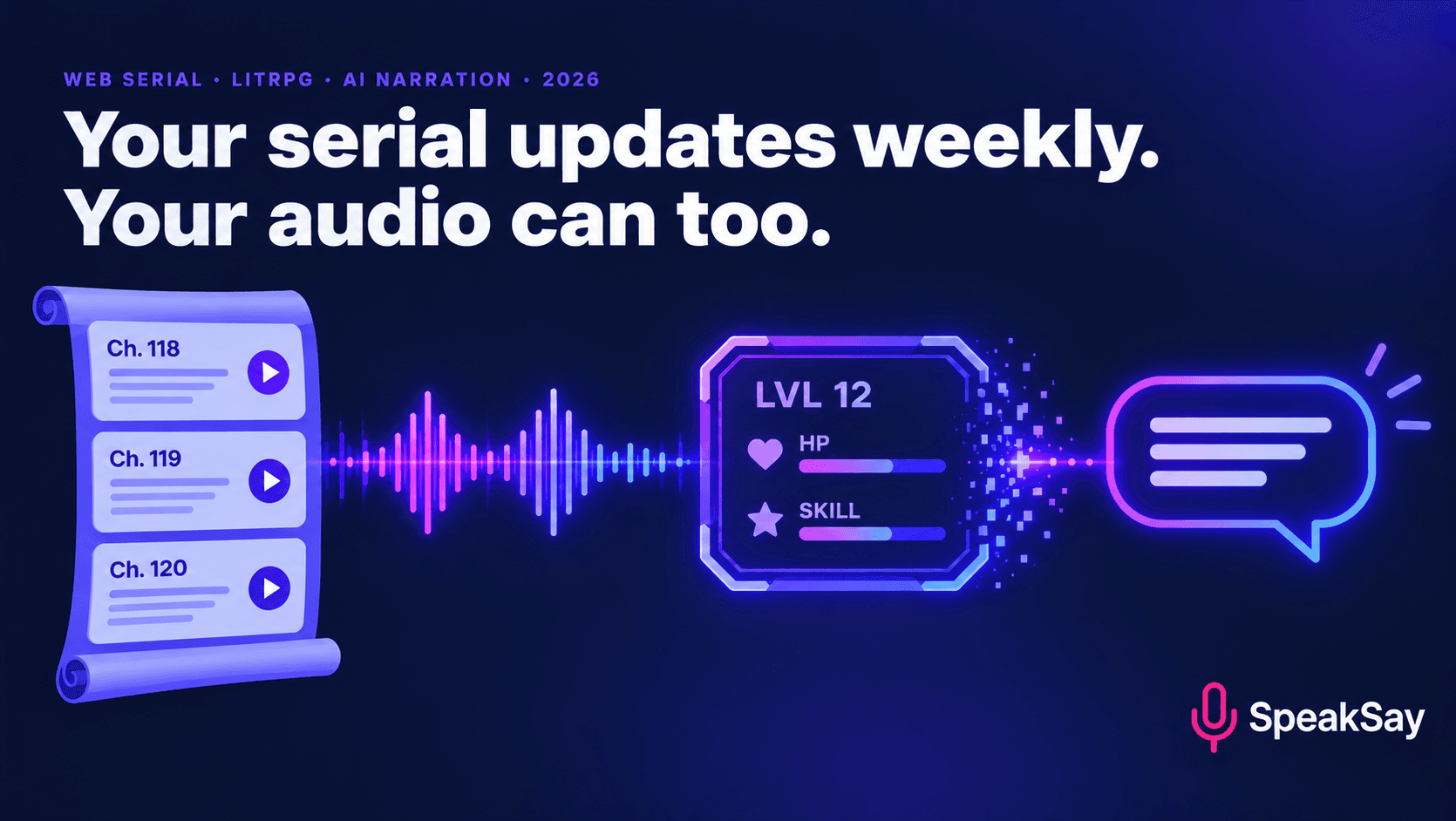
Web serial and LitRPG authors publish a chapter or two a week, often for hundreds of chapters. Traditional audiobook production is built for finished books. This guide covers how to voice a serial on its own schedule, how to handle stat blocks and system messages, and how to keep audio in step with chapters you keep editing.
1. Why the audiobook model doesn't fit a serial
- Volume. A serial can run to hundreds of chapters. Hiring a narrator for all of them in advance is out of reach for most authors, and hiring one chapter at a time is slow.
- Rhythm. Readers expect the next chapter on a schedule. Audio that arrives months later is a different product.
- Revision. Serials get edited: typos, continuity fixes, rewritten early chapters. A recorded human performance can't be patched easily.
- Income. Many serial authors earn through reader support, not per-copy sales. An audio cost has to fit that income.
AI narration fits all four, with the usual caution: it needs a proper listening pass, as our guide to proof-listening a long audiobook explains.
2. Decide what the audio is for
| Purpose | What it needs |
|---|---|
| A free "listen" button on each chapter | Speed and consistency. Short, steady reads of every chapter. |
| A reward for supporters | The same, delivered a few days ahead of or beside the text, as you choose. |
| A finished audiobook of a completed arc | Higher polish: a full proof-listen, chapter titles, opening and closing credits. |
Start with the first. You learn what your listeners care about before you spend time on polish.
3. Stat blocks, system messages and lists
This is where LitRPG audio most often fails. A screen of stats looks fine and sounds like someone reading a spreadsheet.
- Pick a rule for each kind of block and apply it everywhere.
- Read in full for short, important messages such as a level-up or a new skill.
- Summarise for long tables, for instance "his strength rose by four and his agility by two".
- Skip for pure reference tables, and put them on a linked page with the audio.
- Give "system" messages a distinct voice or a short sound cue, so listeners know it isn't a character speaking.
- Rewrite brackets. A line like "[Skill Acquired: Iron Skin (Rare)]" needs a lead-in such as "A message appeared: Skill acquired, Iron Skin, rare."
- Read numbers for the ear. Large values, percentages and ranges should be written as words. See our normalization pass for numbers.
Keep a one-page "audio style sheet" with your choices, and use it for every chapter. The listener learns the pattern in a couple of chapters.
4. Invented names and a pronunciation glossary
Fantasy and science fiction names are the classic problem for a synthetic voice, and a serial makes it worse because the same name will appear hundreds of times.
- Make a glossary with every character, place, skill and faction and the respelling you want.
- Test each new name the first time it appears and add it to the glossary.
- Use the same respellings forever. A name that changes pronunciation midway through the story is noticed.
Our guide to pronunciation fixes for names and acronyms covers the techniques.
Audition a narrator for your serial
Paste a chapter that has a stat block, an argument and a battle into SpeakSay and hear how different voices handle it.
5. Voices: one narrator, or a few
For a free chapter-by-chapter feature, one steady narrator is enough. If your serial has a lot of dialogue, you can add a second voice for the "system" or for a recurring character. Don't build a large cast on day one. Dialogue attribution is hard enough for listeners already; see how to keep it clear who is speaking.
6. A weekly production routine
- Finalise the chapter text. Don't voice a draft you plan to change.
- Apply your style sheet to stat blocks and system messages.
- Run new names through the glossary.
- Generate the audio and listen to the first minute, the stat block and one dialogue exchange. A full proof-listen is for the arc-level audiobook.
- Publish with the text or on your agreed schedule.
Over a year this adds up to a lot of audio. A plan with a fixed amount of monthly generation, or a lifetime plan, is easier to budget than paying per chapter. Compare the options on the lifetime plan page.
7. When you edit a chapter that already has audio
- Minor typo or word change: regenerate the chapter and replace the file. With synthetic voice this takes minutes.
- Substantive rewrite: regenerate and note the revision in the chapter's post.
- Keep versions. Name files with the chapter number and the date, so you know which audio matches which text.
This is the biggest practical advantage over a human recording, which would need a new session for every correction.
8. Check platform rules and disclose
Platforms and support services have their own rules about audio, and about AI-generated material. These change, so read the current terms of any site, store or membership service where you plan to post the audio. Tell your readers the audio is AI narrated; many serial readers are comfortable with it when they are told and uncomfortable when they find out later. If you plan to sell a finished version through a retailer, our guides to going wide with AI narration and selling audio direct as a serialised feed may help.
9. FAQ
Can I make an audiobook of my web serial?Yes, if you own the rights to the text. Check the terms of any platform where you plan to publish the audio and tell listeners if it is AI narrated.
How do I handle LitRPG stat blocks in audio?Choose a rule for each type of block: read short messages in full, summarise long tables and skip pure reference tables. Apply the rule consistently so listeners learn the pattern.
What if I change a chapter after the audio is out?Regenerate the audio from the new text and replace the file. Keep dated versions so text and audio stay matched.
Should I use more than one voice?Start with one narrator. Add a second voice for system messages or a recurring character only if it helps listeners.
Do I need to tell readers the audio is AI?It is the safer and more respectful practice, and some platforms require it. Say it clearly on the chapter or series page.