69% of Audiobook Listeners Had Already Read the Book: What Audible's 18,000-Listener Survey Says About Which Title to Narrate First (2026)
Most authors narrate their newest book first. A new Audible-commissioned survey of 18,000 consumers suggests that's backwards: most listeners had already read the book, audio sends them on to an author's other titles, and openness to AI narration is higher for fiction. Here's a scoring method for picking the title that earns its audio edition.
1. What the survey found
As reported by Publishing Perspectives on October 9, 2026, Audible's chief content officer Rachel Ghiazza presented these findings at Frankfurt:
- 34% of respondents listened to more audiobooks in the past year than the year before.
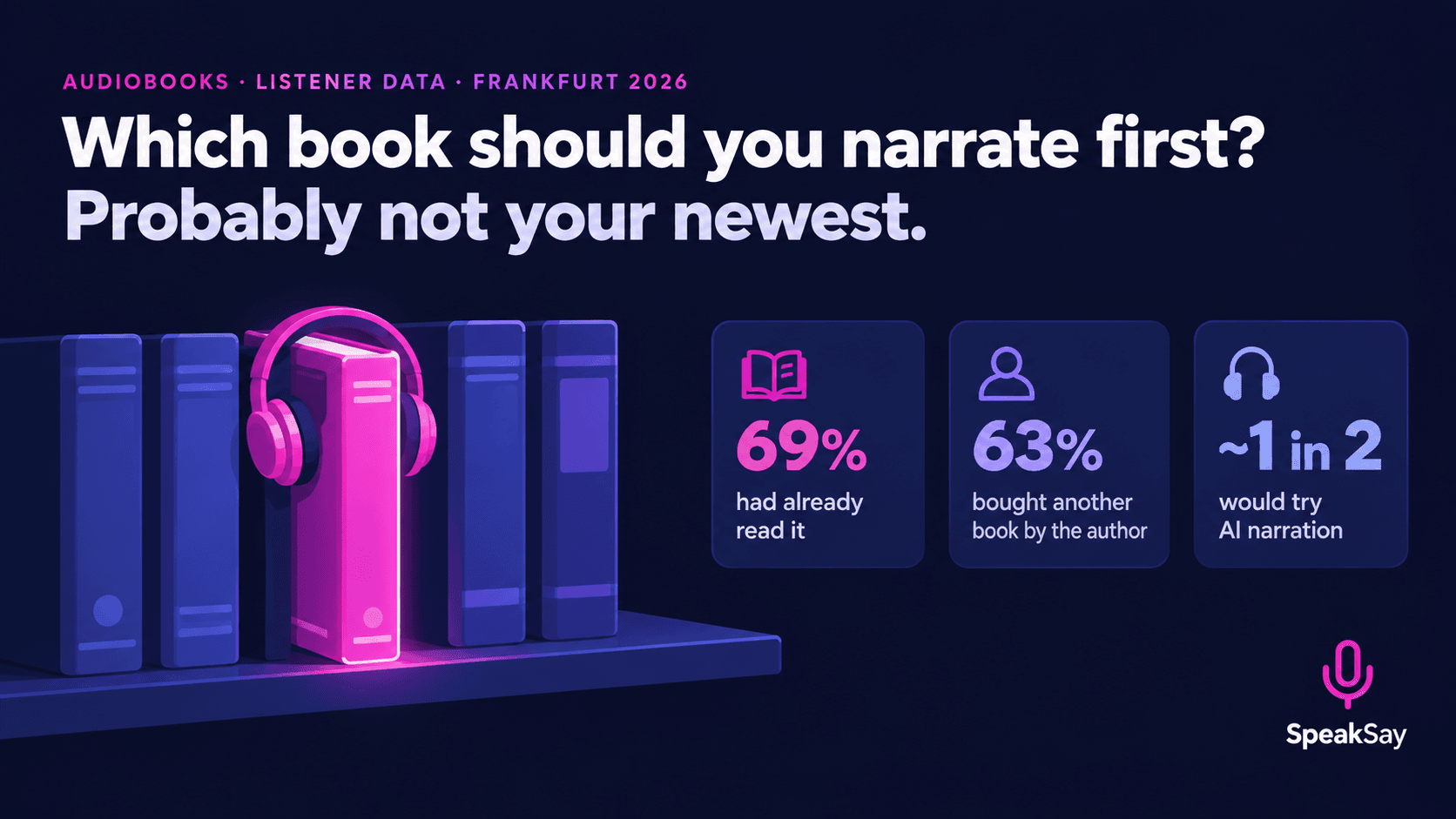
- 69% of listeners had already read the title they listened to.
- 63% who discovered an author in audio went on to buy another work by that author.
- Discovery is organised around genre. Ghiazza described genre as "a concept of fandom", with listeners going deeper once hooked. Leading genres differ by market.
- About half would try AI narration. Interest was higher for fiction than nonfiction in most markets. Germany and Japan were the exceptions.
- Audible framed AI narration as "an and strategy": human performers remain, and the savings fund more titles. Ghiazza said quality and transparency are "critically important".
Audible also said it is expanding Read + Listen, which pairs the e-book and audiobook editions in one app, to five more markets. That matters for authors who control both formats.
2. Finding 1: listeners re-experience books they know
If 69% of listeners had already read the book, a large share of audiobook demand is people coming back to a story they liked, not discovering it for the first time. For an author, that changes the first-title question from "what's newest?" to "what do readers already love?"
Signs a book has re-read demand:
- It has the most reviews, or the highest rating, in your catalogue.
- Readers mention it by name in emails, comments or reader groups.
- It keeps selling without promotion.
- Readers ask, unprompted, whether there's an audio version.
Your newest book has none of those signals yet. Its readers haven't finished it, and the ones who'll want to hear it again haven't formed. That doesn't mean newest is always wrong (see the scoring method below), but it shouldn't be the default.
3. Finding 2: audio sends listeners to your other books
The 63% figure is about what happens after a listener finds you: they buy something else of yours. Ghiazza put it plainly: "Audiobooks are not competitive to other formats." For an author with a series or a backlist, the first audio title is a front door, and the question is which door leads furthest into the house.
- A series starter leads to every later book. A middle book leads to confusion.
- A standalone that represents your style leads to your other standalones in the same genre.
- A short entry point (a novella, a prequel, a short nonfiction guide) is cheaper to produce and a lower-risk first listen. See our micro-audiobooks guide.
Audible also reported that early data from its new interactive story features shows "more progression to the next volume of a series". Series readers move forward. Make sure there's somewhere for them to go, in audio or in print.
Pick one narrator for the whole series
If book one becomes the front door, books two to ten need to sound like the same house. Choose a voice from SpeakSay's library, lock the settings and keep it across the series.
4. Finding 3: AI narration interest is higher for fiction
Publishing Perspectives notes that this "cuts against the working assumption" that nonfiction, which is closer to news and reference, would be the natural entry point for AI narration. In most of the surveyed markets, fiction listeners were the more open group. Germany and Japan went the other way.
What this does and doesn't mean for your choice:
- Fiction isn't easier to narrate with AI. Dialogue, character voices and emotional scenes are harder than an explainer chapter. Our fiction narration guide covers where AI struggles and the multi-voice workflow that helps.
- Listener openness is a reason to try, not a reason to skip the work. Proof-listen the whole book. Fix who-is-speaking problems before release.
- Selling in Germany or Japan? The survey suggests nonfiction may be the better first AI-narrated title there. Check your retailer's rules for those markets as well.
- Nonfiction still has its own case: it often has a clear audience problem to solve, and many nonfiction authors use audio as lead generation. See our nonfiction lead-generation guide.
5. A scoring method for your first audio title
Score each candidate book from 0 to 3 on the six rows below. Highest total goes first. If two tie, pick the cheaper one to produce.
| Criterion | What a 3 looks like | Why it matters |
|---|---|---|
| Re-read demand | Your most-reviewed or best-loved book. Readers ask for audio. | 69% of listeners had already read the title. |
| Front-door value | Book one of a series, or a standalone that leads to your other books | 63% of authors' new audio fans bought another of their works. |
| Genre fandom | A genre whose readers binge (romance, fantasy, thrillers, cosy mysteries) | Listeners dig deeper once hooked on a genre. |
| Listener openness | Fiction in most markets, nonfiction in Germany or Japan | About half would try AI narration, with genre and market differences. |
| Production difficulty (reverse-scored) | Few characters, little dialogue, no tables or footnotes, a manageable length | Harder books cost more QC time. See our real-cost guide. |
| Rights and format control | You hold audio rights and also control the e-book | Pairs with read-along and Read + Listen-style formats. |
An example: an author has a three-book fantasy series (book one is the most reviewed) plus a new standalone thriller. Book one scores high on re-read demand, front-door value and genre fandom, and the author holds both formats. The new thriller scores high on genre but zero on re-read demand. Book one goes first, and the thriller follows once its readers have caught up.
6. What the survey can't tell you
- Audible commissioned it. Audible sells audiobooks and has its own AI narration programme, so treat the findings as useful signals, not neutral proof.
- The methodology hasn't been published in detail. Publishing Perspectives notes this, along with the fact that "a stated openness to AI is not purchasing behavior".
- The 69% may mix print readers and repeat listeners, and we don't know how "already read" was asked.
- It averages across 11 markets. Your readers may behave differently from the average.
Use the survey to question your default (newest first), then check your own data: reviews, reader emails, sales without promotion and where readers drop off in a series.
7. After you choose: make it the first of a set
The first title only works as a front door if what's behind it is ready. A few steps make the rest of your catalogue easier to reach:
- Lock your narrator and settings before chapter one, so later books match. Our voice consistency guide shows how.
- Make the retail sample count. Listeners decide in the first few minutes. See the first five minutes guide.
- Add an end-of-book line pointing to the next title in whatever format is available, even if it's print only for now.
- Disclose AI narration in the credits, without apologising. Our opening credits guide has wording.
- Consider a read-along edition if you control the e-book. See read-along e-books.
- Plan the rest: once two or three titles exist, a box set is a natural next product (see our box set guide), and the backlist conversion guide covers scaling up.
Narrate the series without paying per book
The SpeakSay Lifetime Plan is a single payment, so book one, the series and the backlist don't each add a new per-character bill.
8. FAQ
Which of my books should I turn into an audiobook first?Usually the book readers already love most, or the first book in a series, rather than your newest release. Audible's 2026 survey found 69% of listeners had already read the title they listened to and 63% of authors' new audio fans bought another of their works.
What is Audible's "Future of Listening" survey?An Audible-commissioned study run by NielsenIQ, polling 18,000 consumers in 11 markets including the US, UK, several European countries, Japan and Brazil. Findings were presented at the Frankfurt Book Fair in October 2026.
Are listeners open to AI-narrated audiobooks?About half of respondents said they'd try AI narration. Interest was higher for fiction than nonfiction in most markets, with Germany and Japan as exceptions. Stated openness isn't the same as buying, so quality and disclosure still matter.
Should I narrate book one or my latest book in a series?Book one. It's the entry point for every later title. A middle or latest book in audio form leaves new listeners without context.
Is fiction or nonfiction better for AI narration?Listeners in most markets say they're more open to AI narration for fiction, but fiction is technically harder to narrate well. Nonfiction is easier to produce. Score both on the criteria above for your own catalogue.
Does an audiobook take sales away from my print and e-book editions?The survey suggests the opposite: audio sends listeners to other formats and other titles. Audible's own phrase was "Audiobooks are not competitive to other formats."