Whose Chapter Is This, and What Year? How to Make Dual-Timeline and Multi-POV Novels Easy to Follow in an AI-Narrated Audiobook With Spoken Chapter Headers (2026)
In print, a chapter heading such as "Maya, 1987" tells the reader who and when at a glance. In audio, the same heading can vanish. This guide shows indie authors how to write and voice chapter headers so listeners always know whose chapter it is and what year it is.
1) Why print headings fail in audio
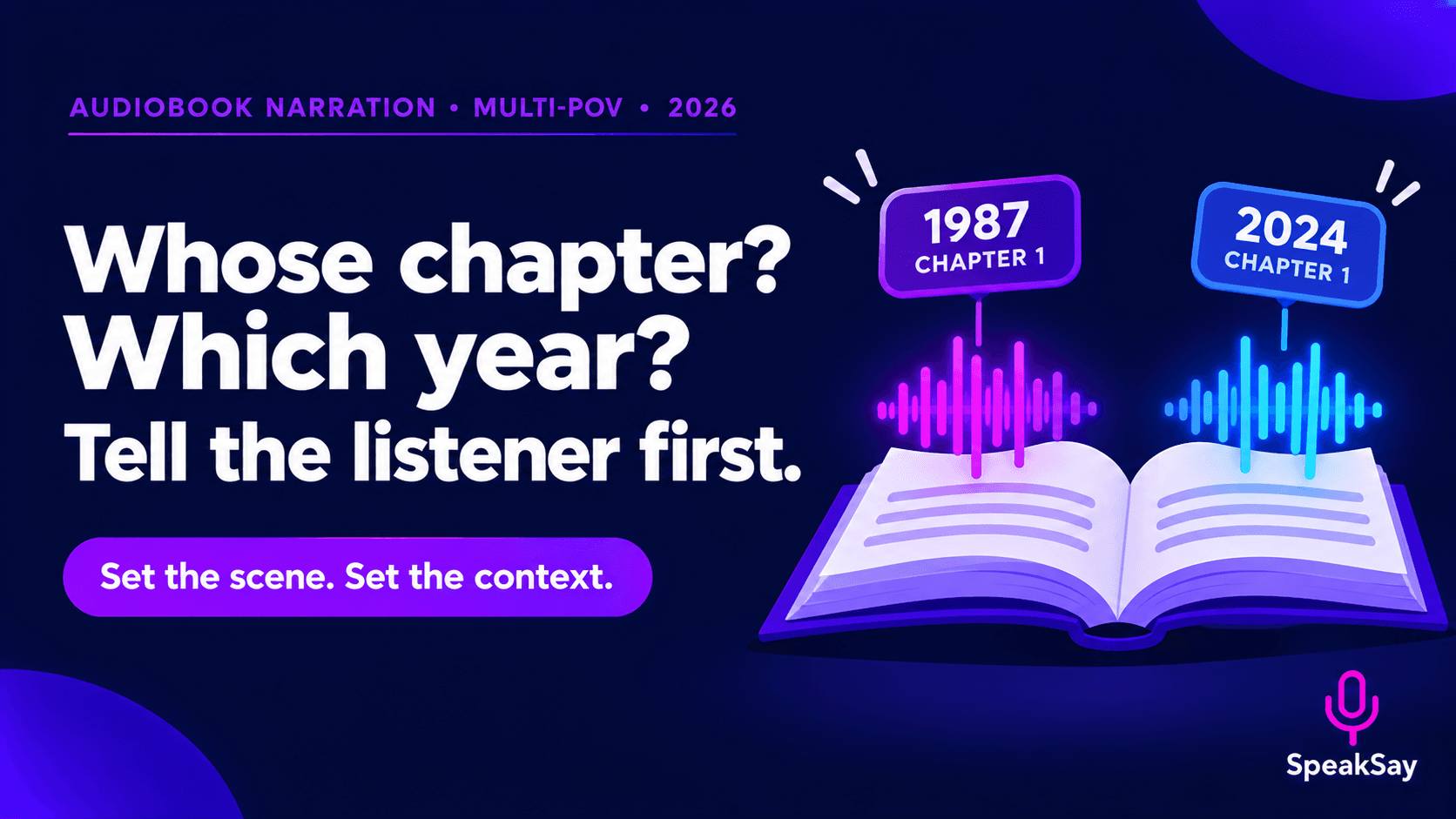
A printed heading is visual. It sits apart from the text, uses a different font and stays on the page while the reader goes on. A spoken heading is just a few words at the start of a chapter. If they are read at the same pace as the prose, or without a pause, listeners treat them as part of the story.
Listeners cannot flip back a page. If they lose the thread in a dual-timeline book, they often keep going confused or stop listening. Multi-POV novels have the same risk when the voices sound alike.
2) Three kinds of spoken header
- Name only: "Maya." Works if every point-of-view character is clearly different and there are fewer than five.
- Name and time: "Maya, nineteen eighty-seven." Best for dual timelines, where the same character may appear in two eras.
- Name, time and place: "Maya, Lisbon, nineteen eighty-seven." Useful when the timelines also move between locations.
Pick one pattern and use it for every chapter. Consistency teaches the listener to expect the cue.
3) Write headers for the ear
- Spell years out in the script: "nineteen eighty-seven," not "1987." Check that the voice reads it the way you intend.
- Add a short pause after the header. A full stop or a line break in the script usually gives one.
- Avoid symbols such as slashes or arrows. "Maya / 1987" is read unpredictably.
- If the header is a date such as "March 3," write out the month and day in full.
- Do not use numbers alone for chapters if they do not help the listener. "Chapter twenty-two" matters less than "Maya, 2024."
Our guide to dialogue clarity in AI audiobooks covers similar problems inside a chapter.
4) Voices: one narrator or several?
There are three practical options.
- One voice for everything: simplest, and cheapest. Rely on the header and first sentence to carry the information.
- One voice per timeline: useful when the past and present are clearly different. Pick two voices that are easy to tell apart.
- One voice per point-of-view character: best for romance and thrillers with a few main characters. Keep the number small.
Browse options in the SpeakSay voice library. See genre voice casting for how to match voice to genre.
Hear your chapter headers before you commit
Generate two sample chapters in SpeakSay with your header pattern and listen to them back to back. Plans cover full-length books, and a lifetime option exists for authors with a backlist.
5) Make the first sentence do the work
A header can be forgotten in seconds. The first sentence of each chapter should confirm who and when without repeating the header.
- Weak: "The room was cold."
- Better: "Maya pulled her coat tighter. The apartment still had no heating."
- For a past timeline: include a small detail that fits the era, such as a rotary phone or a cassette tape.
This is also an improvement for print readers, so you are not writing a worse book for audio.
6) Produce and test the chapters
- Produce the first three chapters from different timelines or characters.
- Ask two or three people who have not read the book to listen and write down, after each chapter, who was speaking and when it was set.
- Where they are wrong, change the header or the first sentence, not the listeners.
- Check the pause after each header. If it sounds rushed, add a line break in the script.
- Re-listen to the chapter transitions at 1.25 times speed. Many listeners use faster playback, and cues can shrink.
7) Pre-publication checklist
- Every chapter begins with a spoken header in the same pattern.
- Years and dates are written out in the script.
- A pause follows every header.
- No more voices than a listener can track.
- First sentences confirm the point-of-view character and era.
- Sample chapters tested on at least two people.
- AI narration is disclosed in line with your retailer's rules.
8) FAQ
Should the narrator read the chapter number too?Only if it helps. For most dual-timeline books, "Maya, nineteen eighty-seven" is more useful than "Chapter twenty-two."
Can I skip headers and rely on different voices?It can work for two timelines, but listeners who start mid-book or come back after a break still benefit from a header.
Do retailers require chapter headers to match the ebook?Rules vary by retailer. Check the current audio guidelines for the one you publish with.
What about a book with more than five points of view?Use one narrator, the name-only header and strong first lines. Too many voices make the book harder to follow.