Ramadan Starts Feb 8, Lent Feb 10: How to Plan a 30- or 40-Day Daily Podcast With AI Voices (2027 Playbook for Mosques, Parishes, Schools and Creators)
Ramadan is projected to begin February 8, 2027 and Lent begins February 10. A daily series is a promise to publish 30 or 40 days in a row, and the weeks before are when it is easiest to produce. Here is a calendar, a script structure, the moon-sighting problem and the parts of a faith series AI should not voice.
1. Why a daily series is a production problem
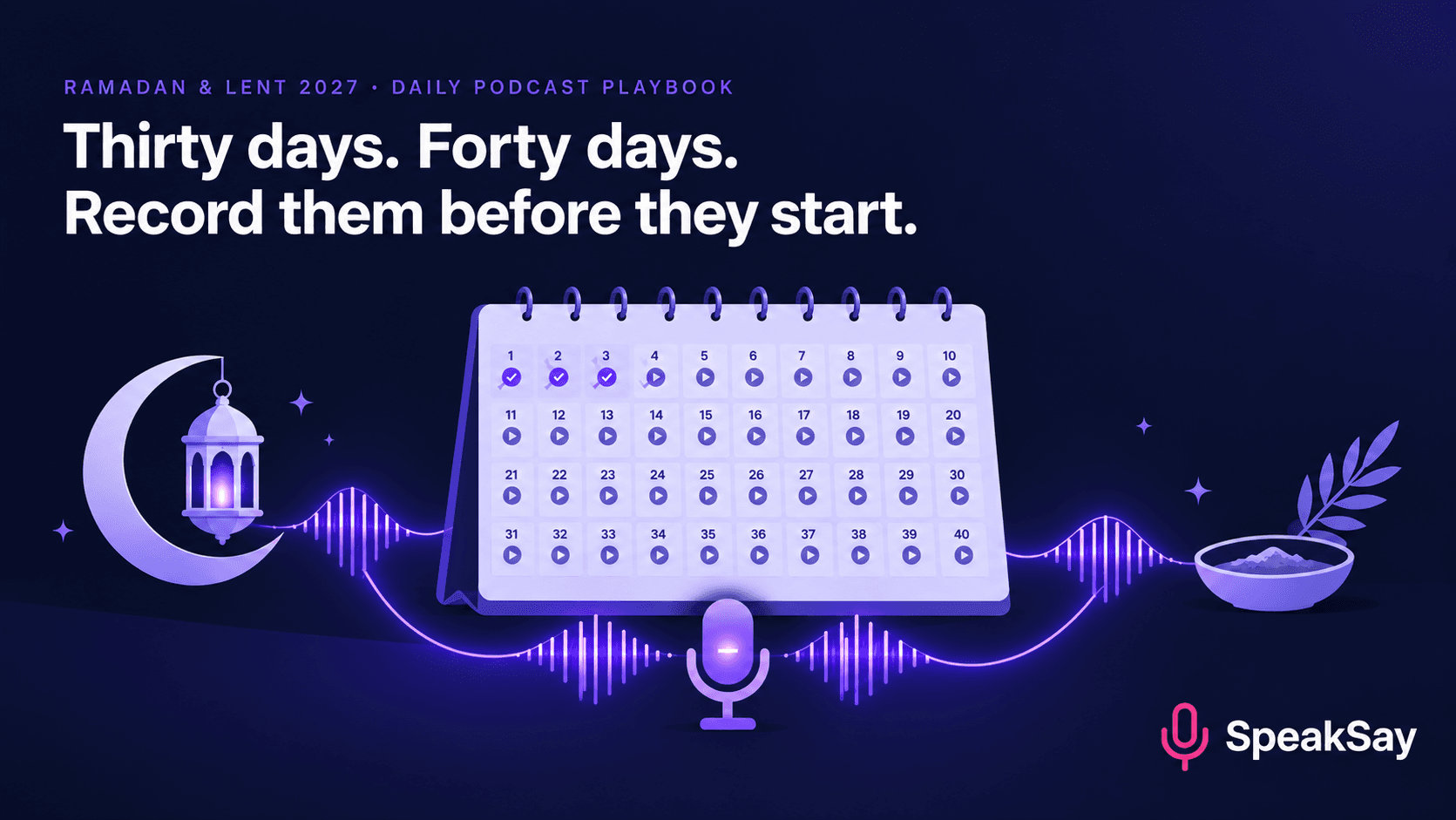
A weekly show can survive a missed Tuesday. A daily series can't. Listeners who commit to a 30-day or 40-day practice notice on Day 9 when nothing arrives, and many don't come back for Day 10. Organizations that already publish daily devotionals or Ramadan reflections know the pattern: the first week is polished and the third week is a scramble. The fix is to treat the whole series as one production, finished before it starts.
We covered the same structure for December in our Advent calendar podcast playbook, and for weekly sermon audio in our church sermon to podcast guide. This post adds what is different for Ramadan and Lent: moving dates, longer runs and more sensitive material.
2. The dates, and the moon-sighting problem
- Ramadan 2027: projected to begin February 8 and last 29 or 30 days, ending around March 8 or 9. Dates are confirmed by moon sighting, and communities may begin a day apart.
- Eid al-Fitr: expected around March 9 or 10, again pending sighting.
- Lent: begins Ash Wednesday, February 10. It's 40 days not counting Sundays, which is 46 calendar days to Easter on March 28.
The moon is the practical problem. If you name episodes by calendar date ("February 12") and your community starts a day later, every episode is a day off. Name them by day number ("Day 5") and write each script so it holds whether Day 5 lands on the 12th or the 13th. Hold the final episode, and any Eid message, as a short file you can finish when the date is confirmed.
For Lent, decide up front whether Sundays are episodes. A 40-episode series that skips Sundays is a different promise from a 46-episode series that includes them.
3. What a person should voice, and what AI can
This is the most important decision in the plan, and it is a values decision, not a technical one. Our suggestion:
| Part of the episode | Who voices it | Why |
|---|---|---|
| Scripture and prayer recitation | A person, always | Many communities expect recitation by a human voice, and listeners will notice and mind if they don't get it. |
| Imam, priest or teacher reflection | The person themselves, or a clone they have consented to and approved | The authority of the reflection comes from the speaker. |
| Daily intro, outro and "today's practice" | AI voice or the leader's consented clone | Repeatable, consistent, short. |
| Local logistics (iftar notices, service times, food drive) | AI voice | Changes often; needs fast regeneration. |
| Children's explainers ("What is fasting?", "What is Lent?") | AI voice, reviewed by an adult who knows the tradition | Plain language at scale. |
If you are unsure, ask your leadership. A short line at the start of each episode saying which parts are voiced by AI is respectful and usually welcomed. If a leader's voice is cloned, get their recorded consent first; our consent recording script template shows what a good one contains.
4. A five-minute episode template
- Opening (20 seconds). "Day [number]. [One line on today's theme.]" Same words, same voice, every day.
- Reading or recitation (60 seconds). Human voice, recorded in advance.
- Reflection (2 minutes). The leader's short reflection, written as one idea.
- One small practice (60 seconds). Something to do today. Keep it specific and doable.
- Community note (30 seconds). Where to gather, what to bring, who to call. This is the only part that changes at the last minute.
- Closing (10 seconds). The same sign-off every day.
Total: about five minutes. Short enough to play before work or during a commute, long enough to feel substantial.
Build the whole series as one project
SpeakSay AI Podcast turns your reflections into finished episodes with consistent voices, so Day 30 sounds like Day 1.
5. The production calendar: November to February
- November: decide the format, the roles in the table above and the day-numbering rule. Collect the written reflections from your contributors.
- December: finish all scripts for Days 1 to 15. Record the human parts for those days. Pause for the holidays.
- Early January: finish scripts for the rest. Generate AI parts for every episode and review five at random.
- Late January: record the human parts for Days 16 to the end. Do a full listen of Days 1 to 7 on a phone speaker.
- One week before the start: publish a short trailer. Schedule Days 1 to 7.
- During the series: only the community note changes. Regenerate that 30-second part when it does.
6. Pronunciation, names and terms
Religious vocabulary is where a generic voice most often fails: Arabic phrases, Latin liturgical terms, names of saints and scholars. Build a one-page pronunciation list in November, ask a fluent speaker to record each hard term, and follow the fixes in our pronunciation guide. A wrong pronunciation of a sacred term is more costly here than in most subjects. When the voice can't get a word right, give that word to a human.
7. Publishing, timing and reminders
- Release before the practice, not after. Publish the episode early enough to be heard before suhoor or before the day's reflection time, according to your community.
- Use one feed and one link. People will share it by message; make it easy.
- Offer a text version. Not everyone can listen. Our guide to multilingual audio for families covers adding languages with a review step.
- Plan for the end. Record a closing episode for Eid or Easter that points to where the community goes next.
Produce 40 episodes without 40 recording sessions
See plans for a daily series, from a short season to a full year of episodes.
8. FAQ
When does Ramadan 2027 start?It is projected to begin on February 8, 2027 and last 29 or 30 days. The exact date depends on moon sighting, so confirm with your local community.
When does Lent 2027 start?Lent begins on Ash Wednesday, February 10, 2027, and ends before Easter on March 28.
Should AI recite scripture or prayers?We recommend that a person does. Many communities expect scripture and prayer to be recited by a human voice. Use AI for introductions, practical notices and plain-language explainers.
How do I avoid wrong dates if the moon sighting changes the start?Number your episodes by day (Day 1, Day 2) rather than by calendar date, and write each script so it works whichever date the day falls on.
How long should daily episodes be?Around five minutes. It's short enough to fit into a morning routine and long enough for a reading, a reflection and one practical step.
Can the leader's own voice be used for every episode?If the leader gives recorded consent and approves the output, a voice clone can handle intros and short notices. Their own recorded reflection is still the best choice for the main message.