Translated AI Audiobooks: The Complete 2026 Guide (Rights, Translation, Narration, Metadata, Pricing, Distribution)
Publishing your audiobook in another language is six decisions in a fixed order, and most failed translated editions got the order wrong. This hub walks the whole path — rights, translation, narration, metadata, pricing and distribution — with the one question to answer at each step and a link to the deep guide for each.
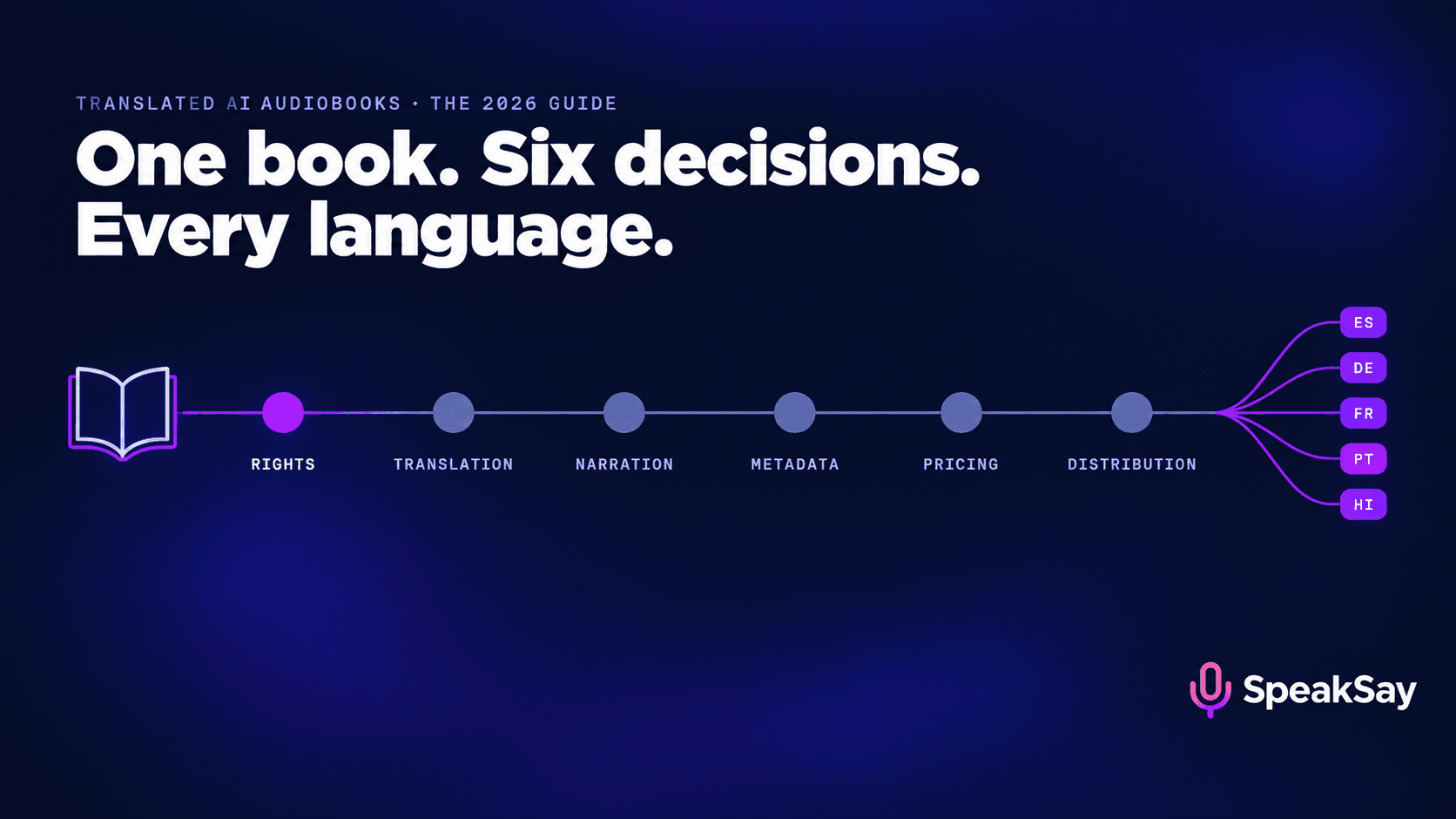
1. The six decisions, in order
| Step | The one question | Most common mistake | Deep guide |
|---|---|---|---|
| 1. Rights | Do I hold translation and audio rights for this language? | Assuming audio rights include translation rights | Rights, voice and QC playbook |
| 2. Translation | Who translates, and who checks them? | Machine translation with no native reviewer | Sourcing and QC-ing a translator |
| 3. Narration | Which voice, and how do I check a language I don't speak? | Publishing audio nobody fluent has heard | Translate in your own cloned voice |
| 4. Metadata | Will a native speaker searching in their language find it? | Translated title, English everything else | Per-market metadata |
| 5. Pricing | What does this length cost in this market? | Letting the retailer convert your US price | Per-market pricing and promotion |
| 6. Distribution | Where do listeners in this language actually listen? | Assuming Audible is where everyone is | Libraries and subscription apps |
The order matters because each step constrains the next. You can't price before you know your channel, you can't pick a channel before you know which platforms accept AI narration, and none of it matters if step 1 is a no.
2. Step 1 — Rights: can you publish this edition at all?
Translation rights and audio rights are separate rights, and they're often licensed separately. If you're a self-published author who has never signed a rights deal, you most likely hold both — but check anything you've signed, including old foreign-language print deals and audio deals, before you commission a translation. If a publisher holds translation rights in a territory, a translated audiobook for that language may not be yours to make.
Two further checks before any money is spent:
- Does your translator's contract give you the rights to the translated text, including for audio? Translators often retain rights unless the contract says otherwise.
- Do the platforms you plan to use accept AI-narrated titles, and how must they be labelled? Rules differ by retailer and change often; see our overview of AI narration rules across audiobook platforms and the original ACX, Google Play and Kobo guide.
This is general information, not legal advice; for a contract you're unsure about, ask a publishing lawyer or your author organisation.
3. Step 2 — Translation: where the text comes from
The text is the product; the voice only delivers it. A narration that sounds perfect reading a clumsy translation is still a bad book. There are three realistic routes:
| Route | Cost | Quality risk | When it fits |
|---|---|---|---|
| Professional literary translator | Highest | Lowest | Fiction, voice-driven non-fiction, your flagship title |
| Machine translation + professional post-editor | Medium | Medium — depends on the editor | Practical non-fiction, series with plain prose |
| Machine translation only | Lowest | High | Not recommended for a commercial edition |
Whichever route you choose, write an audio-specific brief: a pronunciation list for names and invented terms, a note on how you want numbers and units handled, and a request that the translator flag sentences that read well but will be hard to follow by ear. The translator sourcing guide covers vetting and sample tests.
4. Step 3 — Narration: voice, consistency and QC
Three decisions here:
- Your voice or a native voice? Your own cloned voice speaking the translated edition keeps continuity for readers who know you; a native voice from the voice library can sound more natural in some languages. For fiction with an established narrator identity, the clone is often the stronger brand choice; for practical non-fiction, test both with a native listener. We covered the accent side in dubbing in your own voice with a native accent.
- Consistency across a long book. Render in chapter-sized pieces with fixed settings, and keep those settings in a file. See keeping an AI audiobook voice consistent.
- QC in a language you don't speak. Non-negotiable: a fluent listener hears every chapter before release, with a simple error sheet (timestamp, what's wrong, suggested fix). Fix by editing and regenerating the affected sentence, not the whole chapter.
Narrate every edition from one place
Use your own cloned voice or a native voice for each language, and regenerate only the lines your reviewer flags.
5. Step 4 — Metadata: can anyone find it?
A translated edition with English keywords, an English description and an English category is invisible to the people it's for. Every field that a listener in that market reads or searches should be in their language and written for their market: title and subtitle, description, keywords, categories, and the series name. If the listing discloses AI narration, disclose it clearly in the target language as well. Our per-market metadata guide covers the field-by-field approach.
6. Step 5 — Pricing: per market, not converted
A price that's normal in the US can be out of line in another market once converted, and the reverse. Set each market's price deliberately against comparable titles in that language, and plan launch promotions per market rather than globally. The pricing and promotion guide walks through it.
7. Step 6 — Distribution: retail, libraries, subscription, direct
There are four channel types, and the right mix depends heavily on the language:
| Channel | How listeners pay | What matters most | Guide |
|---|---|---|---|
| Retail (per-title purchase) | Per unit | Store acceptance of AI narration, pricing | Retail platforms |
| Libraries | Library licence | Aggregator reach, AI labelling | OverDrive, Libby and Hoopla |
| Subscription apps | Share of listening time | Series depth, strong opening minutes | Libraries and subscription for non-English editions |
| Direct / serialised | You set the terms | Owning the listener relationship | Selling translated audio direct as a serialised feed |
In many non-English markets, subscription listening is a far bigger share of consumption than it is in the US, so an English-market instinct to "just go wide on retail" can miss most of the audience. Library disclosure of AI narration is also still uneven — 2026 reader-side criticism has pointed out that some library apps rely on publishers self-identifying AI-narrated titles — so label your editions clearly yourself rather than relying on the platform.
8. After launch: keeping a multilingual catalogue healthy
Once you have several languages live, a new problem appears: the editions drift apart. Voice models update, a correction lands in the English text and not the others, and a series recorded over two years stops sounding like one series. Two habits prevent most of it:
- Keep a single change log per title, listing every edit and which language editions have received it.
- Re-listen to a sample chapter from each language whenever your voice settings or model change. Our back-catalogue drift audit gives a full procedure.
9. Which language first?
Choose the first language by the overlap of three things: where your existing readers already come from (check your sales and newsletter data), where your genre is strong, and where you can find a trustworthy translator and fluent reviewer. A smaller market where you can do all six steps well will outperform a larger market where you can only do narration well. Do one language end to end, learn from it, then repeat — the second edition costs a fraction of the first because the system already exists.
Planning several languages?
Multiple editions mean a lot of narration. A one-time lifetime plan keeps the cost of each new language predictable.
10. FAQ
Can I translate my audiobook into another language with AI?Yes, but treat translation and narration as separate steps. AI narration can voice the edition in your own cloned voice or a native voice; the translation itself should be done or post-edited by a professional and checked by a fluent reviewer.
Do I need separate rights to publish a translated audiobook?Often, yes. Translation rights and audio rights are distinct. Self-published authors usually hold both, but check any contract you've signed and make sure your translator's contract assigns you rights to the translated text. This is general information, not legal advice.
Can I narrate a foreign edition in my own voice?Yes, with a voice clone that supports the target language. Have a native speaker check that pronunciation and accent sound natural before release.
Where should I sell a Spanish or German audiobook?Look beyond per-title retail. In many non-English markets, subscription apps and libraries are major channels, and selling direct as a serialised feed lets you own the listener relationship.
How do I check quality in a language I don't speak?Hire a fluent listener to review every chapter using an error sheet with timestamps, then regenerate only the flagged sentences. Never publish audio no fluent person has heard.