Hear Your Toast Before the Room Does: How to Rehearse a Wedding Speech or Best Man Toast With a Clone of Your Own Voice (Timing, Jokes and Nerves, 2026)
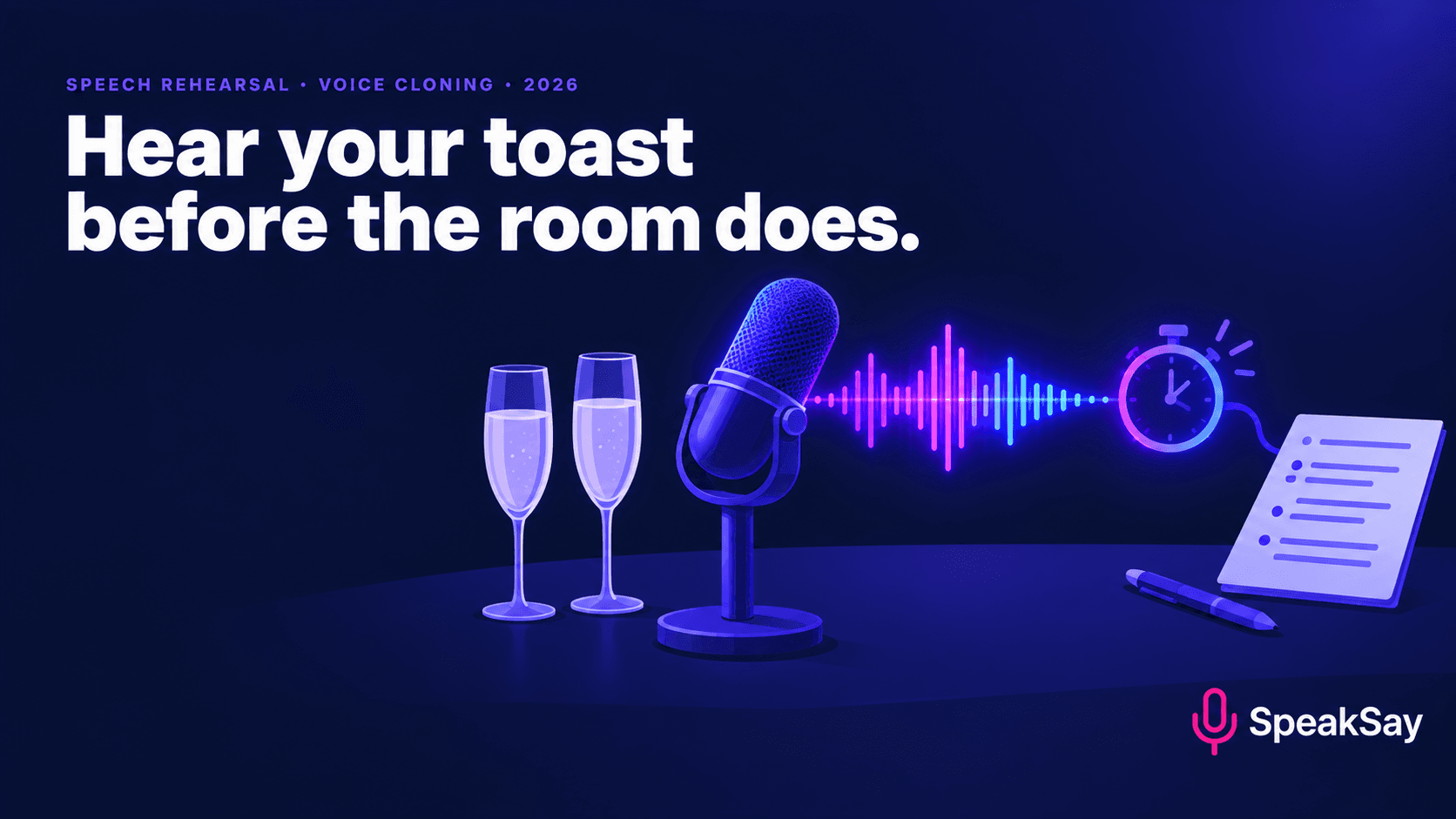
Most people rehearse a toast in their head and discover its problems at the microphone. This guide shows how to hear your speech in a clone of your own voice, check timing and jokes, and then practise the real delivery out loud, without ever using the clone at the wedding itself.
1) Why hear it before you say it
Reading a speech silently hides its problems. Hearing it exposes them. Written phrases that look fine become long, awkward or repetitive when spoken, and you notice them faster when the voice is not your own tired, nervous one.
A clone of your own voice gives you a listener's view of your own words, at your usual pace and tone, as often as you like and without asking a friend to sit through draft seven. It does not give you a delivery coach, and it will not replace a human audience. It is a mirror for the text.
We cannot promise it reduces nerves. Some people find it helps, and others find it uncomfortable. Try it for one draft and decide.
2) One rule: the clone is for rehearsal only
Use your clone to practise, not to perform. The toast at the wedding should be you, in the room, with your own voice, nerves and all. A pre-recorded speech played to guests as though it were live is a different thing, and most people would feel misled.
Clone only your own voice, with your own consent. Never clone the bride, the groom or any other person to "try" their reaction. Our consent recording script shows how to record consent for your own sample cleanly.
3) Set up your voice
- Record a clean sample in your normal speaking voice, in a quiet room, not your "performance" voice.
- Create the clone in the SpeakSay voice clone tool.
- Generate a short test line and compare it with your real voice. Our guide to what a short sample captures and misses explains what to expect.
A clone often sounds smoother than the real you. That is fine for checking text, but do not use it to judge your delivery. Treat it as a reader, not a performer.
Hear your draft in your own voice
Create a clone of your voice and listen to the toast before you stand up.
4) Check the timing
Most receptions give a toast about two to four minutes. Ask the couple or the planner what they expect, because a long toast is a common complaint from guests.
- Generate the full speech and note the length.
- Add about 20 to 30 percent for pauses, laughter and breath when you speak it live.
- Cut the weakest section first, not the ending.
- Re-generate after each cut. Each draft takes a minute.
| Audio length | Likely live length |
|---|---|
| 2:00 | 2:30 to 2:45 |
| 3:00 | 3:30 to 4:00 |
| 4:00 | 4:45 to 5:15 |
These are rough rules of thumb, not measurements. Time yourself once when you practise out loud.
5) Test the jokes and the sentimental parts
A clone reads every line at the same steady pace, so it cannot tell you whether a joke is funny. It can tell you three useful things:
- Setup length: if the setup goes on too long in audio, it will feel longer in the room.
- Clarity: if a punchline hides in the middle of a sentence, move it to the end.
- Inside references: if you would need to explain a joke to half the guests, cut it.
For the sentimental part, listen for lines that feel too grand. If you would not say it to the person in conversation, rewrite it. Our unscripted practice guide has a drill for turning written lines into spoken ones.
6) Move from listening to delivering
- Listen to the clone read the speech once, with the text in front of you.
- Mark places where you want to pause, breathe or look up.
- Say it out loud yourself, standing up, with the notes you will have on the day.
- Record yourself on a phone and compare it with the clone: where do you rush, where do you drop your voice?
- Do this three times in the week before. By the third, put the notes on a card of key words only.
The clone is the first step. Your own voice, out loud, is the rehearsal that counts.
7) The week of the wedding
- Five days before: final text locked.
- Three days before: last full run-through out loud.
- The day before: read it once, then stop editing.
- On the day: carry a printed copy, not a phone.
Delete the clone and the test audio after the event if you do not want to keep them. A sample of your voice is personal data.
8) FAQ
Can I play a cloned-voice recording at the wedding?We do not recommend it. A live toast in your own voice is what the couple asked for. Use the clone for rehearsal only.
Will hearing my speech reduce nerves?It may help you feel familiar with the text. It does not replace practising out loud, and some people find it unsettling. Try a single draft.
How long should a wedding toast be?Often two to four minutes, but ask the couple or planner for their preference.
Can I clone my partner or best friend to test the speech?No. Clone only your own voice, with your own consent.